R254 billion down the drain


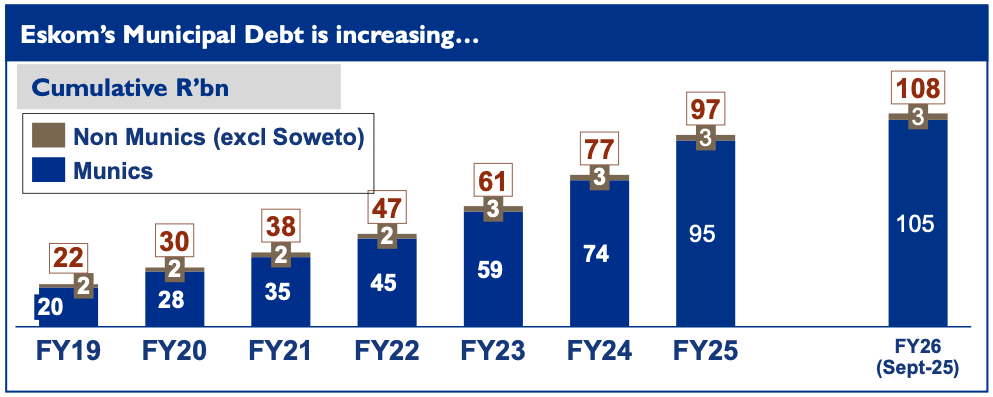
Municipal debt owed to Eskom has ballooned over the past few years, going from R22 billion in 2019 to R108 billion in the 2026 financial year so far.
This enormous growth has been attributed to weak collections, excessive electricity and water losses, and inadequate credit control.
Eskom has warned that this massive debt burden is preventing the utility from achieving sustainable financial health, which could undo the gains of its R254 billion Debt Relief Programme.
In a recent presentation to the Portfolio Committee on Electricity and Energy, Eskom’s group executive for distribution, Agnes Mlambo, outlined the municipal debt crisis.
Mlambo warned that, if left unresolved, this debt burden will undo the gains of Eskom’s Debt Relief Programme.
This programme, which has since been amended and slightly reduced, was introduced by the National Treasury in 2023 and consists of three payments over three years, totalling around R254 billion.
This bailout package, along with Eskom’s Generation Recovery Plan, has been credited as one of the major reasons for the utility’s turnaround in recent years.
For its last financial year, Eskom posted its first profit in around eight years, with the Treasury’s debt relief package playing a major role in this achievement.
However, Mlambo warned that the positive impact of this package will be undone if the issue of municipal debt is not resolved.
In addition, this debt burden is preventing Eskom from unbundling its Distribution Division, a key step needed to ensure that South Africa can foster a competitive energy market and secure the country’s long-term electricity supply.
To prevent the problem from spinning further out of control, Finance Minister Enoch Godongwana announced the following measures in his recent ‘mini-budget’ –
- As an interim measure, some defaulting municipalities will transition to Eskom’s Distribution Agency Agreements (DAAs) for defaulting municipalities.
- Under these agreements, Eskom will temporarily operate municipal electricity services, support cost-reflective tariff setting and loss reduction, and assist with collections.
- Measures are also being taken to help municipalities raise revenue, including expanding smart metering.
Mlambo explained that the last measure is needed because most municipal debt is caused by a combined result of weak collections, excessive electricity and water losses due primarily to a lack of maintenance, and inadequate credit control.
Eskom’s vicious cycle
Ballooning municipal debt owed to Eskom is not only a threat to the utility but to the country as a whole.
If Eskom’s financial health deteriorates further, the Treasury may need to step in again with another bailout, something the country’s slowly recovering fiscus and strained taxpayers can scarcely afford.
Eskom CEO Dan Marokane has warned that this rise in municipal debt owed to Eskom could result in the utility entering a financial crisis.
The utility’s CFO Calib Cassim also previously warned that, without urgent intervention, municipal debt could exceed R300 billion by the end of the 2030 financial year.
“Let me tell you what drawing the line means. In any other business, you start exercising your credit control. In our case, this means we have to stop the supply of electricity,” Marokane explained.
“If we stop the supply of electricity ourselves, for example, to the City of Johannesburg, the City of Tshwane, and the City of Ekurhuleni and other municipalities, they will be non-functional.”
“So, our credit control options are not as available to us as they are to many other businesses.”
Electricity Minister Kgosientsho Ramokgopa has described the problem as “structural”, with the country’s high electricity prices playing a major role.
The price of electricity in South Africa has skyrocketed in the past two decades. Since 2009, electricity prices have jumped by more than 600%, significantly more than CPI inflation over the same period.
These high tariffs have made electrcity unaffordable to many South Africa, leading to a culture of non-payment and increased illegal connections. This results in lost revenue for municipalities, which, in turn, fail to pay bulk suppliers like Eskom.




Comments