South Africa walking a fine line


South Africa finds itself in a delicate balancing act, having to navigate carefully between a more protectionist United States and expanding its trade with emerging economic blocs.
While United States tariffs have not yet harmed South Africa’s trade balance, the country’s deteriorating relations with Washington could spell trouble in the coming years.
Momentum Investments economists Sanisha Packirisamy and Tshiamo Masike recently identified key trends in South Africa’s economy.
One of the trends they noted was that South Africa has to tread carefully between tariffs and trade alliances.
Last year saw one of the biggest shocks to global trade in decades when US President Donald Trump announced his ‘Liberation Day’ tariffs in early April 2025.
While these tariff threats evolved as the year progressed, and are still not in full effect, they forced South Africa and many other countries to consider expanding their trade with nations other than the United States.
The result of this was a notable increase in global trade and a shift in worldwide trade patterns, with South Africa also benefiting from these trends.
Based on the data available for 2025, South Africa’s trade surplus jumped from R101.7 billion in 2024 to R176.7 billion in 2025.
From January to November 2025, South Africa recorded R163 trillion in exports, compared to R150 trillion for the full year of 2024.
These increases were achieved despite South Africa’s worsening relations with the United States, which have become increasingly tense over the past year.
“South Africa finds itself having to steer carefully between a more protectionist US and the expanding gravitational pull of emerging economic blocs,” Packirisamy and Masike said.
“Washington’s tariff escalation, coupled with sharper scrutiny of strategic imports, continues to complicate access for several South African exporters, with diplomatic tension over geopolitical alignments adding another layer of uncertainty.”

Walking a thin line
In 2025, the Trump administration became increasingly frustrated by South Africa’s inability to address the United States’ demands in trade negotiations.
Some of Washington’s concerns include South Africa’s ICJ case against Israel, the country’s BEE and land expropriation policies, and its alignment with countries considered antagonistic to the US.
Many experts have advised the government to smooth over its disputes with the United States, as conflict with the world’s largest economy is not in South Africa’s best interests.
More broad-based tariffs and the loss of duty-free access to the US through the African Growth and Opportunity Act (AGOA) present a notable threat to South Africa’s trade with the United States.
At the same time, more trade avenues have opened up to South Africa in recent years, particularly due to the country’s membership in BRICS+ and the Southern African Development Community.
As the United States’ trade policy becomes increasingly protectionist, these new avenues become increasingly attractive.
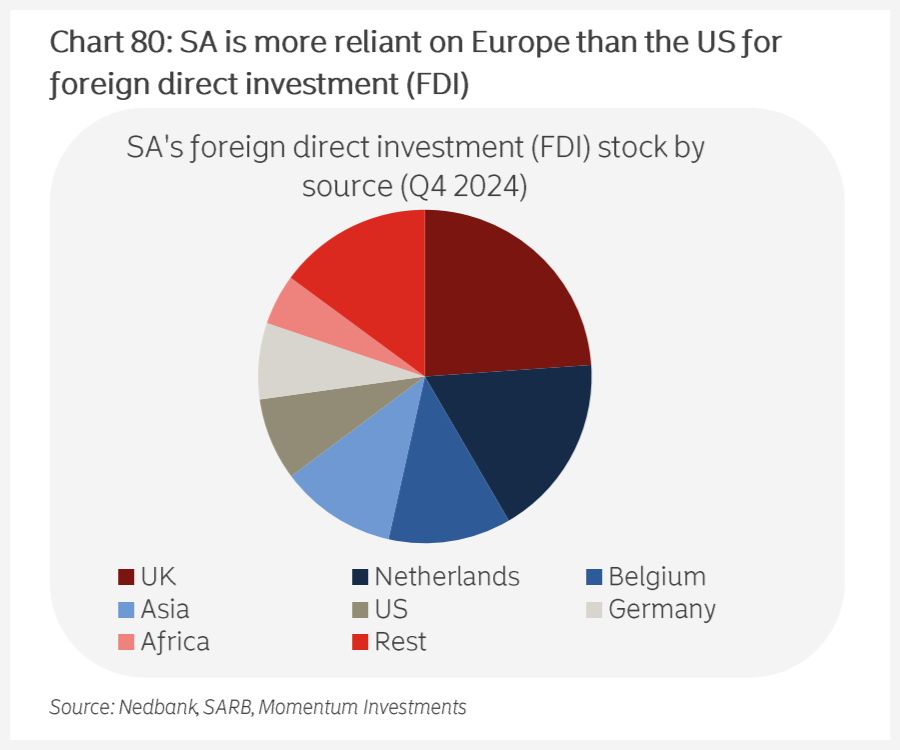
South Africa already exports more to Asia, Europe and Africa than it does to the United States, with the country also far more reliant on Europe than the US for foreign direct investment.
“Deepening commercial links within Africa, helped by the slow but tangible rollout of the African Continental Free Trade Area, are widening markets for manufactured goods and services,” Packirisamy and Masike said.
“At the same time, stronger ties with India, Southeast Asia and parts of the Middle East are shifting the composition of South Africa’s export basket toward regions less exposed to US policy swings.”
South Africa has a good opportunity to strengthen its trade ties with countries other than the United States, particularly in light of the nation’s removal from the Financial Action Task Force’s (FATF) so-called “greylist”.
Packirisamy and Masike explained that the country’s removal from the FATF greylist in late 2025 has further eased transactional bottlenecks.
This has allowed for a more diversified set of commercial relationships by improving the operating environment for banks and corporates engaged in cross-border trade and investment.





Comments