South Africa’s government is focused on all the wrong things


South Africa’s government has failed to address the basic services that are critical to creating a conducive environment for increased investment and faster economic growth.
Instead, much of the government’s resources have been spent on policies that have little impact on service delivery, such as expropriation without compensation, the National Health Insurance scheme, and new Black Economic Empowerment (BEE) targets for businesses.
This reflects a doubling down of the government on policies that have resulted in economic stagnation over the past 15 years, with South Africa’s economy averaging an annual growth rate of 1.1% during that period.
These policies neglect what the private sector needs to invest more heavily in the country’s economy, with corporates sitting on over R1.8 trillion in cash in the bank.
This investment is crucial for faster economic growth as the government’s balance sheet has been significantly weakened by excessive spending and mismanagement since 2010.
The balance sheets of South Africa’s largest public corporations, such as Eskom, Transnet, and the Post Office, are also effectively spent, with these companies sitting on mountains of debt.
Stanlib chief economist Kevin Lings has explained that this means the government has run out of options, with it now only able to deregulate sectors of the economy to drive private investment.
“I would say that deregulation is your only option now. It is your only choice, and while you may not like it ideologically, it is your only option,” Lings said.
“You are out of options, and those options have been taken away because you took government debt from 26% to 76% of GDP. That increase meant you have taken away your option to use your own balance sheet.”
Lings said it would have been ideal for South Africa for the government to use its own balance sheet for infrastructure investment. Now, this option is no longer available.
However, instead of listening to what private businesses need to invest, creating an enabling environment, and providing basic services, the government’s attention has been elsewhere.
This has resulted in declining performance from key sectors of the South African economy, particularly mining and manufacturing.
South Africa’s manufacturing output has steadily declined in recent years and remains far below the levels reached prior to the Covid-19 pandemic.
Of vital importance in this regard is the performance of South Africa’s automotive manufacturing industry, which provides hundreds of thousands of jobs and billions in export earnings.
BDO South Africa Automotive Sector Leader Siyabonga Mthembu said South Africa’s automotive sector is at a crossroads, with the decisions made today likely to determine the industry’s chances of survival in the coming years.
Infrastructure challenges, particularly related to ports, which are still ranked among the worst-performing, and rail efficiency, as well as policy and regulatory uncertainty, are the most significant headwinds the industry currently faces.
“Of concern is that, as a country, we’ve not yet effectively addressed the basics that are critical to ensuring a conducive investment climate for the automotive manufacturing sector,” Mthembu said.
“As if this wasn’t enough, the sector now faces an onslaught from imports of Chinese and Indian vehicle models.”
Wrong focus

Instead of focusing its efforts on what private businesses are asking of the government, particularly around service delivery, the government has focused elsewhere.
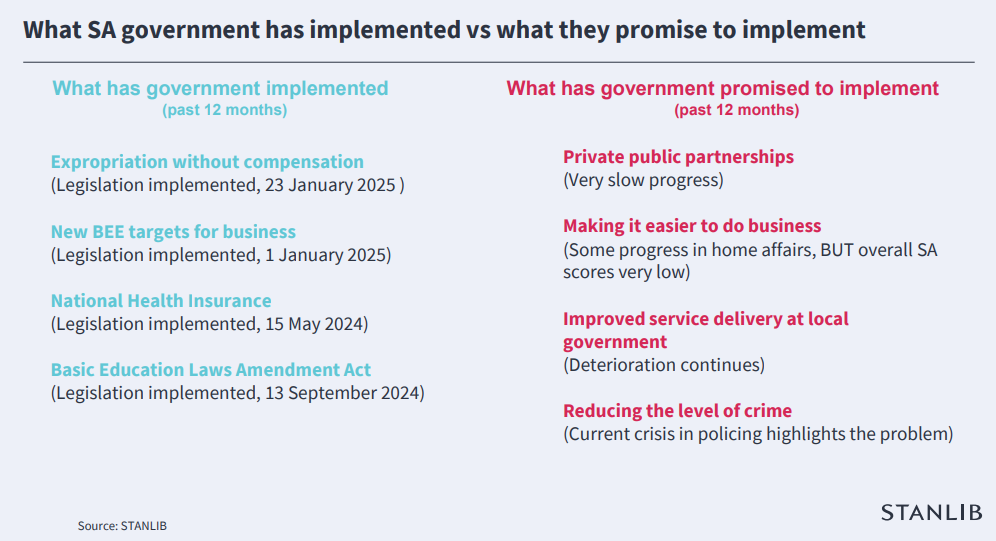
Lings has previously compared what the government has promised to do in recent years versus what it has actually done in that time.
It is easy for officials and ministers to pledge commitment to economic growth and job creation. It is very difficult to actually do the things required to make that a reality.
“Please do not think the government has done nothing in the past year. The government has done stuff,” Lings said.
“What are those things? Expropriation Bill, done. We have new fancy BEE targets. We have the National Health Insurance Act, and we have the BELA Act.”
This stands in stark contrast to what the government has said it will do over the past year, which includes various proposals to increase the private sector’s role in the economy and boost investment.
“How do I know the government has said they are going to do it? It is in every single speech from a government office. Sometimes they mix up the flow, but the same things are said,” Lings said.
“They say, ‘We are going to make it easier to do business. We are going to fix crime. We are going to improve service delivery’.”
“All of those ingredients that we keep talking about that will boost the economy. It is not as if we do not know them. That is the problem – they are just not done.”
The policies that the government has focused on discourage investment in South Africa and make existing businesses hesitant to expand their operations and increase employment.
Furthermore, the time and resources that go into these policies could be better allocated towards the government’s efforts to revive the local economy.
This includes work from Operation Vulindlela to reduce red tape, the reform of the electricity and logistics sectors, and efforts to increase infrastructure investment.
The Centre for Risk Analysis’ executive director, Chris Hattingh, explained that these laudable efforts will continue to be hamstrung by the government’s doubling down on failed policies.
Despite more positive corporate and market sentiment towards South Africa, as shown by the JSE’s strong performance and continued investment into local bonds, the country’s economy remains largely stagnant.
Hattingh pointed to the continued implementation of policies that discourage investment from businesses as one of the main factors preventing faster economic growth in South Africa.
“Policy impediments to domestic investment will continue to act as a cap on South Africa’s growth potential,” Hattingh said.
“The Expropriation Act, possible implementation of the NHI, and a harsher version of the Employment Equity Act disincentivise business growth and capital formation.”






Comments