One thing can triple South Africa’s economic growth


South Africa’s economic growth in the coming years will be driven by infrastructure investment from the private sector and the government.
If ambitious plans come to fruition, this expenditure has the potential to triple economic growth from its current rate of around 1% and drive better outcomes over the long term.
Coupled with ongoing reform in key sectors of the economy and a renewed focus on municipal service delivery, local companies are set to benefit and investors will be tasked with identifying the winners.
This is feedback from Melville Douglas chief investment officer Bernard Drotschie, who outlined what needs to be done to accelerate South Africa’s economic growth.
Drotschie put it simply, saying that the country needs to effectively become a construction site, with trillions of rands being needed to upgrade and maintain infrastructure.
He explained that since the buildup to the 2010 FIFA World Cup, there has been little investment in infrastructure from the state and public companies.
This has translated into declining private investment in fixed assets, with companies preferring to keep their cash on the sidelines to capitalise on better opportunities and a more dynamic economy.
“The key thing when we talk about growth in South Africa over the next few years is the government’s reform agenda, which is set to increase private participation in the economy and ease structural constraints,” Drotschie said.
While slow, these are the right reforms and are set to significantly boost South Africa’s economic growth over the medium term.
The next phase of this is infrastructure investment, which is measured by the gross fixed capital formation metric. This has been stagnant or declining over the past 15 years.
“South Africa’s growth will be primarily driven by infrastructure investment, which includes water, roads, electricity, railways, and ports,” Drotschie said.
“This is effectively the base of the economy, and we need to get it to work to drive better outcomes. We need basic infrastructure to function before anything else.”
Drotschie explained that the amount of money to be spent in this area will be significant, boosting the local economy and hopefully getting some private capital off the sidelines.
If the government’s infrastructure plans come to fruition and private sector participation is increased and encouraged, Drotschie expects to see a pick-up in business confidence.
This should create a virtuous cycle, in which private companies will then take some of their cash off the sidelines and invest it in fixed assets and growth.
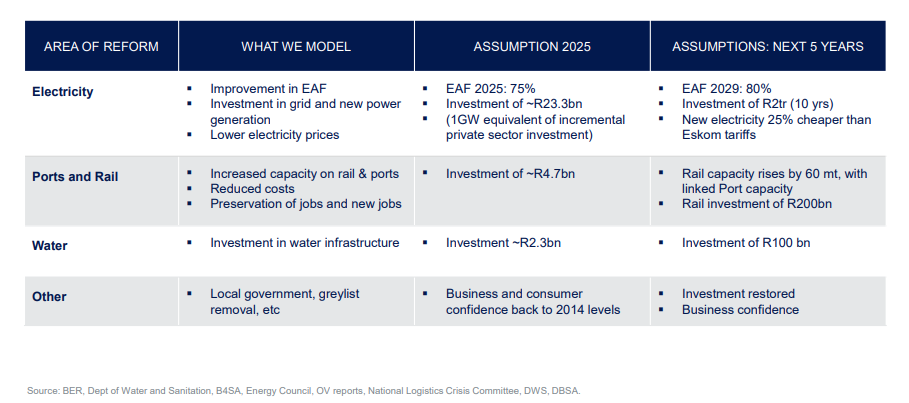
The reforms and rough estimates of the amount of money needed to be spent in key areas of the economy are outlined in the table below, courtesy of Drotschie.
R1.5 trillion goldmine
South African corporates are currently sitting on nearly R1.5 trillion in cash deposits, held in various accounts with asset managers and banks.
This cash is sitting on the sidelines and is not being used to invest in growth, expansion, or acquisition. Rather, it collects tidy amounts of interest and provides a buffer against shocks.
South African companies have historically held a lot of cash compared to their global peers as a buffer against shocks and a war chest to invest when the time is right.
Stanlib chief economist Kevin Lings explained that South African companies see a cash pile as a necessity they need to have in place from a comfort and security perspective.
With low confidence, corporates are unwilling to allocate this money to new projects to expand their business and increase employment.
Rather, much of the investment from corporates in recent years has been in the form of subsistence investing.
This is to keep their doors open, with capital directed to alternative energy supply, backup water supply, and security.
To increase economic growth and dent unemployment, investment would have to pick up significantly.
“The current investment level is mainly maintenance capex and kind of treading water, with companies waiting for a better environment,” Lings said.
“Instead of deploying capital into growth or hiring, corporates are parking it in money market funds or call accounts.”
To get this money out of those accounts and into the ‘real’ economy, business confidence has to improve substantially.
Businesses have to be able to reliably predict the future operating environment and growth prospects to justify a long-term investment in expanding operations and increasing employment.
This is not the case in South Africa, where elevated policy uncertainty and a stagnant economy limit business confidence.
“What we really need in South Africa is what we call expansion capex, and that tends to be a function of confidence,” Lings said.
“This type of capital is unlikely to suddenly and miraculously materialise overnight, despite trillions sitting in cash.”
“You have to have policies in place that are going to lead to that outcome. Our view is that the best way to start that is through public-private partnerships.”




Comments