South Africa failing spectacularly to meet its NDP 2030 targets for ports and rail


The government is failing spectacularly in its plans to increase the Durban port’s capacity and develop the Durban-Gauteng freight corridor.
In 2012, the South African government published its National Development Plan (NDP) 2030, providing a roadmap for the country over the next eighteen years.
The former Minister in the Presidency of the National Planning Commission, Trevor Manuel, launched the plan during a joint sitting of both houses of Parliament.
Manuel said the NDP was the product of thousands of inputs and perspectives from South Africans.
“We received comments from individuals and organisations and engaged with government departments, provinces, municipalities, state-owned enterprises and agencies,” he said.
“They spoke about the ravages of crime on their lives and their communities. They expressed concern that good policies are poorly implemented and therefore fail.”
These consultations and feedback were used to develop the NDP, which set overarching objectives and key targets for various sectors. The NDP also made 119 recommendations on how these targets can be achieved.
“It is a plan for a better future in which no person lives in poverty, where no one goes hungry, where there is work for all,” he said.
The plan focused on economic development, which included the necessary rail and port infrastructure to meet the country’s demands.
The NDP stated that South Africa should develop the Durban-Gauteng freight corridor, including a new dug-out port on the site of the old Durban airport.
“By 2030, the Durban-Gauteng freight corridor should be a model for how to strengthen and optimise freight corridors,” it said.
“As the corridor that handles most of the country’s high-value freight, it is the first priority. It is the most strategic corridor to achieve a shift of freight from road to rail.”
It said improving the performance of terminals on both ends would help to overcome rail’s primary drawback – lack of intermodal flexibility.
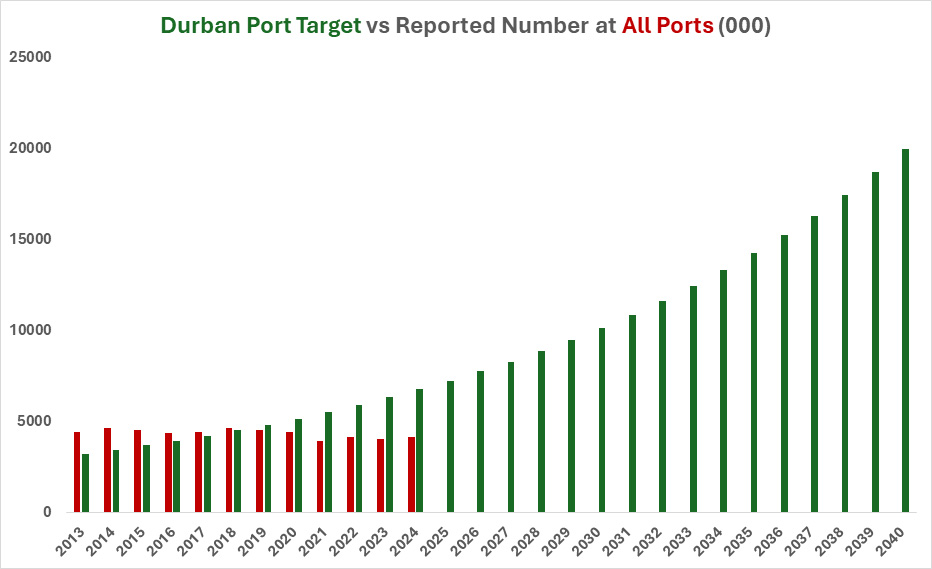
It specified that the Durban port capacity should increase from 3 million containers a year to 20 million by 2040.

Tracking the performance of the National Development Plan 2030
Over the last decade, Transnet, which operates the Durban port, collapsed. Rail freight became so poor that many businesses are using trucks to transport their goods.
Cadre deployment, corrupt contracts, and inflated asset valuations have plagued Transnet’s leadership, undermining its performance and credibility.
Over the past decade, Transnet significantly underinvested in maintenance, which caused serious problems with its rail and port networks.
This has resulted in freight volumes dropping sharply, with coal, iron ore, and other exports at multi-year lows.
Rail corridors, especially the vital Durban-Johannesburg container line, have been severely impacted by cable theft and sabotage.
Considering the target the NDP 2030 set for Durban’s port, it is important to consider Transnet’s port operations.
Transnet manages four commercial ports with major container-handling facilities, which are Durban, Port Elizabeth, Ngqura, and Cape Town.
At the time of the NDP’s release, the four major container ports handled a total of 4.4 million containers per year.
The Durban port target was ambitious, as it had to increase its port capacity to five times the capacity of all four combined.
The actual reported container capacity, from all four container ports, increased slightly from 4.4 million to 4.6 million from 2013 to 2018.
However, since then, the capacity has decreased. From 2018 to 2024, the number of containers handled annually declined from 4.6 million to 4.2 million.
To meet the target, Durban alone would have to have reported an annual capacity of 6.8 million containers in 2024.
This means that all four container ports together have a lower capacity than what Durban alone would have generated if the government were on track to meet its goals.
In November 2023, the Transnet National Ports Authority (TNPA) released a plan to increase the port of Durban’s annual capacity from 2.9 million containers to 11.4 million containers by 2026.
This means that the port would need to improve its operations and infrastructure within a year to such an extent that its maximum annual capacity would increase fourfold.
Reviewing Transnet’s track record in meeting its targets thus far, it seems highly unlikely that this would come to fruition.
The graph below shows how the actual containers handled at all four ports have fallen behind the NDP 2030 target set for just the Durban port alone.





Comments