South Africa flushing R20 billion down the drain


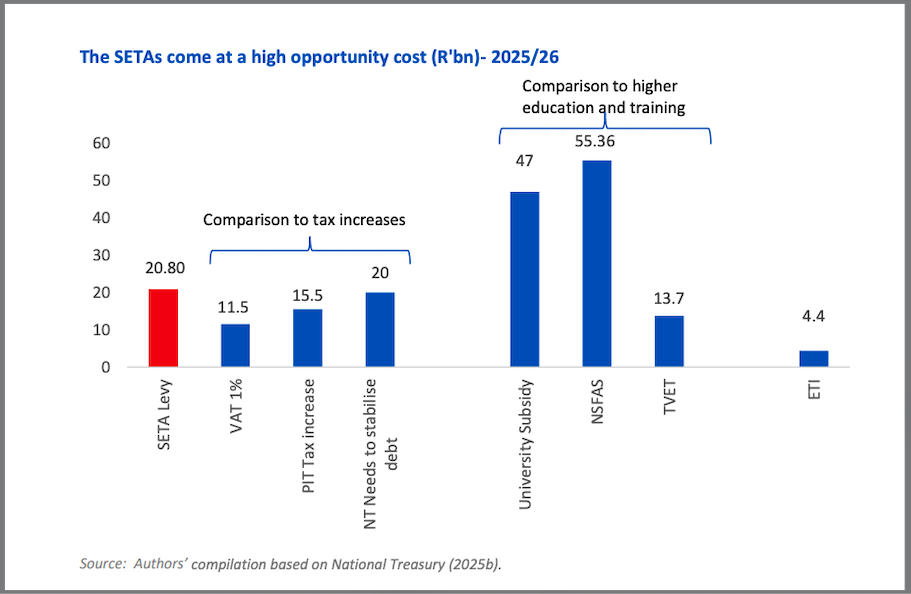
In the 2025/26 budget, the government allocated over R20 billion to the highly ineffective Sector Education and Training Authorities (SETAs) system.
This is significantly more than the R11.5 billion the National Treasury would have raised through its now withdrawn one percentage point value-added tax (VAT) increase.
It is also more than the R15.5 billion tax revenue the government makes through bracket creep by not having adjusted the country’s personal income tax brackets for inflation.
In addition, the funds allocated to the SETA system are more than the amount the Treasury has said it would require to help stabilise South Africa’s debt ratio in the 2026/27 financial year.
These findings are outlined in a recent research note by Robert Botha, Roy Havemann, and Claire Bisseker of the Bureau for Economic Research (BER).
The report, called ‘Time for a skills rethink – A review of the SETA system’, described the significant operational and financial troubles faced by the state-led SETA system.
Launched in 1998 as a way to remedy the structural skills deficit inherited from the pre-1994 era, the SETA system was expected to usher in a “skills revolution”.
However, more than two decades later, South Africa’s skills crisis has only grown, and the SETA system is plagued by systemic underperformance and serious financial mismanagement.
The researchers found that the SETA levy is significant relative to other tax and budget sources.
SETA programmes are funded by the Skills Development Levy (SDL), a levy imposed to encourage learning and development in South Africa.
This levy is determined by an employer’s salary bill and is due by registered employers. These SDLs are then distributed via SETA.
Over the BER researchers’ 13-year review period, R164 billion was disbursed from the SDL fund to SETAs. In the 2025/25 Budget alone, the SETA allocations from the SDL were approximately R20.8 billion.
Despite this significant funding, the SETA system consistently underspends its budget and hoards cash reserves, pointing to significant financial inefficiency and chronic mismanagement.
The researchers said this represents a “massive opportunity cost”, with billions of rands intended for skills development sitting idle in bank accounts. The graph below shows this opportunity cost.
Solutions
In their research note, the researchers proposed four options for reforming the SETA system and closing the opportunity gap.
The first option is the most radical, proposing to phase out the SETAs entirely, including the levy.
The researchers explained that, while relatively radical, this option has many advantages, including reducing the cost of employment.
Currently, SETAs are funded through a payroll tax of 1% and, by making employment more expensive, indisrectly contributes to higher unemployment.
Abolishing the levy and the SETA system would, therefore, decrease the cost of employment, leading to increased employment, firmer profits and, therefore, more corporate tax income for the government.
However, the researchers noted that this option comes with one main disadvantage, as it would take away funding for skills development.
“Even though the SETAs are inefficient, the system creates an existing pool of funding that could arguably still be used for developing skills, but in a better way,” they said.
Therefore, the second option involves merely reducing the levy, which makes sense given that the SETAs are currently not spending their entire allocations, with excess funds accumulating in growing surpluses and cash reserves.
However, the researchers said this option is “the worst of both worlds”, as the cost of employment has increased, and the money is simply going into a SETA bank account.
“This increases unemployment without the offsetting benefit of an increase in skills. We evaluate this in some detail and conclude that (under this option) the deadweight losses of the SETA system will remain,” they said.
The third option aims to address this by focusing on rather redirecting the levy, which could be used for other purposes like funding shortfalls in basic education.
“For instance, using the levy to fund early childhood development would support skills development over the long run,” they said.
“However, this does not directly address the skills shortages and mismatches that the economy currently faces.”
The fourth option
The fourth option is more complex than the others and suggests converting the current SETA system to one based on a revenue-neutral tax incentive.
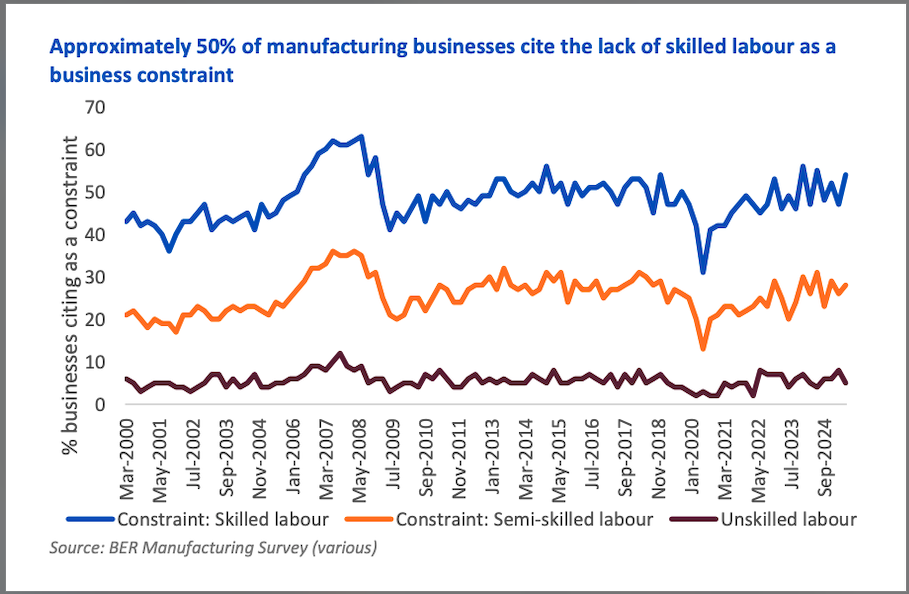
This is based on economic theory, which suggests that a market failure in skills development arises because firms are not incentivised to skill up their employees with general skills, nor is there an incentive to skill up the unemployed.
“The market tends to underprovide training in general or transferable skills, as firms fear that once employees are trained, they may leave for competitors or be poached by them,” they said.
“Consequently, firms invest primarily in firm-specific training, which does not address broader labour market needs.”
“Similarly, there is little to no incentive for firms to train unemployed individuals, as the return on such an investment is uncertain and may be captured by other employers.”
They explained that this results in a suboptimal equilibrium in which overall skill levels in the economy remain low, particularly among new entrants to the labour market.
Therefore, the researchers suggested that a more optimal solution could be to shift from the current SETA system to a revenue-neutral skills tax incentive, funded from the SDL, and paid with other employment creation incentives.
Some of these existing incentives include the Youth Employment Service (YES) and the Employment Tax Incentive (ETI).
“The proposed design would mirror the Research and Development Incentive,” they explained.
In other words, firms would be able to claim their qualifying skills programme spend off their SDL contribution. This would essentially create a ring-fenced pool of money for each firm to spend on skills.
This also means the choice of skills development would be at the firm level, rather than at a centralised SETA level.
 Loading ...





Comments