NHI is coming to South Africa whether you like it or not


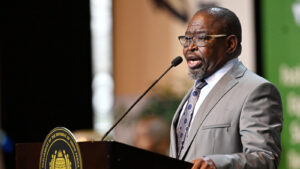
Health Minister Aaron Motsoaledi said that, despite critiques of the government’s plans for National Health Insurance (NHI), the policy will be implemented in South Africa.
Motsoaledi recently spoke at the Health Department’s Budget Vote for 2025/26, where he outlined the three objectives his department has with its budget.
These three objectives are:
- To lay a strong foundation in preparation for the improvement of the public health system of our country, and to lay the ground for the NHI
- To lay a strong foundation and to embark on the journey towards the elimination of certain diseases, especially communicable diseases, but not leaving non-communicable diseases behind.
- To implement serious reforms in the private health sector
On the first point, the Minister referred to criticism he, the Health Department and the government in general have received regarding their plans for NHI.
“There are people who believe that we have no plans nor inclination to do that. We want them to listen very attentively today,” he said.
He further urged attendees to “ignore those who want us to believe that there is nothing to fix” in the private healthcare sector.
The government’s plans for universal healthcare in South Africa have been controversial since the start, and intensified after President Cyril Ramaphosa signed the NHI Bill into law in 2024.
Most of the criticism of this legislation has centred around two points – its effect on private medical insurers and the lack of a funding mechanism.
Once NHI is fully implemented, a section in the legislation states that private medical schemes will only be able to offer ‘complementary services’ that are not available through the NHI.
This section of the legislation has been criticised for how it would affect South African businesses that provide medical schemes, and some have argued that it also limits South Africans’ freedom of choice.
“All international concepts of universal healthcare make provision for freedom of choice, and we believe citizens should be allowed to purchase additional healthcare should they have the desire and means to do so,” medical aid provider Bonitas previously said.
The other major criticism of NHI, the lack of a funding mechanism, has also been widely debated.
Funding for NHI

Estimates of the NHI’s cost to South Africa have varied, with the Department of Health projecting an annual expenditure of approximately R200 billion.
However, this estimate is seen as highly conservative, with research from private medical aid providers showing that the NHI will cost significantly more depending on the level of care provided.
These estimates argue that the government’s projections are based on the level of care provided by the state, which is far below that of the private sector.
Momentum Health estimated the private sector spends an average of R1,750 a month, or R21,000 a year, on each of the country’s 9 million medical scheme beneficiaries.
If the NHI plans to offer the same care to all 63 million South Africans, this would translate into a cost of R1.3 trillion annually. This is more than the government is currently spending on the entire health function.
What is also concerning about the government’s NHI plan is that it is already struggling to fund the current level of healthcare the state provides.
Over the past few years, government spending on healthcare has become a far lower priority for the state.
Recent data from The Outlier showed that in 2017, health received the second-biggest share of the government’s budget. In 2025, it dropped to fourth place.
In addition, despite South Africa’s severe doctor shortage, there are currently insufficient resources to hire more healthcare professionals.
The public health system lost close to 9,000 health workers in the past year.
“We did not have the money to retain or replace them even after reprioritising funds budgeted for consumables and medicines,” Finance Minister Godongwana said in his March 2025 Budget presentation.
In January 2025, Motsoaledi attributed this mainly to the austerity measures implemented by Godongwana, which have also impacted various sectors outside of healthcare.
“We have got severe austerity measures, very crippling budget cuts that affect not only our capacity to hire doctors but to perform quite a large number of functions,” Motsoaledi said.
Therefore, it is still unclear how the government intends to finance its ambitious plans to provide universal healthcare to every South African, especially while limiting the role of private medical aid schemes.





Comments