South Africa heading for a fiscal dead-end


South Africa is heading for a fiscal dead-end if the government does not confront the “unsustainable” composition of its expenditure.
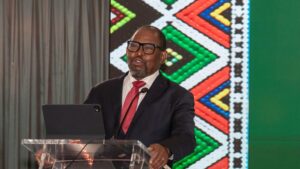
This is the warning from Chairperson of the Standing Committee on Public Accounts (SCOPA) and Rise Mzansi leader Songezo Zibi in a post-Budget Speech Parliamentary Finance Cluster media briefing.
He stressed that nearly 90% of the country’s revenue is consumed by just three items: salaries, social grants, and debt servicing. This leaves little room to address urgent service delivery failures.
“South Africa has a problem – and that is the composition of expenditure,” said Zibi.
“Over R820 billion in salaries, over R440 billion in social grants, over R424 billion in debt service costs at R1.2 billion per day. That makes up about 90% of the revenue we collect, 90%!”
This, he argued, leaves far too little for the goods and services people depend on.
“Schools without modern science and computer equipment; clinics with insufficient medication, needles and anaesthetics; and so on,” said the SCOPA chairperson.
“When we do pay for these goods and services, we pay too much because they are poorly conceived, poorly planned, poorly managed and often riddled with corruption – at all levels of government.”
These remarks come after the Finance Minister’s recent Budget speech, which he said failed to prompt the deeper national conversation needed about how government money is actually spent.
While the national conversation has been dominated by the VAT controversy, Zibi argued it had the unintended effect of obscuring critical issues of budget prioritisation.
“VAT overshadowed everything else. Budgets are about expenditure priorities,” he said.
“The composition of expenditure is a much bigger discussion about government policy and what we choose to prioritise.”
Zibi said budgets are meant to solve problems, and their debates are supposed to be about the order of those priorities and whether these allocations are sufficient or spent efficiently.
“We never got a chance to have that discussion. I hope now there will be an opportunity to do so,” he said.

Analysis
These concerns were echoed by economist Dawie Roodt, who recently warned that the bulk of the national budget is consumed by salaries, debt repayments, and social grants, leaving little room for economic investment or service delivery.
“It’s simply not sustainable for several reasons,” Roodt said, warning that the country is entrenching dependency rather than fostering growth.
“We got here because of high levels of unemployment and poverty. People depend on the state because they don’t have a choice.”
He pointed to the gap between taxpayers and nearly 28 million grant recipients as a long-term economic risk, warning that “this sizeable current expenditure also boosts consumption expenditure… to the detriment of investment”.
On the wage bill, Roodt said, “Many civil servants are overpaid and underworked in South Africa.” Public sector salaries in South Africa are far higher than those of their global peers and have grown by over R315 billion in a decade.
“South Africa’s wage bill [as a percentage of GDP]… towers over economic powerhouses such as the United States, United Kingdom, Australia, and Japan,” noted a Centre for Risk Analysis report.
Zibi challenged the country’s entire public service structure, questioning whether it still aligns with modern-day objectives.
“Do we have the right number of civil servants doing the kind of work that needs to be done, or are we trying to fit a square into a circle because in 1998 we thought the government should look the way it does now?” he questioned.
The SCOPA chairperson, however, was careful to clarify that he is not advocating for retrenchments.
“I am asking, for instance, whether we do not spend hundreds of millions of rands on consultants because the people we have in place aren’t fit for purpose. Then we end up paying millions of rand for work that officials should be able to do,” he said.
Zibi also raised tough questions about how the government delivers the social wage.
“Do we want to give people R370 to last them 48 hours, or do we want to use the R35 billion for carefully planned and executed initiatives to grow the economy and create jobs that pay a living wage?” he asked.
Zibi called for tighter controls on government spending, citing “mismanagement of projects, and the massive corruption therein” as issues “on an industrial scale”.
He proposed spending caps and incentives for timely, on-budget project delivery, adding that consulting engineers are a significant weakness.



Comments