Serious threat to South Africa


South Africa’s unemployment rate has yet to improve to levels seen in 2019, threatening the country’s economic growth.
Statistics South Africa recently released the country’s latest Quarterly Labour Force Survey, which covered the period from January to March 2025.
The survey revealed that South Africa’s unemployment rate worsened significantly, rising from 31.9% in Q4 2024 to 32.9% in Q1 2025.
Using the broad definition, which includes discouraged work seekers, the unemployment rate in Q1 2025 was 46.78% compared to 45.70% in the previous quarter.
NWU Business School economist Professor Raymond Parsons explained that this higher-than-expected rise in South Africa’s unemployment level raises a red flag about the country’s weak growth performance.
Various institutions and economists have already progressively reduced South Africa’s GDP growth forecasts for 2025 to about 1.5% or below.
Therefore, Parsons said it is not unexpected that this should now be reflected in higher unemployment levels.
“The overall total unemployment level is now where it was a year ago, and youth unemployment in particular remains at an unacceptable magnitude,” he said.
“The latest rise in unemployment again confirms that economic growth in South Africa has been too low for too long.”
Parsons lamented that no “magic wand” exists to create jobs overnight, as the disappointing unemployment picture is the cumulative outcome of seasonal, cyclical and structural factors.
Nonetheless, he said the deteriorating employment outlook reinforces the need for the National Treasury’s third Budget, set to be delivered on 21 May 2025, to be growth-driven.
“It needs to create a policy environment which promotes economic expansion and boosts investor confidence,” Parsons said.
“The Budget must be dedicated to policies and projects that demonstrably support the GNU’s commitment to at least 3% GDP job-rich growth in the medium term.”
Parsons’ sentiments were echoed by Aluma Capital chief economist Frederick Mitchell, who said the latest employment figures are somewhat discouraging.
He attributed the slowdown in job growth to ongoing international uncertainties, including the United States’ tariff war against China and other nations and concerns regarding the future of the AGOA agreement beyond September 2025.
“Diplomatic tensions between Washington and Pretoria related to various issues have also weighed on economic confidence,” he said.
“Consequently, many businesses appear to have adopted a cautious ‘wait-and-see’ approach regarding expansion and hiring in the short term.”
However, Mitchell said the recent 90-day suspension of the US-China tariff war could positively influence local and global markets, potentially boosting employment figures in the upcoming quarters.
Unemployment analysis

Daily Investor analysed South Africa’s unemployment figures from Q1 2019 to Q1 2025 and found that the country has not come close to the levels seen in 2019.
In the first quarter of 2019, South Africa’s unemployment rate was 27.6%, and, including discouraged work seekers, it stood at 40.89%.
The Covid-19 pandemic, which hit in 2020, saw unemployment rise steadily, reaching 32.5%, or 45.66% using the broad definition, in the last quarter of that year.
Unemployment continued to worsen in 2021, reaching a peak of 52.47% using the broad definition in the third quarter.
There was a slight rebound in 2022 and 2023, as companies started to recover from the effects of the pandemic.
Unemployment reached its lowest level in years in the third quarter of 2023, when the narrow definition put levels at 31.9% and the broad definition stood at 44.75%.
However, 2024 saw unemployment figures tick up again, although not reaching the high levels seen in the years prior.
2024’s best reading came in its fourth quarter, when the narrow definition of unemployment put the figure at 31.9%, and the broad definition came in at 45.70%.
Statistics South Africa recently released figures for the first quarter of 2025, showing that unemployment, in the broad definition, reached a low last seen in the fourth quarter of 2022.
South Africa’s unemployment crisis illustrated
The graph and table below show how South Africa’s unemployment rate has worsened between the first quarter of 2019 and the first quarter of 2025.
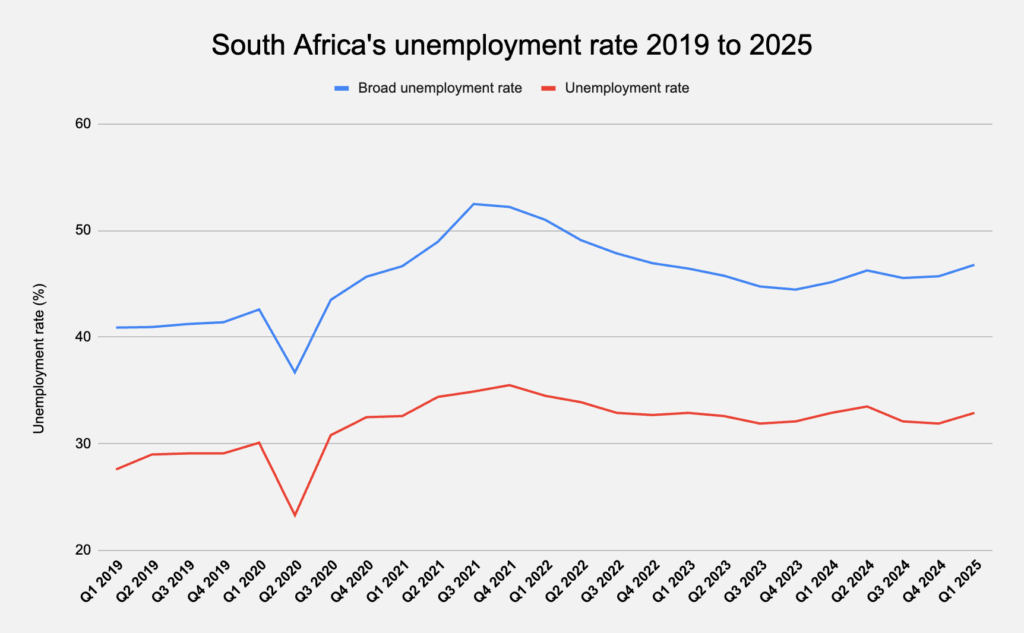
| Date | Unemployment rate | Broad unemployment rate |
| Q1 2019 | 27.6% | 40.89% |
| Q1 2020 | 30.1% | 42.59% |
| Q1 2021 | 32.6% | 46.65% |
| Q1 2022 | 34.5% | 50.99% |
| Q1 2023 | 32.9% | 46.42% |
| Q1 2024 | 32.9% | 45.15% |
| Q1 2025 | 32.9% | 46.78% |
 Loading ...





Comments