South African households face tough times in 2025


Pressure on South African households is expected to worsen as the year continues, as companies remain concerned about the country’s growth prospects in 2025.
Investec chief economist Annabel Bishop explained that corporates’ concerns over weakened economic growth outcomes this year are material.
Bishop said South Africa’s economic growth rate is at risk of being lower than the current forecast of 1.3% this year.
Part of the reason for this is expected trade tariffs from the United States President Donald Trump’s administration.
“While South Africa’s export exposure to the US is relatively low compared to the EU, a weakening in global growth will negatively affect South Africa,” Bishop explained.
For example, commodity prices have already been negatively affected by the sharp rise in global tariffs and the uncertainty surrounding the global trade and growth outlook.
South Africa also has several local challenges that are weighing on growth. For example, load-shedding has returned intermittently, while Transnet reforms are too slow to meet economic growth needs.
Bishop said this was reflected in the most recent industrial production numbers, which already show a risk of contraction for the quarter with a 3.6% drop in the data available for the first quarter of 2025 compared to the first two months of the fourth quarter of 2024.
In addition, for the first quarter of 2025 so far, building completions in construction are down 24.2% compared to Q4 2024.
Bishop also highlighted severe flooding in parts of the country, which has hurt production and affected agriculture, mining, and transport.
Local uncertainty has also weighed on business and consumer confidence in South Africa, particularly related to the 2025 Budget and the Government of National Unity (GNU).
The 2025 Budget was postponed in February as the ANC sought to bring in major changes to the previously agreed budgeted finances for the fiscal years ahead.
Specifically, political parties across the spectrum vehemently disagreed with the ANC’s planned 2% VAT increase.
Bishop said GDP growth would have been close to 0.5% lower for the year on a 2% VAT hike, and CPI inflation 1% higher.
The VAT hike was toned down in the Budget speech in March, but it would still have suppressed growth and lifted inflation.
“With the VAT hike now scrapped, but a new Budget date set for 21 May, clarity is expected,” Bishop said.
However, businesses and households in South Africa are still left uncertain about where the government will find the additional revenue needed for its ambitious spending plans over the next three years.
Households under pressure
All of these factors have led to significant pressure on South African consumers, and not only in terms of confidence.
Bishop said consumer confidence collapsed this quarter, as the state depressed consumer sentiment by its 2% proposed VAT hike.
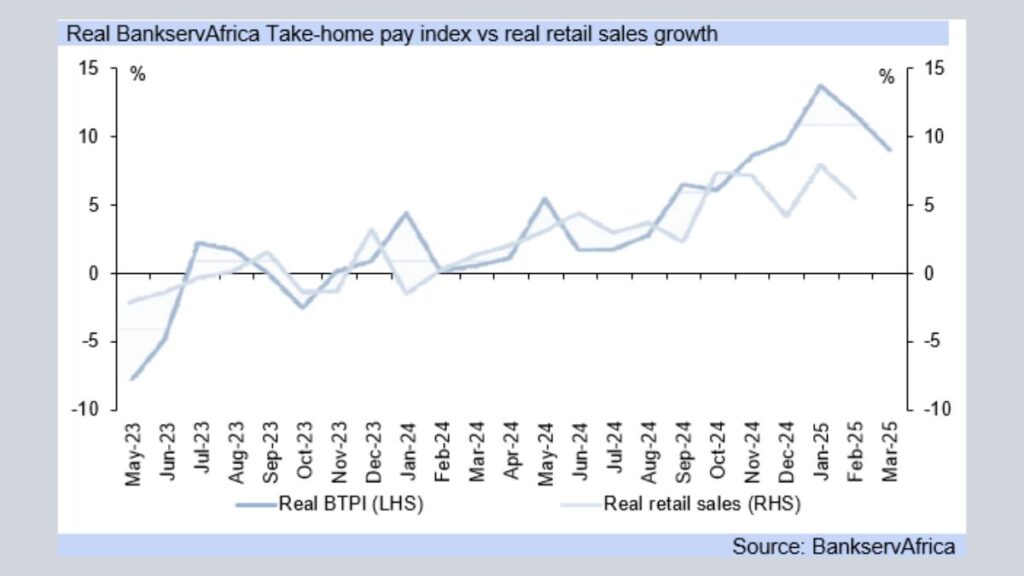
Real income growth also slowed to 0.9% month-on-month in February from 5.2% in January, as confidence sagged on the implications for growth and inflation.
Bishop explained that the drop in real incomes signifies corporate concerns over the economic growth outlook for South Africa, as structural repair to state infrastructure is slow, and the global trade war has escalated.
Nominal average take-home pay also fell, by 2.5% month-on-month in March, to R17,881 from R18,272 in February.
Notably, while February saw growth of 0.6% month-on-month, this is well down from January’s 5.6% outcome.
This slower growth in incomes has negatively impacted real retail sales, which lifted by only 0.6% for the first two months of 2025 compared to the same period in Q4 2024.
Bishop said this comes as household spending is seeing weak activity, which also has consequences for economic growth.
In South Africa, household consumption expenditure (HCE) growth is expected to see less expansion this year than was previously forecast.
Bishop explained that real incomes and employment are significant drivers for HCE, which is, in turn, an important factor for economic growth.






Comments