Dark clouds gather over a crucial South African industry


South Africa’s ongoing tensions with the United States threaten the country’s continued participation in the African Growth and Opportunity Act (AGOA), which will significantly impact its automotive manufacturing industry.
This is feedback from Meryl Pick, the head of equities research at Old Mutual, who outlined the potential impact of deteriorating South Africa-United States relations.
Pick spoke at Old Mutual Investment Group’s investment update for the first quarter of 2025, which was characterised by elevated uncertainty.
While this uncertainty was broadly expected with Donald Trump ascending to the White House, what was surprising was the singling out of South Africa.
Relations between South Africa and the US have been battered in the past few months, with Trump’s criticising South Africa’s genocide case against Israel at the International Court of Justice and making claims of land seizure at the expense of white farmers.
South Africa has tried to reset relations with the US by increasing its diplomatic presence in Washington and sending a delegation of business leaders to New York.
The main aim of these efforts is to ensure that some of South Africa’s exports retain their preferential access to the US market under AGOA.
If not, South Africa has prepared a bilateral trade agreement as a backstop in case it loses access to a preferential accord.
The loss of AGOA would be significant but perhaps would not have as much impact as many fear, given its limited scope and South Africa’s diversified export markets.
“The policy had actually become far less relevant in the last decade than it was when it began,” Pick explained.
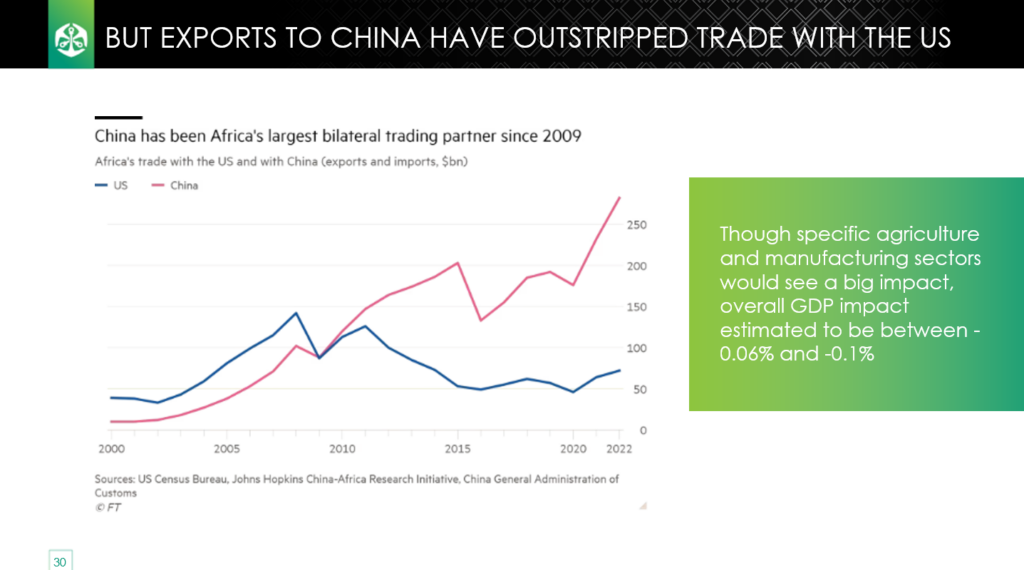
When AGOA was first launched, the US was South Africa’s largest trading partner. China has since replaced it.
The loss of AGOA would only affect around 0.1% of South Africa’s GDP, as less than 10% of the country’s exports fall under the agreement.
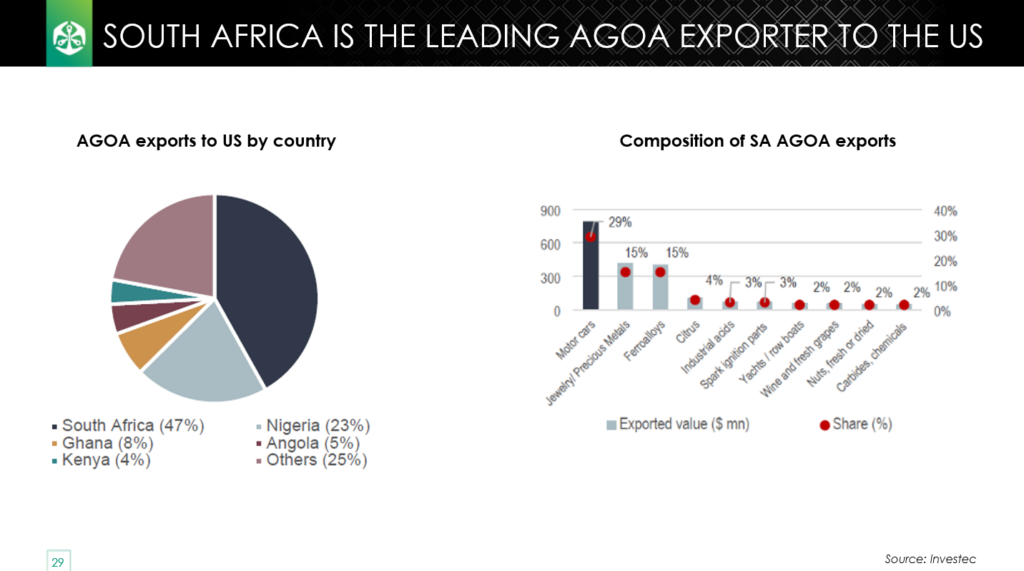
Pick explained that most South Africa’s exports to the US are commodity-based and, thus, they do not benefit from AGOA.
Specific sectors hardest hit
Despite the limited effect, specific sectors employing hundreds of thousands of South Africans could be severely impacted.
“In a specific South African context, the motor industry is clearly the biggest beneficiary of the program,” Pick said. Another major sector impacted would be citrus exports.
“So, very big impact in specific industries, for example, in the motor industry and citrus exports, but at a broader GDP level, the effect should be minimal.”
What is more concerning for Pick and Old Mutual is the knock to confidence the loss of AGOA would be for investors and businesses in South Africa.
“It is very bad for sentiment, we would say. For us to be excluded from this is being kicked out a club that has the tacit support of the United States.”
Old Mutual Wealth investment strategist Izak Odendaal outlined in more detail the impact a loss of confidence in the South African economy could have.
If South Africa loses AGOA access and America levies tariffs on South African exports, the Reserve Bank estimates it could shave 0.2 percentage points off the growth rate.
If these tariffs were associated with a confidence shock, growth could be 0.7 percentage points lower.
The Reserve Bank has incorporated these factors into its most recent forecast for economic growth in South Africa, revising its expectation downward to 1.7% in 2025.
It added that the risks to economic growth remain firmly tilted towards the downside, meaning that the actual growth rate of the country is likely to be lower than forecast.
The knock from losing AGOA to confidence in South Africa would be exacerbated by the ongoing confidence crisis in the country.
One of the most overlooked issues in South Africa is a lack of confidence in the local economy due to a deteriorating political environment.
The main driver of this deterioration is policy uncertainty and question marks around the country’s future, given some of the legislation enacted in the past decade.
There was not always a lack of confidence in South Africa, with the country experiencing strong economic growth in the early 2000s on the back of sound policy and good governance.
The combination of sound policy and good governance naturally engenders trust in the country, which is vital for economic growth as it enables businesses and households to plan for the future and commit capital to fixed investments.
South Africa’s political climate has emerged as the biggest handbrake on the local economy, with its chilling effect on investment being greater than load-shedding or Transnet’s issues.
 Loading ...





Comments