South Africa making enemies with the wrong countries


South Africa is alienating its biggest trading partners, including the United States and Europe, in preference for countries it does not benefit from, like Iran and Russia.
Business leaders, including economist Dawie Roodt, Sygnia CEO Magda Wierzycka, and former Eskom CEO Andre de Ruyter, said South Africa should carefully choose its partners.
Wierzycka said Donald Trump’s election as the next United States President poses a significant challenge for South Africa. “It is time to choose our allies carefully,” she said.
South Africa is a member of the BRICS alliance, which includes China and Russia. Iran is also closely linked to this group of countries, having attended a BRICS Summit and being part of the new BRICS+ grouping.
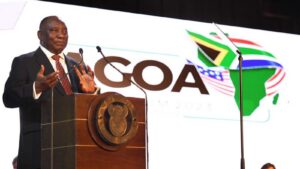
Trump has no time for South Africa, and there is a risk that South Africa can be suspended from the benefits of the African Growth and Opportunity Act (AGOA).
“Although largely insignificant, it tarnishes South Africa’s international standing, particularly when its bedfellow is grey-listing,” Wierzycka said.
She advised South Africa’s government to follow India’s example and work much harder at staying neutral. “It is not what you say but what you do that matters,” she said.
De Ruyter, who currently works as a senior fellow at Yale’s Jackson School of Global Affairs, urged South Africa to support countries based on its interests rather than friendships.
He cited former US Secretary of State Henry Kissinger, who said, “America has no permanent friends or enemies, only interest”.
De Ruyter said a country should not support another country because of friendship. Instead, it should base its support on serving its interests.
“South Africa has many friends. However, we do not always strive to serve the country’s interests,” he said.
Roodt warned that South Africa’s closeness to many rogue nations could significantly impact the country’s economy.
He also warned that if South Africa is excluded from AGOA, it would negatively impact the country.
The United States is one of South Africa’s largest trading partners, and it is running a trade surplus with the US.
“We’re going to be the big losers here, but it doesn’t mean we’re going to stop trading with Americans,” he said.
“Although the impact is not necessarily going to be that large on the South African economy, every time we shoot ourselves in the foot, it is bad for the economy.”
South Africa is making enemies with the wrong countries
Daily Investor analysed South Africa’s trading volumes with many prominent countries, which shows that it is making enemies with the wrong groups.
South Africa’s largest trade partners are China, the USA and Germany. These countries account for 24% of all South African exports and 30% of its imports.
As one of the BRICS nations, South Africa enjoys lowered tariffs primarily on agricultural and mining exports to China.
The BRICS nations do not have a free trade agreement and rely on bilateral agreements between each country.
BRICS objectives include removing trade barriers between members. However, there is no unified formal trade agreement between member countries.
South Africa’s export trade with BRICS countries relies mostly on mineral exports such as gold and agricultural goods, which generally fall under the raw materials category.
Imports from BRICS nations such as India and China rely mostly on manufactured and refined goods such as electronic equipment and oil.
These goods require significant production input and are much more expensive than their component raw materials.
As such, at the end of 2023, South Africa ran a trade deficit with every BRICS country, meaning it had negative net exports.
Simply put, South Africa paid these countries more for imports than it received for the products it exported to them.
Over recent years, South Africa has seen a deepening trade deficit with every single BRICS country.
At the end of 2023, South Africa had a R146 billion trade deficit with China and a R39 billion deficit with India.


United States and Germany
South Africa also has important trade agreements with the European Union and the United States.
These include the EU-SADC trade agreement with Europe and the AGOA agreement with the USA.
South Africa enjoys zero and lowered tariffs on various exports to the European Union to promote trade.
Almost 99% of all exports to the EU enjoy the removal of customs duties within specified quantities.
The AGOA agreement removes approximately 6,800 US tariffs on qualifying Sub-Saharan African countries to promote Sub-Saharan African exports to the United States.
These trade agreements have had a significantly positive impact on South Africa’s trade balance, as seen with two of South Africa’s largest trade partners, the US and Germany.
Trade with the United States and Germany has left South Africa with strong trade surpluses.
South Africa has continued to benefit from these agreements as its trade surpluses with Germany and the US have increased over recent years.


Make friends with trading partners
South Africa’s beneficial trade position with the European Union and the United States absorbs a significant portion of the deficits with BRICS nations.
Trade agreements with the European Union and the United States are valuable to South Africa and should be protected.
The AGOA agreement, for example, has strict requirements for South Africa to maintain its benefits. These include:
- Upholding a market economy protecting property rights with minimal government interference.
- Combating corruption and anti-bribery conventions.
- Not engaging in activities that undermine U.S. national security or foreign policy.
This last point has recently put the AGOA agreement in the spotlight, as South Africa underwent actions that jeopardised its EU and US trade agreements.
Since the Russian-Ukraine war, Russian naval and cargo ships docked at Cape Town to replenish supplies, which drew strong criticism from the USA.
These events have been perceived as active support of Russia during its conflict with Ukraine, which the US has strongly opposed.
On top of this, South Africa initiated a legal case against Israel at the International Court of Justice after Israel defended itself against the Hamas terrorist attack.
The United States, which has strong ties with Israel, strongly criticised this case and rejected it entirely.
White House National Security Council spokesman John Kirby at the time said, “This submission is meritless, counterproductive, and without any basis in fact”.
South Africa’s open support for US enemies risks the AGOA agreement and, by extension, favourable trade with the US and potentially even the EU.
Hat tip to Jaco Kleynhans for his post on the issue that sparked this analysis.



Comments