South African municipalities go from 163 clean audits to only 34 in a decade


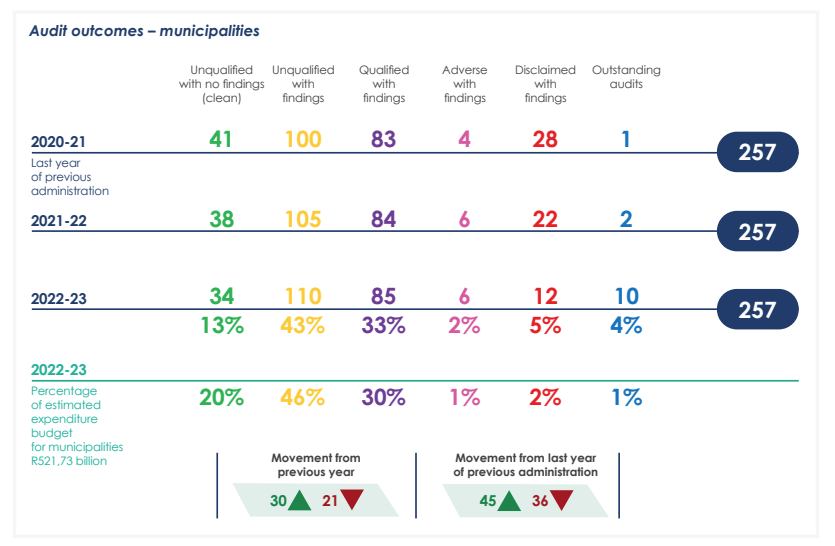
South African municipalities have crumbled under a decade of mismanagement, with only 34 receiving clean audits for the latest financial year compared to 163 a decade ago.
Municipal mismanagement has been at the core of poor service delivery in South Africa, with local government often being the only touchpoint individuals have with the state.
Auditor-General Tsakani Maluleke said local government is instrumental in providing communities with basic services, often being the authority responsible for the delivery of clean water, sanitation, electricity, and waste management.
“After years of service delivery failures, council and administrative instability, financial mismanagement, and disregard for the law, this sphere of government faces greater demands than ever before to regain the trust of South Africans,” she said.
In the latest state of government report, Maluleke said that local government officials have failed to listen to her calls for greater accountability, transparency, and capacity.
“Continued excellence at municipalities that maintained their clean audit status and a reduction in the number of municipalities with disclaimed audit opinions offer a further glimmer of hope. Otherwise, there is still little to celebrate.”
However, the state of local government was not always this dire, with great improvements occurring in the mid-2000s.
This resulted in municipalities receiving more clean audits as their capacity improved, accountability was enforced, and money was allocated to service delivery.
In the 2014-15 report on the state of local government, nearly 60% of South Africa’s municipalities received clean audits.
Only 29 municipalities received a disclaimed audit opinion on their financial statements, marking significant improvements from 2010-11.
The Auditor-General at the time, Kimi Makwetu, said the improvements were driven by the government’s Operation Clean Audit, launched in 2009.
This initiative outlined clear steps to ensure that all municipalities received unqualified audits.
While it failed to reach its target of 75% of municipalities having clean audits, Makwetu said it significantly impacted municipalities’ ability to produce financial statements on time and improve their audit opinions.
This improvement can be seen in the graph below.
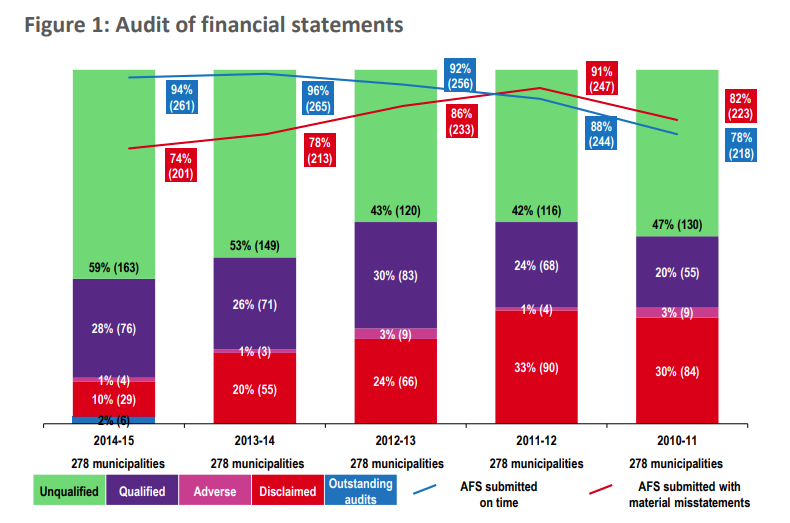
South Africa’s local governments have fallen from the highs seen a decade ago, with financial mismanagement leading to a sharp decline in service delivery.
In the latest report, Maluleke revealed that only 34 (13%) municipalities received a clean audit for the 2022-23 financial year. This is a sharp decline from the 163 (59%) of municipalities in 2014-15.
Makwetu flagged some of the issues that would come down the line and urged municipalities to address his concerns before it negatively affected service delivery.
“Continued reliance on the auditors to identify corrections to be made to the financial statements to obtain an unqualified audit opinion is not a sustainable practice,” he said.
“The over-reliance on consultants is a further warning signal of a lack of capacity and skills in local government to produce unqualified financial statements.”
This foreshadowed the sharp decline in capacity at the local government level, with a growing number of municipalities unable to produce their financial statements on time.
The lack of capacity also resulted in a sharp uptick in irregular and wasteful expenditure, which Makwetu again flagged back in 2015.
In the five years to 2015, irregular expenditure doubled from R7.3 billion to R14.7 billion, with most of this being flagged by auditors and not municipal finance departments.
This has led to poor performance by municipalities, according to the latest report on local government.
“The lack of transparency, accountability and institutional integrity not only leads to non-delivery of services but also harms the people these municipalities are intended to serve,” Maluleke said in the latest report.
“My call is for urgent action and is again directed to the political leadership of municipalities. There is limited time left in their term to leave a legacy of improved governance and delivery.”
The increasingly poor financial management at municipalities is reflected in the graphic below, showing a steady decrease in clean audits and a rise in outstanding audits.






Comments