Residents in South Africa’s richest city effectively pay double taxes


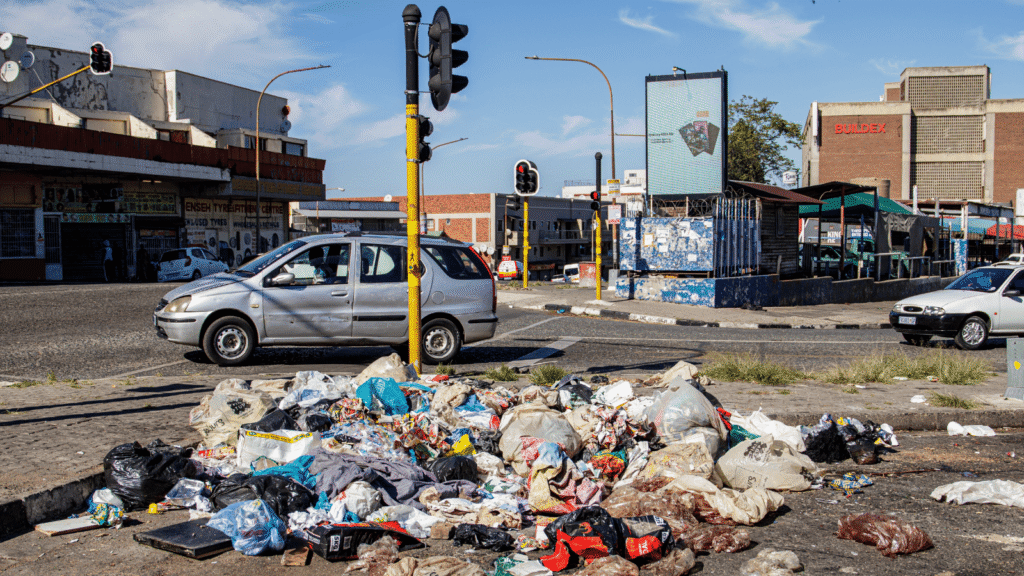
Residents of the City of Johannesburg effectively pay double taxes because they must pay for private alternatives to state services.
This ranges from backup water supply and rooftop solar through to community action groups that provide basic services.
These are services the state is mandated to provide, and that residents pay for through municipal rates and levies, JoburgCAN director Julia Fish told Newzroom Afrika.
Fish explained that double taxation occurs when community groups, residents’ associations, and central improvement districts must fund and provide municipal services.
This happens when the local municipality, in this case the City of Johannesburg, fails to do so and significantly increases the cost of living in the city.
While businesses have the capital to fund mini-city improvement districts in Sandton and Rosebank, for example, individuals do not.
Individuals are already heavily taxed at the national level in South Africa, with the country’s tax base highly concentrated.
A handful of individuals and corporates fund the majority of the state’s budget, with Efficient Group’s Dawie Roodt estimating that a single high-net-worth individual effectively supports 20 low-income earners.
Fish said that on top of this, residents in Johannesburg are expected to pay hefty municipal rates and levies for services that are not delivered.
“The only parts of the city that work are the ones where people can afford to effectively bypass the municipality and do things themselves,” Fish said.
“There is double taxation, where individuals have to fund community groups and associations to do the work of delivering services.”
“That is where you see the city being able to operate somewhat, and that is because they have bypassed a municipality that is not performing their core mandate, which is delivering services.”
Fish accused the councillors of the City of Johannesburg of behaving like preschoolers, as they are constantly locked in political battles rather than serving residents.
Trash is piling up
The most recent example of the failure of basic services in Johannesburg is the trash piling up on the city’s streets.
This is the responsibility of the city-owned Pikitup, whose service delivery has rapidly collapsed following workers’ strike action.
“Pikitup used to be a particularly reliable service. Most residents in suburban parts of the city didn’t really have a problem with their refuse removal,” Fish said.
“This was almost unheard of, but you had this reliable system within Joburg, and most residents were happy with the levels of service delivery provided.”
The past few months have been drastically different for residents, with refuse not being removed by Pikitup workers who downed their tools.
“We have seen in the past few months a change in the contractor who is not delivering to the same extent, and there is now a protracted labour dispute,” Fish said.
“This is closely linked to the liquidity crisis that we are seeing across the city in general, where there simply isn’t money being given to the service utilities.”
Johannesburg’s budget has shifted dramatically towards salaries and short-term consumption, rather than service delivery and infrastructure investment.
Much of the revenue generated by service delivery entities, such as Johannesburg Water and Pikitup, has gone toward paying civil servants’ salaries rather than to the companies that provide the services.
As service delivery levels have collapsed from a lack of investment, the city is unable to collect revenue, resulting in the current liquidity crisis.
“They also don’t have a clear, complete supply chain management structure within their own entity,” Fish said.
“So things like fleet hiring and fleet maintenance are all outsourced, and because of that, they don’t have cash on hand to be able to pay these contractors.”
Fish said the challenges also relate to the new wage agreement, which is supposed to raise wages for lower-end workers over the next few years.
“Which they’ve already given to the executives and top-level management, but not to the people on the ground who are actually delivering the service. So at the end of the day, that system has fallen back,” she said.





Comments