Call for SARS to take money from graduates’ salaries to fund NSFAS


As universities grapple with growing student debt, some are proposing that NSFAS work with SARS to automatically deduct proportional repayments from graduates’ salaries once they begin earning.
Speaking on Newzroom Afrika, Rhodes University director of the Centre for Postgraduate Studies, Sioux McKenna, explained that universities need stronger systems to recover money owed by former students.
McKenna said the issue is particularly important as universities face growing financial pressure from unpaid student debt and delayed payments from the National Student Financial Aid Scheme (NSFAS).
Currently, public universities across South Africa are reportedly owed more than R10.5 billion by NSFAS.
Some institutions are carrying significant unpaid balances, including about R1 billion at the University of the Free State and R1.2 billion at North-West University.
McKenna noted that universities are increasingly being forced to carry these costs themselves. Institutions without large investments or reserves to draw from face a more serious problem.
“In the end, it ultimately becomes the student who’s waiting for funding for accommodation, waiting for funding for food,” she said.
This can leave students without adequate accommodation or food while universities struggle to manage their own cash flow.
McKenna explained that student debt recovery is already difficult for universities, with some students leaving university with large outstanding balances.
Those who complete their studies can then enter the workforce while still owing money to their universities.
To address this problem, she proposed a stronger relationship between universities, NSFAS and SARS to ensure that graduates repay their debts once they start earning.
“We need to find ways of bringing in a proportional amount as students go out into the world and start earning,” McKenna said.
The amount repaid could depend on the graduate’s income. This would create a system where repayments increase as the graduate’s ability to pay improves.
McKenna said there is currently too much reliance on individuals to remember to make payments or establish stop orders. This could, instead, be handled automatically.
“We need to have a much stronger relationship with SARS to ensure that there aren’t any challenges in repaying that money,” she said.
“It isn’t up to the individual to remember or to set up stop orders and things. It’s just automatic at the point of payment.”
Concerns over the current system
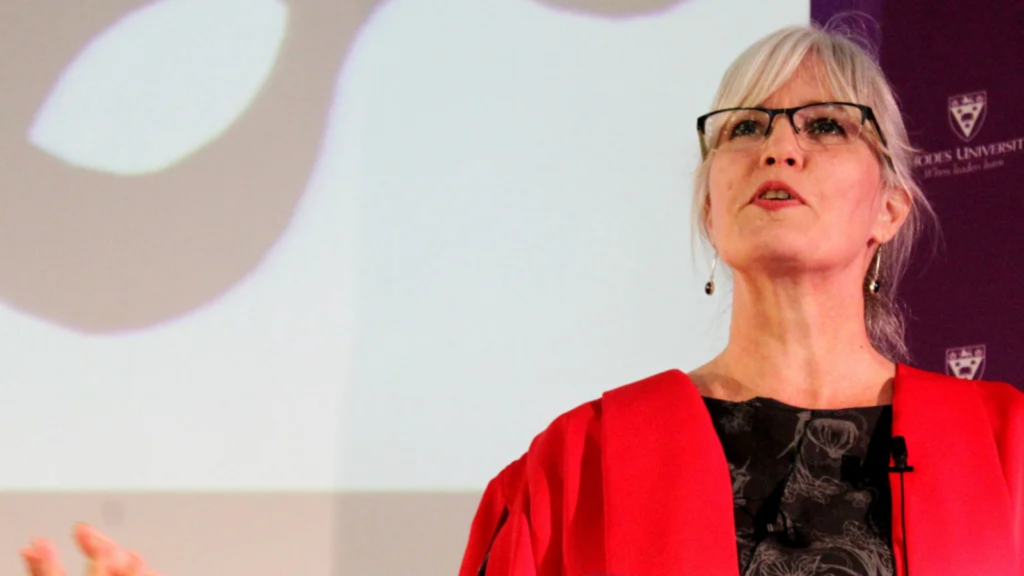
McKenna stressed that improving debt collection alone will not solve NSFAS’s problems. While repayments are a key issue, broader structural problems must be addressed to make the scheme sustainable.
“At the moment, it simply will not hold. And I think we shouldn’t be waiting for it to collapse as we seem to be doing.”
One of the issues is the scale and nature of NSFAS funding. NSFAS has effectively become more than an education grant. It also covers accommodation, food and other living expenses.
According to McKenna, this creates additional administrative pressure and means the funding can become a vital source of income for students’ families.
The result is that some students become, in effect, breadwinners for their households, when the money was intended to support them during their studies.
McKenna also discussed proposals to change how NSFAS funding is distributed. One option is to return to the previous model, where funding was transferred from the National Treasury to universities.
She said this system worked efficiently in most cases, although some universities had problems with financial management.
Another option would be to pay funding directly to students. However, McKenna said this would still require a strong system to determine which students qualify and how much they should receive.
A different approach, she explained, would be to separate the different types of support currently provided through NSFAS.
“The option would be to split the grant and to put the funding for the education portion directly to the student or to the university, and put the rest into the bigger social grant mechanisms.”
This would recognise that NSFAS currently covers several different needs, including tuition, accommodation, food and books.
Pressure on universities
The financial pressure is not limited to student services. McKenna said universities that cannot rely on large reserves may have to reduce spending when cash flow is restricted.
These budget cuts could affect universities’ ability to maintain infrastructure, employ staff, and fund research.
McKenna also pointed to the growing size of NSFAS relative to other university funding. “The NSFAS budget is now bigger than the block grant budget.”
This means universities are receiving a smaller share of government funding to cover their general operating costs, while a larger amount is directed towards NSFAS.
McKenna added that improving repayments through SARS could help address one part of the problem, but a broader overhaul of NSFAS is needed.
The proposed salary deductions would create an automatic repayment mechanism for graduates, while allowing repayments to be linked to their ability to pay.
However, she said this should form part of wider reforms aimed at making NSFAS financially sustainable and ensuring that universities can continue to provide education, research and other services.





Comments