South Africa’s big land ownership lie


Civil rights organisation AfriForum said the widely cited claim that white South Africans own 72% of the country’s land is misleading because it is based on incomplete, outdated data that excludes large categories of land ownership.
The claim that white South Africans own 72% of the country’s land has become one of the most frequently cited statistics in debates over land reform.
It is also often used to justify calls for policies such as Expropriation without Compensation, one of the most controversial issues in South Africa’s political space.
However, according to AfriForum, a closer examination of the government’s own data shows that the figure is based on incomplete information, questionable methodology and a narrow subset of land ownership.
This was revealed in a recent fact sheet released by AfriForum, which argued that this flawed data makes the 72% figure a misleading representation of South Africa’s overall land distribution.
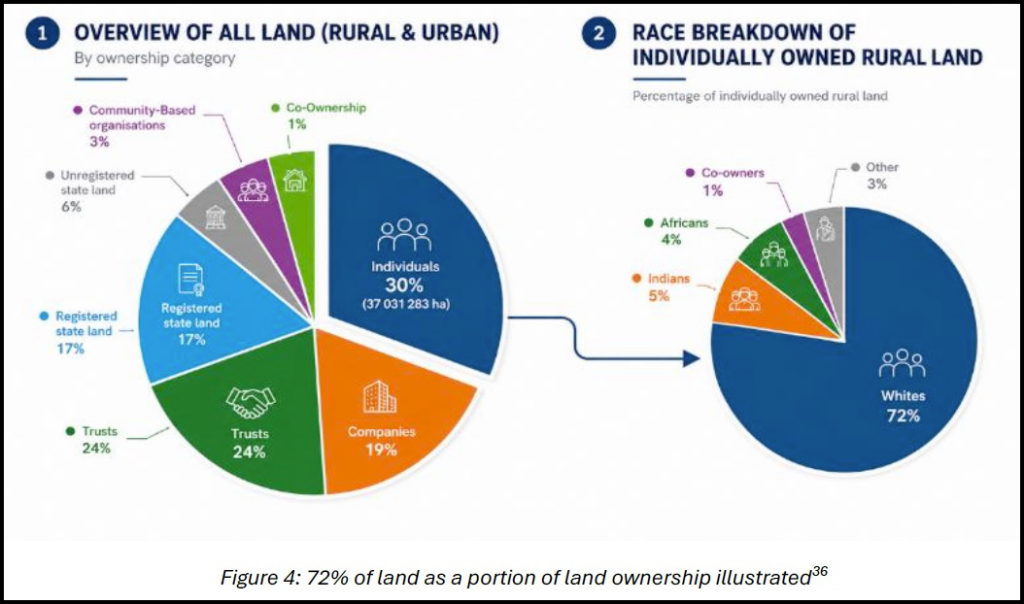
The widely quoted statistic originates from the government’s 2017 Land Audit Report, but one of its biggest shortcomings is that it does not refer to all land in South Africa.
The racial ownership analysis covered only around 38 million hectares of the country’s approximately 122 million hectares.
Large categories of land ownership – including trusts (24%), companies (19%), and state-owned land (23%) – were excluded from the racial analysis because ownership could not be linked to individuals.
As a result, the 72% figure applies only to a subset of individually owned agricultural holdings and farms where the owner’s race could be identified.
When measured against South Africa’s total land surface area, white-owned rural land accounts for approximately 22% of the country, while the state is the single largest landowner, holding roughly 23%.
The report itself also relied on data collected in 2015, which means that it no longer reflects current ownership patterns.
Problems with the data
AfriForum further questioned the audit’s reliability due to weaknesses in the underlying data. The report drew information from multiple government departments whose records were not fully integrated.
This has led to inconsistencies between official datasets. In some cases, estimates of South Africa’s total land area differed by more than one million hectares.
The audit also contained numerical errors, including claims about provincial ownership figures that exceeded the total number of registered erf owners nationally.
Perhaps most controversially, where official racial information was unavailable, the report attempted to identify landowners’ race by analysing surnames.
The report itself even acknowledged the significant risks of using this method and warned that it exposed the audit to the risk of under- or over-reporting racial ownership patterns.
Therefore, AfriForum argued that the 72% figure has been presented with greater certainty than the underlying data justifies.
Another limitation of the debate, AfriForum explained, is that land ownership is often measured solely by surface area, without considering the land’s productive value.
Only around 26.4% of South Africa’s land is classified as arable, while grazing quality also varies significantly across the country.
A hectare of land in one province may have vastly different agricultural potential from the same amount of land elsewhere.
This distinction is particularly important because more than 43% of individually owned white rural land is located in the Northern Cape, a province with very limited arable land.
As a result, comparing ownership purely by land size can create a distorted impression of agricultural dominance or economic value.
AfriForum also argued that land ownership has evolved considerably since the data underpinning the audit was collected.
According to agricultural property experts, approximately 19.5 million hectares have already been redistributed, representing around 84% of the government’s 2030 land reform target.
Measured by the value of agricultural land rather than simply its size, black ownership is considerably higher, accounting for 43.3% nationally and exceeding 80% in provinces such as Mpumalanga and Limpopo.
South Africa has also become increasingly urbanised, with roughly 67% of the population now living in urban areas. Consequently, demand for urban property has become more significant than for rural farmland ownership.
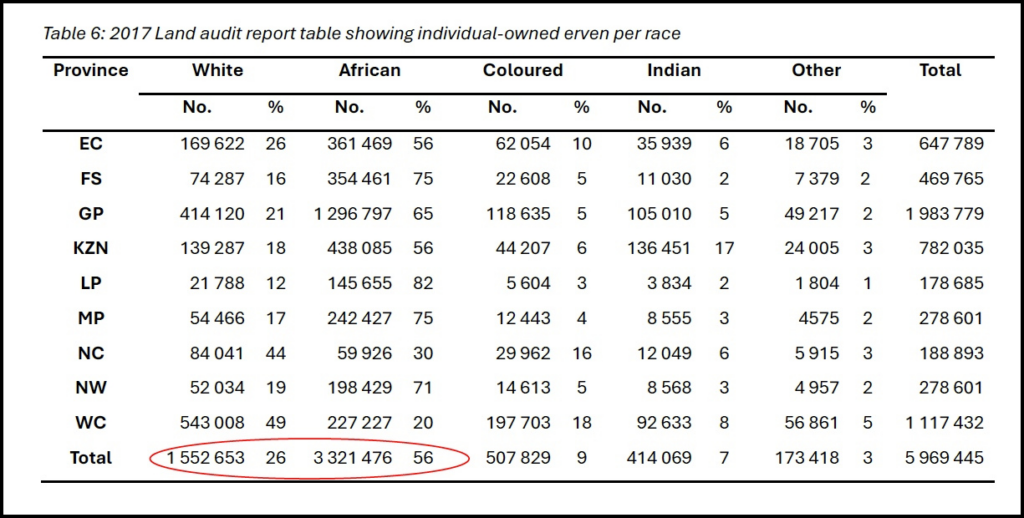
The 2017 Land Audit itself found that individual black South Africans owned 56% of urban erven, compared with 26% owned by white South Africans.
The bigger challenge
While ownership patterns have changed over time, AfriForum said many of the greatest obstacles to successful land reform lie in implementation rather than redistribution targets.
The government shifted away from the market-based willing-buyer, willing-seller approach towards the Proactive Land Acquisition Strategy.
Under this strategy, the state acquires land and leases it to beneficiaries rather than transferring full ownership through title deeds.
Investigations by the Special Investigating Unit have uncovered widespread fraud, corruption, and maladministration within land restitution programmes. Hundreds of state-owned farms are reportedly abandoned or underutilised.
Meanwhile, many Communal Property Associations established to manage redistributed land reportedly remain dysfunctional, with only a small proportion fully compliant.
These shortcomings have undermined the effectiveness of land reform despite significant amounts of land already having been transferred.
“Politicians must stop injecting misinformation, half-truths, and outright lies into the land debate for political gain – such as the falsehood that white South Africans own 72% of the land in the country,” AfriForum said.
“This does not facilitate solutions. It only misinforms people, fuels division and conflict, and muddies the waters. It is shameful and should not be tolerated.”
Rather than relying on disputed statistics or pursuing increasingly radical policy proposals, AfriForum argued that the focus should be on improving the existing restitution system.
This can be done through better governance, stronger post-settlement support for beneficiaries, agricultural training and the eradication of corruption.
A successful land reform programme ultimately depends not only on transferring land but also on ensuring that new landowners have the ownership rights, support, and resources needed to use it productively.
At the same time, the organisation said confidence must be maintained in South Africa’s constitutional protection of property rights.
“The issue of land remains complex and multi-dimensional,” AfriForum’s Head of Public Relations, Ernst van Zyl, said during a recent conference.
“It is in the interest of honest public debate, sound policymaking and improved race relations that AfriForum calls for a more balanced, evidence-based and less racialised discourse surrounding land and property rights in South Africa.”
 Loading ...





Comments