The government could have paved 5,000 kilometres of roads in two years with money it chose not to spend


South Africa’s government has significantly underspent its public infrastructure budget over the past two years, wasting the opportunity to build 5,000 km worth of roads.
This was revealed in a recent presentation by Infrastructure South Africa (ISA) to the Select Committee on Public Infrastructure and the Minister in the Presidency.
In this presentation, ISA explained that South Africa has a massive infrastructure investment gap, based on spending targets outlined in the National Development Plan (NDP).
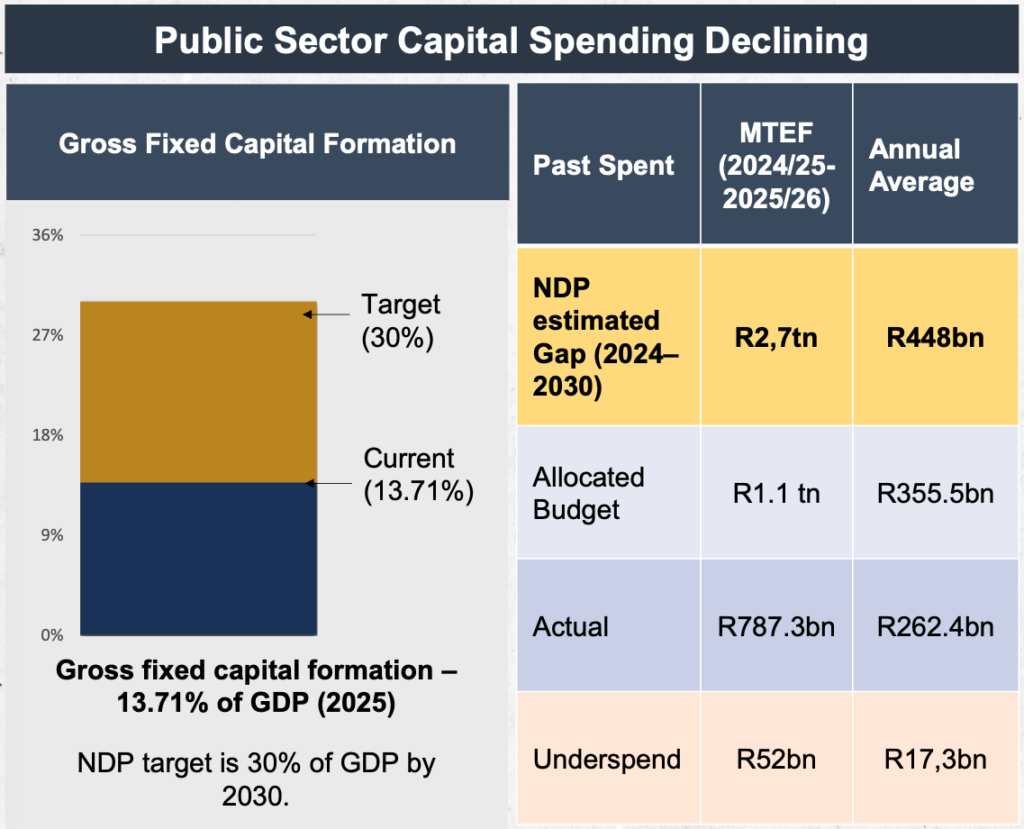
In the NDP, the government committed to increasing infrastructure spending – also known as gross fixed capital formation (GFCF) – to 30% of GDP by 2030. In 2025, it was only 13.71% of GDP.
This is not only less than half of the NDP target but also far below the levels seen in South Africa’s emerging-market peers.
For example, Brazil was at 17% of GDP in 2024, India at 30%, China at 40%, Mexico at 24%, Chile at 23%, and Saudi Arabia at 29%.
It should also be noted that South Africa’s current GFCF level of 13.71% of GDP in 2025 marks a decrease from the previous year and a significant decline from 18% a decade ago.
Concerningly, South Africa’s failure to increase its infrastructure spending and keep pace with its emerging-market peers is not necessarily due to a lack of capital.
According to ISA’s presentation, South Africa had allocated a budget of R1.1 trillion for this exact purpose for the 2024/25 to 2025/26 financial years.
However, the government underspent this allocated budget by R52 billion.
ISA said this represents a significant opportunity cost, as that R52 billion could have been used to pave 5,000 kilometres of low-volume rural roads in South Africa.
Now, South Africa needs to spend R1.6 trillion within the next four years to reach the NDP target by 2030.
South Africa’s weak link
The consequences of the government’s underspending on infrastructure go far beyond its inability to meet the NDP goals.
As ISA explained, capital formation is a critical enabler of economic growth and development, employment opportunities, and national competitiveness.
In other words, South Africa is missing out on faster GDP growth, lower unemployment, and global opportunities by underspending on infrastructure.
Melville Douglas’ chief investment officer, Bernard Drotschie, previously estimated that substantially higher fixed investment could more than triple the country’s current economic growth rate.
To make matters worse, this is not a new problem for South Africa. In the NDP, the government noted that infrastructure spending had fallen from an average of 30% of GDP in the 1980s to 16% in the early 2000s.
“In effect, South Africa has missed a generation of capital investment in roads, rail, ports, electricity, water, sanitation, public transport, and housing,” the NDP read.
“To grow faster and in a more inclusive manner, the country needs a higher level of capital spending.”
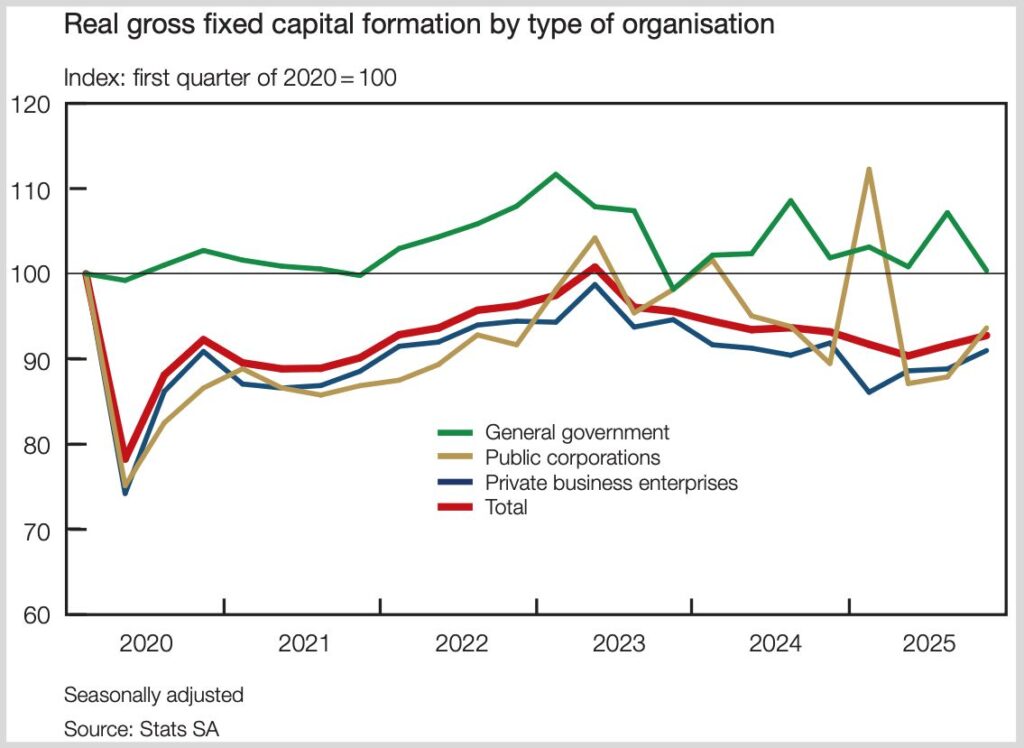
So far, South Africa has failed to act on this problem identified in the NDP, continuing its trajectory of declining GFCF.
Now, the public sector can scarcely afford to meaningfully increase its infrastructure spending, due to the poor health of the state’s fiscus.
The private sector, which has the capital needed to significantly boost fixed investment, is not confident enough in South Africa’s economy to take its cash off the sidelines and invest in projects that could take decades to complete.
However, there are plans in the works to turn this situation around, with President Cyril Ramaphosa promising to “turn South Africa into a construction site”.
To do so, Public Works Minister Dean Macpherson has said he would focus on expanding and capacitating ISA to ensure the efficient and successful execution of construction projects.
The Public Works Department will also collaborate with other government departments to improve the long-term planning and execution of infrastructure investment in South Africa.
In addition, Finance Minister Enoch Godongwana and the National Treasury have allocated R1 trillion to public-sector infrastructure spending over the medium term.




Comments