Unique South African product headed to the world’s largest market with no tariffs


China’s implementation of a zero-tariff policy on imports from African countries is set to benefit South Africa’s Rooibos tea market.
China is the world’s largest tea-consuming market, presenting a strong opportunity for Rooibos, a uniquely South African tea, to expand its global presence.
The South African Rooibos Council (SARC) welcomed this move in a press statement released on Wednesday, 6 May, describing it as a “significant opportunity”.
This move comes after China already reduced its tariff rate for Rooibos tea in 2024, from a range of 15% to 30% to only 6%.
At the time, the Department of Trade, Industry, and Competition celebrated this as a positive development for the local Rooibos market.
“This decision will enable more South African Rooibos tea to be available to Chinese tea drinkers, creating more jobs in South Africa,” then Trade Minister Ebrahim Patel said.
Since 2020, Japan has consistently been the top export destination for Rooibos. During the late 2010s, the tea experienced a boom in popularity in Japan.
Now that South Africa has tariff-free access to the Chinese market, the Rooibos industry is set to expand its global presence even further.
“This development enhances the competitiveness of Rooibos by removing cost barriers and improving market access for local producers and exporters,” SARC director Dawie de Villiers said.
“It also creates an opportunity to introduce Rooibos to a broader audience, positioning it alongside established tea varieties while highlighting its unique taste profile and natural health benefits.”
SARC said this milestone will support industry growth, stimulate export volumes and contribute to job creation across the value chain.
“The SARC looks forward to supporting and collaborating with stakeholders to build awareness and demand for Rooibos in China, unlocking the significant untapped potential in this key market and delivering long-term value for the sector and the South African economy,” it said.
In 2024, SARC reported that approximately 20,000 tonnes of Rooibos are produced in South Africa every year, generating employment for over 5,000 people.
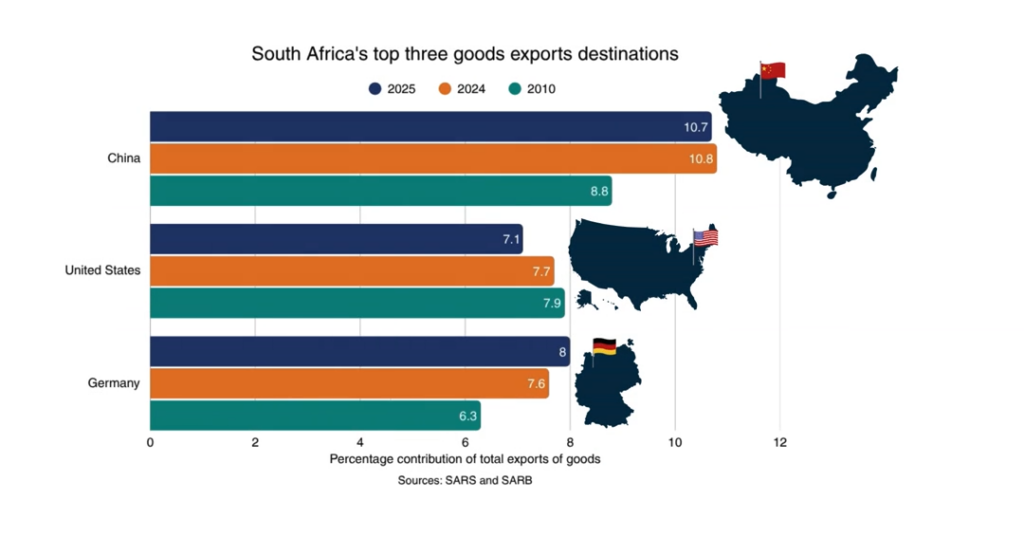
Exports to China grow
China has steadily grown to become South Africa’s largest trading partner, accounting for 10.7% of South Africa’s goods exports in 2025.
Aside from Rooibos, various other South African sectors are also set to benefit from tariff-free access to the Chinese market.
Other trade deals will also serve to strengthen trade relations, with Agriculture Minister John Steenhuisen having signed a landmark deal with China in 2025 for fruit exports.
In October 2025, Steenhuisen signed a stone fruit agreement that opened the Chinese market for the first time to five types of South African stone fruit.
This includes apricots, peaches, nectarines, plums, and prunes, marking the first time China has negotiated access for multiple stone fruit types from a single country under one deal.
At the time the deal was sealed, Steenhuisen described it as a “major breakthrough” for South African fruit producers and exporters, later saying it would transform the local deciduous fruit industry.
“Over the next decade, this protocol could create a market that will support roughly 350 new direct jobs on farms and in packhouses, and close to 600 new jobs overall,” he said.
The strong trade relationship between South Africa and China is only set to deepen in the coming years as South Africa’s relationship with the United States, its third-largest trading partner, continues to deteriorate.
According to the Reserve Bank, South Africa has also expanded its trade with other markets in light of increased US tariffs announced in 2025, including Belgium and Zimbabwe.
The United States fell to third place in South Africa’s rankings of top goods export destinations in 2025, receiving 7.1% of South Africa’s exports – down from 7.7% in 2024 and 7.9% in 2010.
The Reserve Bank explained that this shift is partly due to higher US trade tariffs introduced in 2025, which hit South Africa’s value-added exports the hardest.
“In the final quarter of 2025, the value of South Africa’s exports to the US had been knocked significantly – growing by only 2.9% compared to 11.8% in the third quarter,” the bank said.






Comments