One of South Africa’s most important companies has a R3.58 billion problem


In the 2024/25 financial year, Transnet recorded R3.16 billion in irregular expenditure and R42 million in fruitless and wasteful expenditure.
The vast majority of Transnet’s fruitless and wasteful expenditure in 2024/25 can be attributed to the interest the rail and ports utility had to pay municipalities for debt owed to them, which constituted over R26 million.
While the utility noted some improvements in its financial health over the past year, wasteful expenditure like this, combined with other factors, still saw Transnet post a R1.9 billion net loss for 2024/25.
This was revealed in Transnet’s most recent presentation to the Standing Committee on Public Accounts on Tuesday, 24 March.
Transnet reported positive progress in the implementation of its reform efforts, saying several policies are driving change within the country’s logistics system.
“These policies have an impact on Transnet and the broader land transport and logistics market,” the utility said in its presentation.
Some of these policies include the introduction of new players to the logistics sector, with significant private investment seen in South Africa’s rail and port industries.
However, from a financial perspective, Transnet remains in the red, having posted a R1.9 billion net loss for 2024/25. Notably, this is a 74% improvement from the previous year.
One reason for Transnet’s still significant loss is the 367% increase it recorded in fruitless and wasteful expenditure for the 2024/25 financial year.
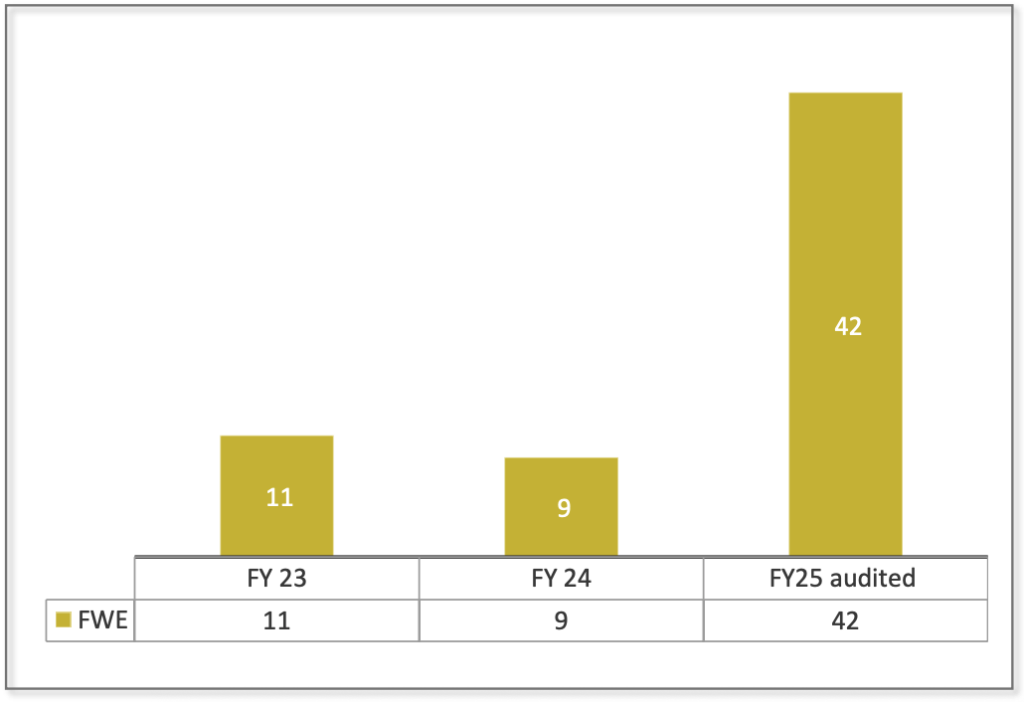
Transnet attributed this jump – from R9 million in 2023/24 to R42 million in 2024/25 – to municipal interest on late invoice payments and SAP maintenance fees for unutilised licenses.
These two factors alone accounted for R35.35 million of Transnet’s wasteful expenditure in 2024/25, with R26.25 million spent on municipal interest and R9.11 million on support and maintenance fees for unused licenses.
It should be noted that the utility has requested the municipalities to waive the charge.
The rest of Transnet’s fruitless and wasteful expenditure consisted of far smaller amounts spent on items like delayed or cancelled projects, uneconomical use of resources, and the purchase of incorrect fluid couplings.
The graph below shows the increase in Transnet’s fruitless and wasteful expenditure over the past three financial years.
Irregular, fruitless, and wasteful
In its presentation, Transnet explained that irregular, fruitless and wasteful expenditure (IFWE) results mainly from non-compliance with procurement processes, not deliberate financial loss.
It should be noted that the R42 million figure above refers specifically to fruitless and wasteful expenditure, with Transnet also having recorded an additional R3.16 billion in irregular spending.
Some of the key causes it lists are –
- Non-compliance with internal supply chain management policies and regulatory requirements
- Contract expansions exceeding approved thresholds
- Inadequate justification and documentation for deviations from competitive bidding
- Weak contract management and insufficient supplier performance monitoring
- Procurement delays that disrupt operations
The Auditor-General (AG) of South Africa, Tsakani Maluleke, has highlighted Transnet’s IFWE as a concern in previous reports, with the utility now working on closing or resolving some of the AG’s findings.
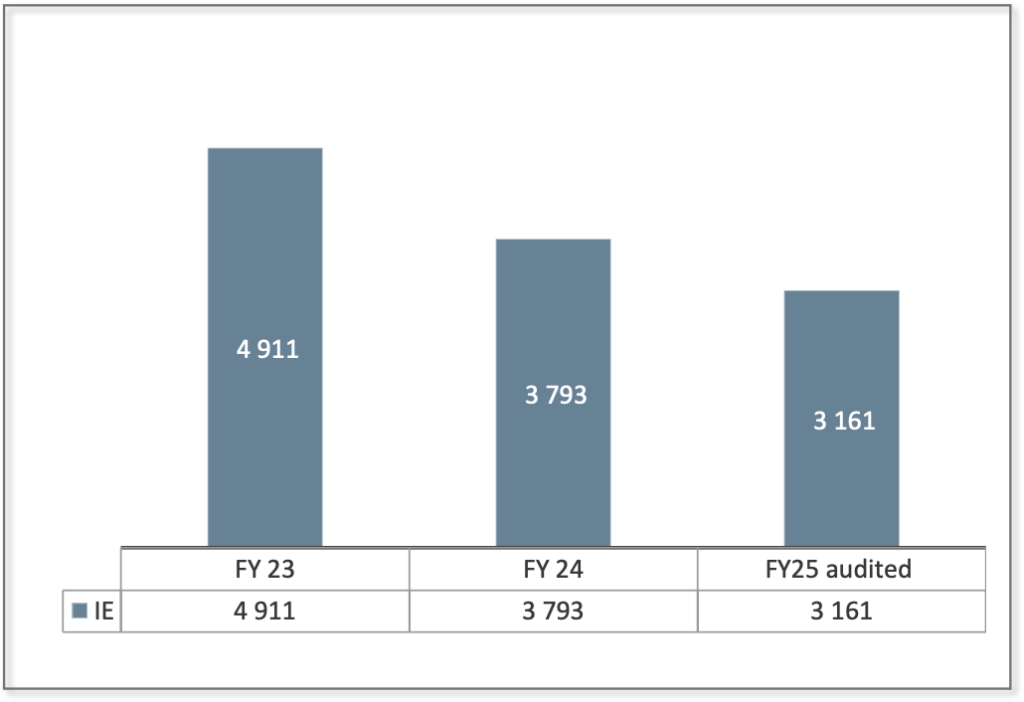
Positively, Transnet’s R3.16 billion irregular expenditure in 2024/25 marks a 16.66% improvement from the previous year.
This decrease has been attributed to enhanced procurement controls, proactive reviews of high-value tenders, and continuous training of procurement personnel.
“The implementation of the remedial plan resulted in significant improvements in the internal control processes and the supply chain control environment,” the utility said.
Looking forward, and to address the AG’s concerns, Transnet will focus on introducing long-term structural interventions, including supplier risk management frameworks and multi-year contracting strategies.
In addition, the utility said technical disputes where interpretations differ between management and auditors, such as procurement rationale, remain a concern and need to be addressed.
More work is also needed to address process-dependent delays, particularly where closure relies on group-wide programmes, cross-functional alignment, or the sequencing of the evidence review cycle.
Transnet’s decrease in irregular spending over the past three financial years can be seen in the graph below.





Comments