South Africa’s richest city missing R70 billion


South Africa’s economic hub of Johannesburg is facing a serious revenue crunch, with households, businesses, and state entities owing it R71.9 billion.
This comes amid the passage of the city’s R90 billion budget after a week’s delay caused by concerns about insufficient time for consideration.
The budget notably slashed the city’s spending on key utilities, despite declining service delivery. City Power’s spending has been cut by R767 million, Joburg Water’s by R575 million, and Pikitup’s by R98.5 million.
This is partly due to the inability of these entities to collect sufficient revenue, with nonpayment and service interruptions negatively impacting sales.
The failure of these entities to collect sufficient revenue is the least of the city’s financial problems, with it being a drop in the ocean compared to historic nonpayment.
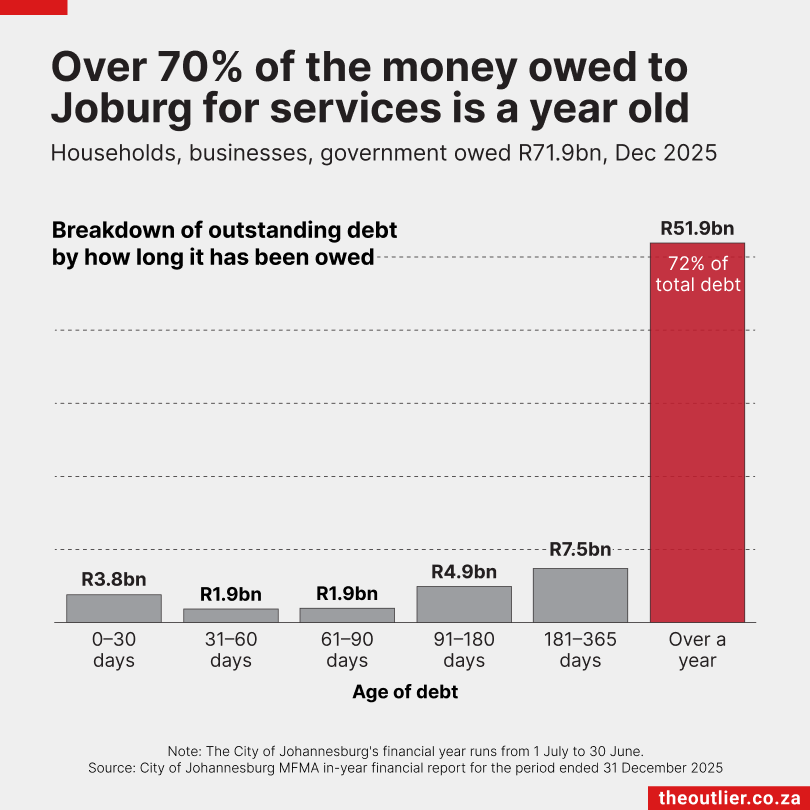
Data from The Outlier shows that by December 2025, residents, businesses, and state entities owed the City of Johannesburg R71.9 billion in unpaid bills.
Worryingly, over 70% of this is more than a year old, indicating that this revenue may never be recovered at all, regardless of any intervention from the municipality.
The city is also failing to meet its own collection targets. It billed R37.2 billion between July and December 2025, but only collected R31.9 billion for rates, water, electricity, and refuse removal.
To address the crisis, the city launched a fourth debt relief phase in November 2025, offering a 50% write-off to homeowners with properties valued below R2.5 million and businesses with turnover under R3 million, provided they repay the remaining 50%.
But past programmes offer little encouragement. Three previous phases recovered just over R500 million combined, less than 1% of the current debt.
In December 2025, disconnection drives for electricity and water recovered only R140 million against R4.5 billion in identified arrears, casting doubt on whether this latest effort will succeed.
An increasing concern for the city, financially, is the rise in service delivery failures in both the electricity and water sectors.
The non-delivery of services due to failing infrastructure means that there is no product to sell in some cases, resulting in declining revenue and increased investment from households and businesses in alternatives.
With regard to electricity revenue, this has the potential to result in a death spiral, whereby revenue keeps declining, resulting in less money for infrastructure maintenance, increasing supply disruptions and the need for alternatives to City Power.
The breakdown of outstanding debt owed to the City of Johannesburg at the end of 2025 can be seen in the graph below, courtesy of The Outlier.
Self-inflicted disaster
This is largely a self-inflicted disaster for South Africa’s richest city, with its history of underinvestment in infrastructure and service delivery coming back to haunt it.
Investment in Johannesburg’s infrastructure has largely taken a backseat in favour of increased spending in the form of salaries.
In the last financial year, the city only spent 26% of its capital budget, despite it being plagued by water shortages and sporadic electricity outages.
This trend is set to continue, with the City of Johannesburg sealing a R10.3 billion wage agreement with the South African Municipal Workers Union.
Opposition parties argued that implementing this wage deal may collapse the city financially, as it comes at a time when the city is on the financial brink.
The main opposition party, the DA, said it would not support a budget that places employee costs above service delivery, saying that the ANC had a worrying disregard for the seriousness of Joburg’s financial situation.
The city is in talks with the National Treasury to address its mounting financial troubles, despite Joburg having the largest budget of any municipality in the country.
Finance Minister Enoch Godongwana said the national government cannot remain a spectator and will have to step in at some point to halt Joburg’s collapse.
President Cyril Ramaphosa lambasted Mayor Dada Morero ahead of the G20 Summit towards the end of 2025, saying that the mayor’s city looked filthy.
“What we are going through in Gauteng is self-inflicted pain by municipalities, where they did not do what is necessary to adequately maintain their infrastructure,” Water Minister Pemmy Majodina said.
Johannesburg needs around R26 billion to halt the collapse of its water infrastructure alone, and it needs billions more to upgrade the system to cope with its growing population.
This R26 billion simply covers Johannesburg catching up in infrastructure repair and maintenance – not expanding to accommodate a growing population.
Joburg Water, owned by the municipality, currently spends around R1.2 billion on its water infrastructure. This will have to be ramped up significantly.
The city estimates that it needs R221 billion to address its maintenance backlog and deliver overdue infrastructure upgrades.
The city has been governed by a series of fragile coalitions since the ANC lost its outright majority in 2016, with no party able to secure control on its own. The ANC currently leads a coalition government in Johannesburg.


Comments