Two men cost South Africa R4.5 trillion and millions of jobs


South Africa has gone from a country with strong economic growth and job creation to one where corruption and mismanagement have destroyed opportunities.
The last 17 years, when Presidents Jacob Zuma and Cyril Ramaphosa were in charge, were marked by poor economic growth and high unemployment.
This was part of the message from former President Thabo Mbeki during his address at the 30th Anniversary Gala Dinner of the Nelson Mandela Children’s Fund.
He cited South African Institute of Race Relations CEO Dr John Endres about the country’s progress since democratic elections.
The period since the 1994 transition in South Africa can be divided into two phases – from 1994 to 2007, and from 2008 to today.
South Africa’s first phase, from 1994 to 2007, was marked by considerable progress across a range of indicators.
The country’s gross domestic product (GDP) grew at an average rate of 3.6%, and the number of employed people increased from 8 million to 14 million.
The average GDP per capita, the most used measure of living standards, increased by almost 40%, from R55,000 to R76,000 in real terms.
Gross fixed capital formation as a share of GDP rose during the first phase, reaching 21.6% in 2008.
The period also saw big improvements in the basic living standards of millions of people, which included access to housing, electricity, and water.
South Africa also rolled out the most expansive welfare programmes of any emerging market, helping millions of people.
“No emerging market has ever matched the scale of the service delivery successes recorded in South Africa’s first decade and a bit after 1994,” political analyst Frans Cronje said.
He added that if South Africa’s economic growth had continued at the rate between 2004 and 2007, the unemployment rate would be 10% instead of over 30%.
South Africa’s second era – from 2008 to today
Endres said South Africa’s second age started around 2008, and the country is now at the tail end of it.
For the period 2008 to 2022, the average GDP growth rate was a lacklustre 1.2%, and the number of people with jobs increased by barely a million.
The population grew by 10 million over the same period, which saw the GDP per capita decline by R1,600. This means people became poorer in real terms.
The unemployment rate has crept up over the years and now sits at an astonishing 32.9%, which is a national crisis.
Gross fixed capital formation as a share of GDP dropped from 21.6% in 2008 to as low as 13.1% in 2022.
Mbeki highlighted that the hallmark of this period was State Capture, which was laid bare by the Zondo Commission.
He explained that this era caused enormous damage to the country as a whole and inflicted much suffering on millions of South Africans.
Mbeki laid the blame for this devastation on “a counter-revolutionary intervention which began some years ago”.
“I believe that this situation makes it incumbent on our people as a whole to act together to address the harm caused by the counter-revolution,” he said.
Two men oversaw South Africa’s decline
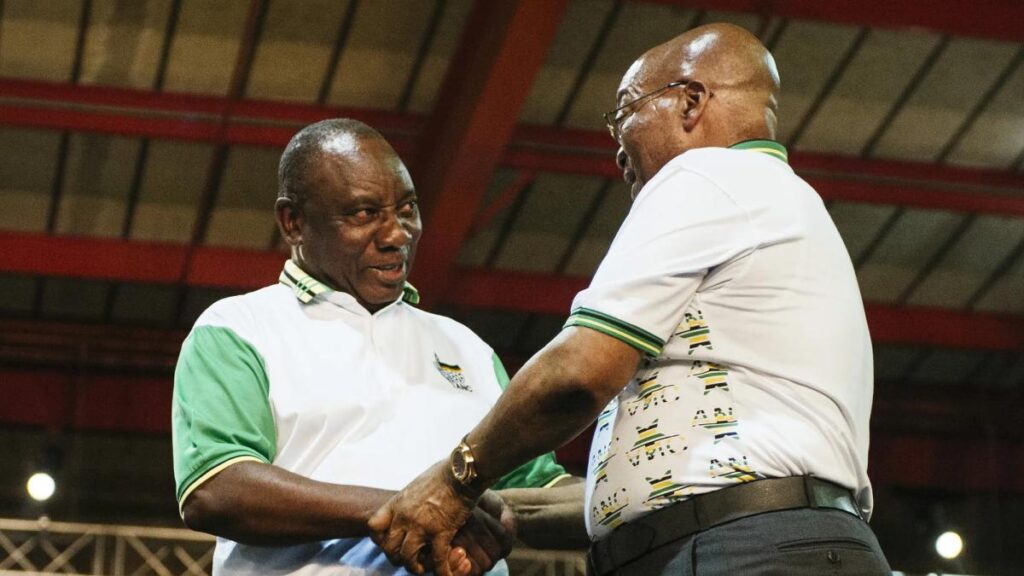
Mbeki said the big question is why there are such large performance differences between the two ages since 1994.
He cited an article by Roy Havemann published by the prestigious Stellenbosch University Bureau for Economic Research (BER).
“South Africa’s economic growth slowed significantly from 2010. The most significant change was a change in the country’s president,” it said.
There are numerous other studies which qualified the damage done to the South African economy over the last seventeen years.
Investec Wealth & Investment International investment strategist Osagyefo Mazwai explained that South Africa has had 15 years of lost growth.
Investec compared nominal GDP with what it would have been had the South African economy been growing at 4.5% per year, in line with emerging market peers.
“Had the economy grown at 4.5%, our nominal GDP would have been R12 trillion in 2024, compared with the actual number of R7.5 trillion,” Mazwai said.
This means that the local economy could have been R4.5 trillion larger if economic growth had not been hampered by mismanagement and corruption.
South Africa would have also added at least 6 million jobs, as was the case in the previous era, which would have significantly lowered unemployment.
Well-known investment strategist Magnus Heystek described the mismanagement of the economy over the past 15 years as a crime against millions of people.
This is an opinion piece.



Comments