Small South African town very important for the United States


The importance of Simon’s Town as a major naval base on a vital global shipping route has surged since the US-Israeli strikes on Iran on 28 February, as shipping is redirected around the Cape of Good Hope.
Simon’s Town has always been on the geopolitical radar of major powers as it is one of the three choke points that anchor the Indo-Pacific, a region that accounts for 60% of global GDP.
While its importance was diminished with the opening of the Suez Canal in 1869, the relative stability of South Africa and the free flow of trade around the Cape have ensured the town remains of critical importance in the 21st century.
This has been made evident with the effective closure of the Strait of Hormuz by Iran as part of its response to US-Israeli strikes.
The closure has effectively halted 20% of global oil supply and ensured the world’s largest producer of liquefied natural gas, Qatar, cannot get its product to market.
Apart from this, the closure of the Strait of Hormuz has forced shipping, even container ships, to be redirected around the Cape of Good Hope.
This is because insurers are refusing to insure ships that seek to travel through the Strait of Hormuz at the end of the Persian Gulf or the Bab al-Mandab Strait at the entrance to the Red Sea.
As a result, most commercial vessels will not traverse those stretches of water, forcing them to go around the Cape.
So far, only ships belonging to Iran’s so-called “dark fleet” of oil tankers have been able to travel through the Strait of Hormuz.
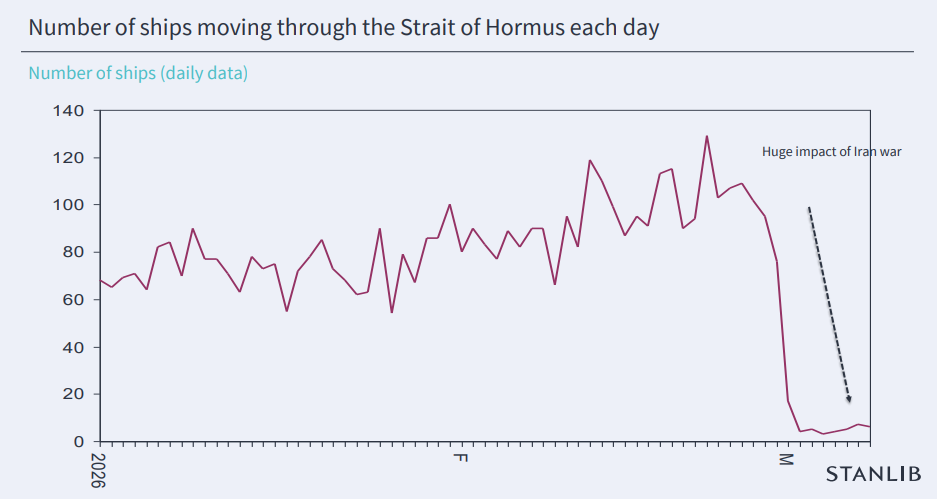
The decline in shipping through the region was almost instantaneous. Stanlib chief economist Kevin Lings noted that within a week after the first US-Israeli strike, the number of ships travelling through the Strait of Hormuz fell from 137 ships to just two.
As insurers are increasingly hesitant to insure ships travelling through the region, cargo shipping has also shifted to travel around the Cape of Good Hope to get from the Indo-Pacific to Europe, the United States, or South America.
Iranian-backed Houthis have been a consistent disruptor to commercial shipping through the Bab el-Mandab Strait, which inhibits travel through the Red Sea to the Suez Canal.
Insurers have also been unwilling to cover ships going this route.
The upshot has been a surge in shipping around South Africa’s coastline, with the port of Cape Town flagging a 112% increase in vessels passing along the trade route.
Two of the world’s largest shipping companies, Maersk and Hapag-Lloyd, have rerouted all their vessels around the Cape of Good Hope to avoid the Middle East region.
The route around the Cape adds between 10 and 14 days to the journey of a ship going to Europe from the Indo-Pacific, raising fuel costs. However, crucially, the diversion saves on insurance costs.
This surge in shipping around the Cape has raised the profile of Simon’s Town once again, with it being a major naval base that sits at the choke point along the trade route.
The town’s importance makes it an increasingly vital strategic point that major geopolitical powers, including the United States and China, seek to influence and control.
The graph below, courtesy of Lings, shows the sharp decline in the number of ships transiting the Strait of Hormuz since the conflict started.
The United States has its eye on Simon’s Town
First opened as a naval anchorage by the Dutch in 1741 to serve as a refuge for merchant ships and whalers, Simon’s Town quickly became a key focal point of maritime trade.
The port’s key advantages lie in its position along the route around Africa and its secluded location, which protects it from the notorious storms at the Cape.
Simon’s Town saw its importance skyrocket as South Africa became part of the British Empire, serving as a vital link between the colonial metropole and the Indian crown jewel.
Through investment from the British, the port became the preeminent naval base in the South Atlantic, with effective control over all traffic flowing from East to West or vice versa.
In 1957, the facilities were formally transferred to South Africa, which was on the journey to becoming a republic and leaving the British Empire. It formally became an independent republic in 1961.
The port’s importance only grew with the advent of modern surveillance technology, with the port at Simon’s Town considerably expanded in the 1970s.
An adjacent surveillance and communications centre was opened in 1973 and can track nearly all ocean traffic in the South Atlantic and South Indian Oceans.
This ability and the location of the naval base have made Simon’s Town geopolitically vital, making it one of the key reasons American interest in South Africa has piqued in recent years.
Political analyst Frans Cronje has long pointed out the importance of Simon’s Town and has urged South Africa’s government to use it as a basis to secure a trade deal with America, along with billions of dollars in investment.
“The Americans have immense strategic interests here. I have aired it previously that Simon’s Town is one of three points that anchors control of the Indo-Pacific and provides a backdoor to the Atlantic Ocean,” Cronje said at the BizNews Investments Conference in late 2025.
“The Americans have fallen behind China in terms of fixed investment in Africa, and the continent is important. It now has more cities of a million inhabitants or more than Europe and America combined.”
In this case, South Africa is particularly important due to its influence as the most developed economy in Africa and its democratic institutions.
“The Americans understand that Simon’s Town is one of the three points that anchor control of the Indo-Pacific,” Cronje said.
“They are in some trouble on the other points, such as the Solomon Islands and the Bab al-Mandab Strait, so Simon’s Town has suddenly become very important to them.”
Simon’s Town also has access to the Atlantic Ocean, which is becoming increasingly important due to oil discoveries off the coast of Namibia and the rise of the South American economy.
“It takes rudimentary diplomatic skill to take America’s fixed investment interest and South Africa’s strategic importance to form a new bilateral treaty,” Cronje said.
A new bilateral trade treaty with the United States could meaningfully increase fixed investment in South Africa and boost economic growth.
“I think it is a vast opportunity for this government that they can take advantage of if they can adopt the correct strategy,” he said.






Comments