One man warned South Africa about the water crisis 20 years ago


Dr Anthony Turton warned 20 years ago that South Africa was facing a water crisis. Instead of being praised for his foresight, he was suspended.
At the time, Turton was a fellow at the Council for Scientific and Industrial Research (CSIR), one of South Africa’s foremost scientific institutions.
Part of his job at the CSIR was to be the media spokesperson on water, for which he was formally trained.
“The scientific community was in crisis due to funding cuts and a change of government a decade earlier,” Turton said.
He and his team came up with the idea of messaging “science in the service of society” as part of a media strategy.
Turton explained that the core problem was that the South African government was not listening to scientists.
“We invited the top scientists to help us develop a new model of governance in which science could still be relevant in a fledgling democracy,” he said.
They published a book entitled “Governance as a Trialogue: Government – Society – Science in Transition”.
“This taught us that if the government will not listen to scientists, then maybe they will listen to society that votes them into power,” he said.
“Therefore, the role of science is to inform the public debate on matters that affect them, so that they can tell the government what they want in the next election.”
He said the empirical data available to the aquatic sciences community showed that South Africa was heading for a disaster in the water sector.
However, the government refused to listen. “The sad reality is that this was a predictable disaster we knew of in 2005,” he said.
“The water disaster is now upon us, almost exactly as we predicted. All of this could have been avoided.”
Dr. Anthony Turton published a watershed paper
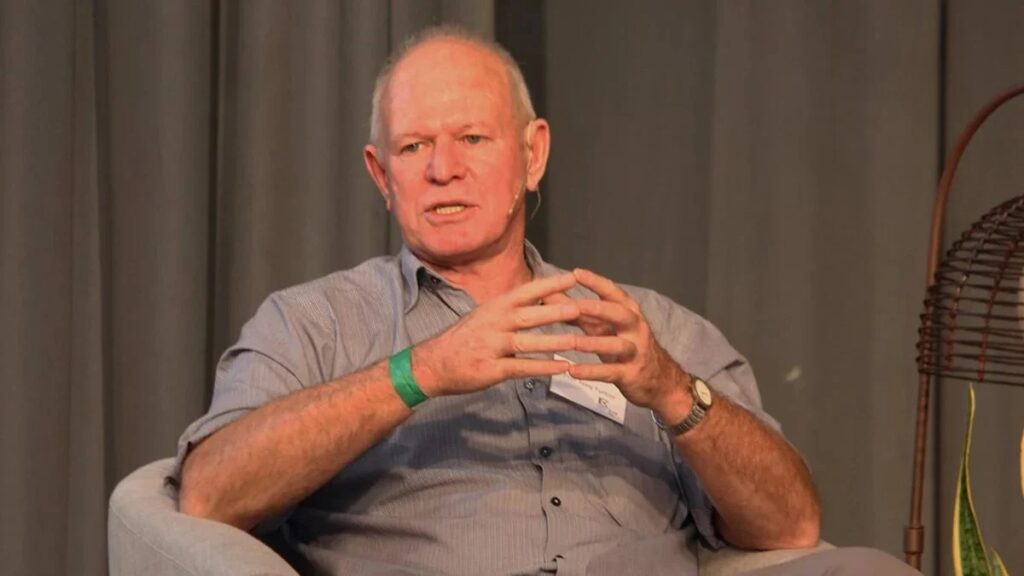
In November 2008, Turton published a paper, “Three Strategic Water Quality Challenges that Decision-Makers Need to Know About and How the CSIR Should Respond.”
In this paper, he warned that South Africa was facing a critical water crisis characterized by a growing ingenuity gap.
He argues that while demand for complex technological solutions was growing exponentially, the country’s capacity to develop them was declining.
South Africa has already allocated approximately 98% of its national water resources, and it effectively has no more surplus water.
Because there is no surplus water available for dilution, all pollutants and effluent must be treated to much higher standards before discharge.
Unlike most global cities located on major rivers or coasts, South Africa’s major economic hubs, such as Johannesburg and Pretoria, are situated on watershed divides.
Because these cities are at the top of the watershed, their treated and untreated effluent flows downstream, degrading water quality.
Another problem was that South Africa was struggling with its national science, engineering, and technology (SET) capacity.
Turton warns that the country was flying blind because it was losing the experts needed to solve uniquely South African water problems.
He warned that if the government fails to deliver essential services, such as clean water, there is a high risk of social unrest.
He added that unresolved water constraints could lead to “anarchy and chaos” as social instability grows.
Turton urged the government to avert the water crisis before it happens. The alternative was to deal with the fallout, as was the case with load-shedding.
Instead of taking his threat seriously, his employer, the Council for Scientific and Industrial Research (CSIR), suspended him.
The council executive of the CSIR charged the water scientist with insubordination and bringing the CSIR into disrepute.






Comments