Major threat to South Africa it has no control over


South Africa is facing a significant threat from the increasingly tense relationship between the United States and its major trading partners, China and the European Union.
While this tension does not directly impact South Africa, it will feel the consequences of a potential decline in global trade and growth.
As a small, highly open economy, the country is highly vulnerable to external shocks. This is exacerbated by the fact that it is heavily reliant on trade with those three economies.
This is feedback from Symmetry chief investment strategist Izak Odendaal, who outlined how South Africa has benefited from increased uncertainty in global markets and how it could face severe negative consequences in the long run.
Odendaal explained that South Africa has been one of the biggest beneficiaries of elevated geopolitical uncertainty, given its status as a significant exporter of precious metals.
Investors have been spooked by US President Donald Trump’s attempts to reorder the global trade system, resulting in heightened volatility and a search for safe-haven assets.
Historically, investors have turned to US Treasury bills and other dollar-denominated assets for safety. However, this time around, they have looked elsewhere due to Trump’s unpredictability and the deteriorating financial health of the American government.
Many have turned to precious metals, particularly gold, for safety and diversification out of financial assets that have experienced large swings in value.
For South Africa, this is good news and some bad news, Odendaal explained, with the country benefiting from elevated precious metals prices but also suffering from a looming trade war between its largest trading partners.
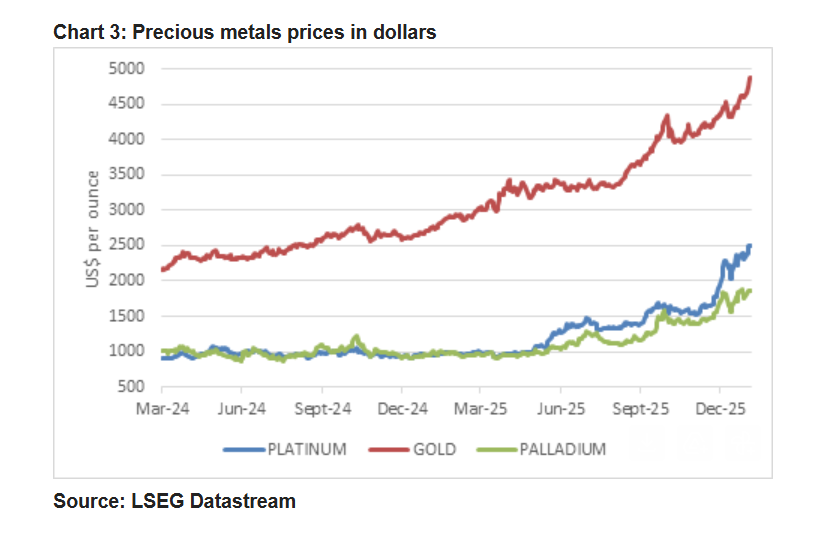
The biggest beneficiary of this geopolitical uncertainty has been gold and other precious metals. Gold recently hit a new record and moved above $5,000 per ounce, and it is only continuing to climb.
This has also pushed the prices of platinum group metals higher, a major boost for South Africa’s currency, financial markets, and ultimately its fiscus.
However, South Africa has a history of being unable to translate higher prices into higher output and employment, as much of the additional tax revenue goes towards consumption rather than investment.
The bad news is that, as a small open economy, the last thing South Africa needs is for trade barriers to go up everywhere while large countries fight for dominance, Odendaal said.
Even when the trade war is between Europeans and Americans, or Americans and the Chinese, smaller countries will suffer collateral damage.
Smaller countries can also be bullied into detrimental concessions or forced to choose sides.
Out of South Africa’s control
Resolving this threat is largely out of South Africa’s control, as it cannot foster better trading relations between the United States, Europe and China.
A global economic downturn resulting from these deteriorating relations could scupper any potential recovery in the country, given its vulnerability to external shocks.
While South Africa may benefit in the short term from elevated gold and platinum prices, over the long run, the impact on the local economy could be severe.
However, it can minimise the impact of any trade war on its economy by focusing on getting its house in order and improving local fundamentals.
The country can also implement its foreign policy objectives more skilfully and avoid unnecessarily antagonising any of its trading partners.
South Africa can also leverage some of its strategic advantages to benefit further from the situation. Its leverage of key mineral resources, for example, can help secure a trade deal with the United States.
The country can also look to win investment from both the United States and China, which are in desperate need of the resources South Africa has in abundance.
Smaller countries can maintain sovereignty and look after their domestic interests without completely rolling over before the Great Powers or needlessly antagonising them, Odendaal said.
However, this will require skilful implementation of foreign policy. The recent debacle over Iran’s participation in naval exercises off the Cape coast is an unfortunate reminder of how South African diplomacy often falls short.
Most importantly, the grass is greenest where it is watered, Odendaal said, adding that South Africa has the potential to make its own economic destiny.
If South Africa can create a business-friendly climate, investors will want to be here irrespective of the geopolitical noise, he said.
Geography also still matters, even in this high-tech age. Deepening trade integration in South Africa’s own neighbourhood, the African continent, should therefore remain a priority.



Comments