Government failures bleeding South Africa dry


Business Leadership South Africa CEO Busi Mavuso has sounded the alarm about the country’s illicit economy, which she said is killing local jobs.
This comes after cigarette giant British American Tobacco (BAT) announced plans to shutter a factory in South Africa due to the continued growth and incredible scale of illicit trade in the country.
Closing this factory will result in around 230 direct jobs being lost, with ripple effects potentially affecting 35,000 jobs across the value chain.
In her latest CEO newsletter, Mavuso attributed South Africa’s notable rise in illicit tobacco trade to policy failures and enforcement gaps, which she said are destroying legitimate manufacturing.
South Africa has seen a surge in illicit trade, particularly regarding cigarettes, over the past few years, to the point where black market cigarettes now constitute around 75% of the market.
Mavuso attributed this surge to policy missteps during the Covid-19 pandemic, when the government’s lockdown regulations banned the sale of cigarettes.
This saw legitimate manufacturers and sellers suffer, while the illicit market flourished. However, the black market growth did not slow down post-pandemic.
“Subsequent steep increases in excise duties on legal products created even wider price gaps that illicit operators exploited,” Mavuso explained.
“Illegal boxes now sell for less than the R26.22 in combined excise and VAT that should be collected, circumventing health warnings and age restrictions while costing the fiscus roughly R30 billion annually in lost tax revenue.”
This problem has also been flagged by the government, with Finance Minister Enoch Godongwana addressing it in his Medium-Term Budget Policy Statement in November 2025.
The minister specifically highlighted the illegal alcohol, cigarette and fuel trade as priority areas, estimating that the cigarette black market has cost the fiscus around R40 billion in lost tax revenue since 2020.
“Each year, billions of rands in taxes go uncollected, funds that could have closed our revenue gap and avoided tax increases entirely,” Godongwana said.
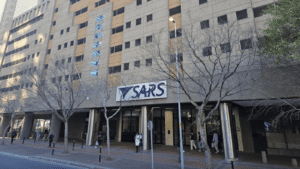
The South African Revenue Service (SARS) has made clamping down on illicit trade a priority over the past few years.
However, SARS Commissioner Edward Kieswetter has explained that this is easier said than done, with the illicit market now firmly entrenched in the local economy.
This is because illicit sellers are able to offer products at significantly lower prices than legitimate sellers since they do not need to pay excise taxes on their products.
Since South African consumers are highly price sensitive, many turn to the illegal market for these lower prices, with an illicit box of cigarettes selling for as little as R10, a notable discount compared to around R36 for the real deal.
Deeper than cigarettes

In her newsletter, Mavuso explained that “this isn’t just about cigarettes”, as the same dynamics that led to a flourishing illicit cigarette market are also destroying legitimate business in other sectors.
“Illicit alcohol sales have grown 55% by volume since 2017, with one in five drinks now from illegal sources,” she said, referring to data from the Drinks Federation of South Africa.
“Counterfeit pharmaceuticals, fake branded clothing, electronics, cosmetics and even food products are flooding the market.”
“The Consumer Goods Council of South Africa estimates the total illicit economy now represents approximately 10% of GDP, a staggering figure that, whilst difficult to measure precisely, indicates the massive scale of the problem.”
Mavuso explained that these illegal operations feed organised criminal networks involved in illegal mining, the construction mafia, and other serious crimes.
“Beyond the immediate tax losses and job destruction, the illicit economy undermines the rule of law and erodes public trust in institutions when criminals operate openly with apparent impunity,” she said.
The latest Global Organised Crime Index places South Africa seventh out of the 193 countries tracked and second in Africa in terms of criminality.
The index explains that illicit trade in excise goods, particularly tobacco and alcohol, is significant in South Africa.
“Corruption among border control officials, especially at ports, enables the continued flow of contraband,” it said.
Mavuso said BAT’s factory closure should be seen as a warning, and the government, in partnership with business, should ensure it is also a turning point, requiring decisive and urgent action.





Comments