South Africa’s richest city has not built a public school in 8 years


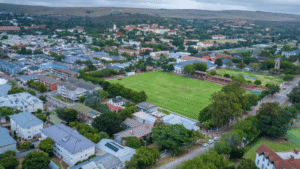
Only one public school has been built in Johannesburg and Ekhuruleni in the past eight years, located in the northern part of the City of Ekhuruleni.
Due to the closure of five public schools during the period, the number of government-run institutions has actually declined by four in the past eight years, while the number of learners has surged by 173,000.
In contrast, 165 private and independent schools have been built in these two municipalities between 2017 and 2024.
This is indicative of broader trends in the South African economy, with the private sector increasingly doing much of the work once left to the state.
In the education sphere, companies like Curro, ADvTECH with Crawford, and other private school groups have increasingly replaced public alternatives.
This is due to declining investment in public schools, declining outcomes, and the increasing affordability of private alternatives.
The increasing dysfunction of the public school system is best shown in Gauteng, where almost 5,000 grade 1 and grade 8 learners had not been placed in schools before the school year began.
Data from The Outlier shows that the pressure is heavily concentrated in just three school districts – Ekurhuleni North, Ekurhuleni South and Joburg East – which together account for 84% of all unplaced learners.
The Outlier analysed the Gauteng Department of Basic Education’s headcount statistics for 2024 to find out why these areas are under so much pressure.
This analysis showed that the three districts with the most unplaced learners also had among the highest numbers of learners per school on average.
Ekurhuleni South, for example, which has the highest learner-to-school ratio, has an average of 1,359 learners per primary school and 1,683 per high school.
If you break that down by grade, the average number of learners per grade in the primary schools (grades R to 7) is 170 and 337 per grade in the high schools.
Even at 40 learners per class, that would mean a high school would need eight classes per grade to accommodate all its learners.
With the rising number of learners and no increase in the number of schools, it is no surprise that the department struggles to place learners every year.
Nor is it coincidental that Johannesburg and Ekurhuleni have 701 private and independent schools. This number grew by 165 between 2017 and 2024, which is an average of around 21 new schools a year.
In comparison, one new public school was built over the same eight-year period. However, five schools were closed due to reasons such as dolomitic instability and sinkhole formation, as well as low learner enrollment.
So, there were actually four fewer public schools in 2024 than there were in 2017, even though the number of learners increased by more than 173,000 over that period.

Betting against the government
Private schools, once the preserve of the wealthy who could afford to send their children to elite institutions, have been significantly democratised over the past 15 years.
Curro has led this charge, becoming the largest private school group in South Africa, providing affordable private education across the country.
The company’s strong growth and increasing importance in South Africa’s education system were recently outlined by Camissa Asset Management analyst Edward Mtsweni.
Mtsweni said Curro has reaped the rewards of the decline in public education in South Africa, with thousands of learners moving towards private alternatives.
While the vast majority of students are still educated in the public sector, private schools have grown rapidly over the past 15 years.
Since 2009, there has been a 10% decline in the number of public schools in South Africa, while private schools have nearly doubled.
Private schools now educate 741,000 students in South Africa, with an average class size of 16 pupils. The public sector educates 12.8 million students at a class size of 31 pupils.
Curro’s business model is built on a steady stream of school fee income, providing predictable cash flow throughout the academic year.
This is buoyed by ancillary income from facility rentals, uniform sales, catering services, aftercare and boarding facilities.
Established in 1998, Curro has grown strongly over the past two decades to have more than 180 schools in operation across South Africa.
While private schools are typically associated with high fees and exclusivity, Curro has broken this by implementing a tiered pricing model.
This enables it to deliver private education to a broader segment of the population, making it a competitive alternative to both public schools and traditional private players.
While this tiered approach and Curro’s business model enable the company to rapidly grow its footprint, it has come with the problem that a considerable number of its schools remain below optimal learner capacity.
This means they are not as profitable as they can be and do not benefit from the positive dynamics where more students can be added with minimal additional cost.
As a result, Mtsweni said schools operating below breakeven levels have significantly weighed on Curro’s financial performance in recent years.
This has forced the company to shift its approach from rapidly growing its footprint to prioritising filling existing capacity at its schools.
This shift should result in improved operational efficiency and better returns on invested capital, as less expenditure will be required to build out new infrastructure.

Comments