South Africa’s unemployment crisis is only getting worse


South Africa’s economy is not growing fast enough for it to create the number of jobs needed to absorb new entrants into its workforce.
This results in the country’s unemployment rate steadily increasing, as thousands of individuals cannot find jobs in the formal economy.
South Africa’s economic growth rate would have to more than triple for the economy to merely absorb the number of new entrants into the economy every year. Even faster growth is needed to make inroads into reducing the unemployment rate.
This is feedback from Stanlib chief economist Kevin Lings, who explained that South Africa’s economy is growing faster than expected, but not fast enough.
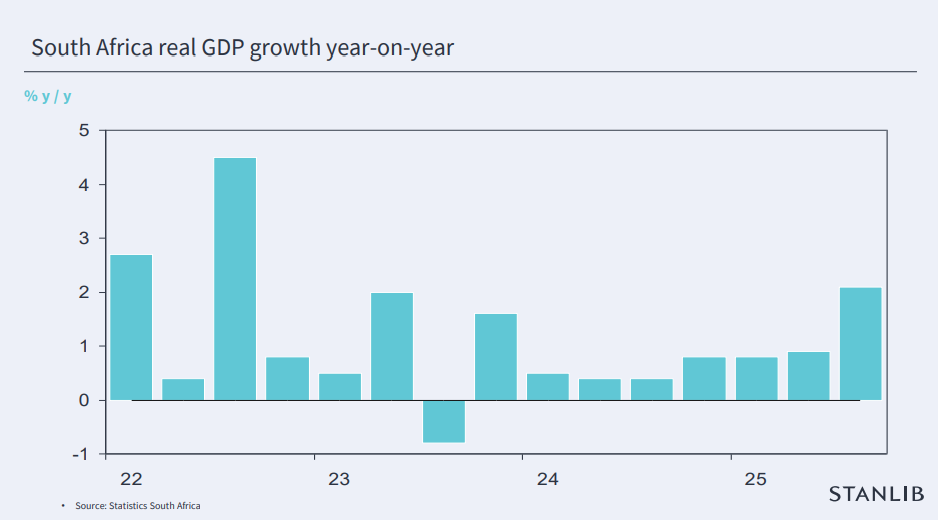
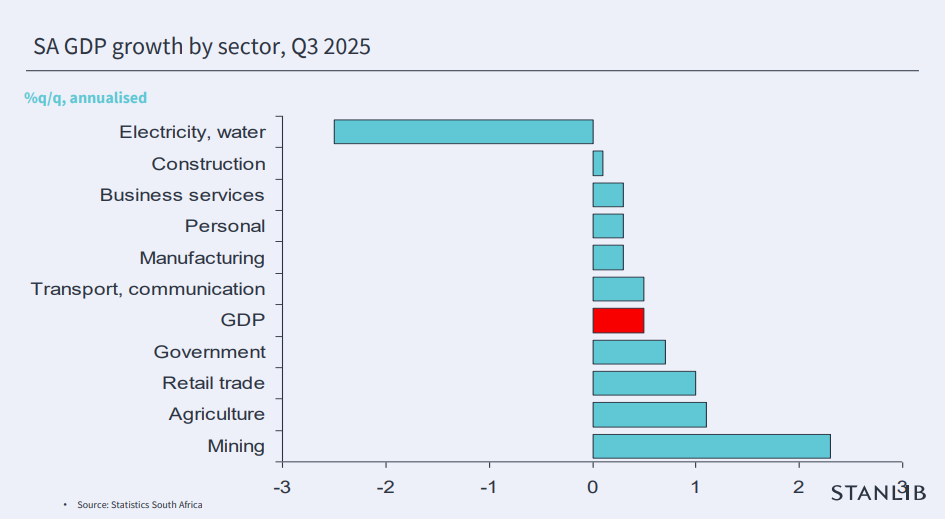
In the third quarter of 2025, South Africa’s economy grew by 0.5% quarter-on-quarter, with it managing a 2.1% year-on-year growth rate.
“What helped the annual growth quite a lot was the fact that some of the historical data was revised higher, which tends to push up the annual rate of growth,” Lings said.
“The 2.1% annual growth rate is certainly encouraging, but unlikely to be a sustained level of growth. In other words, I do not think that is the underlying rate of growth of the South African economy.”
Lings explained that the sustainable growth rate for the moment sits somewhere between 1% and 1.5%, with it being limited by deteriorating infrastructure and weak business confidence.
“Clearly, we have got a lot of work to do to move it beyond that, which is very much achievable. For the moment, we are stuck in a range of 1% to 1.5%,” he said.
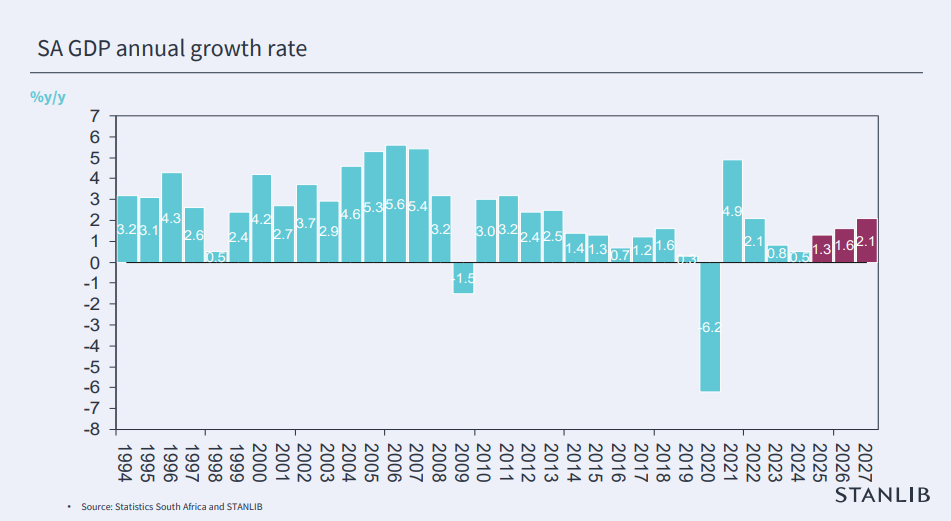
Stanlib had revised its growth estimate for 2025 upwards to 1.3% for the year from 1% earlier in 2025, due to a lower-than-expected impact from US tariffs and improving local fundamentals.
“There has clearly been some improvement, with most of that occurring in the second half of the year, and it reflects a broadening out of South Africa’s economic growth performance,” Lings said.
“Historically, much of South Africa’s growth has come from retail activity, as well as finance activity from banks. In the last six months, there has been a broadening out to most sectors of the economy.”
Not enough for jobs
While this faster economic growth is encouraging and reflects the progress made on key reforms, it is simply not fast enough to make a meaningful dent in South Africa’s unemployment crisis.
Lings said the picture is somewhat better when looking at fixed investment figures, which is gradually beginning to pick up.
Fixed investment in equipment, machinery and infrastructure is vital for economic growth as it expands the productive capacity of the economy.
In other words, it drives productivity growth, which is self-reinforcing and can lead to sustained economic growth in the long run.
However, with this only growing by just over 1% year-on-year, economic growth is unlikely to meaningfully accelerate, hence Ling’s 1.3% forecast for the year.
“I think a 1.3% growth rate is still nowhere near enough. We need to really get that growth rate above 3% and heading toward 4%,” Lings said.
“Then, I think, we will be in a position to be adding enough jobs to absorb the number of people entering the labour market.”
“At a growth rate of just over 1%, we are not going to create enough jobs to deal with the growth in the population.”
Lings compared the longer-term trend of the country’s economic growth rate versus population growth to make this point clearly.
Since the beginning of the Covid-19 pandemic, the economy is bigger than it was then, with it expanding by 3.5% in real terms over the past six years.
Over that time, the population has grown by more than 6%. This tells you that the growth in the economy is just not keeping pace with population growth.
“This results in income per capita falling, on average, resulting in the living standards of South Africans stagnating and then falling,” Lings said.
“We have got to do a helluva lot more to lift the growth rate on a sustainable basis and then get that to be accompanied by a meaningful increase in formal sector employment.”






Comments