One city in South Africa built fewer than 4,000 new houses in ten years


Buffalo City in the Eastern Cape has reported that fewer than 4,000 residential buildings were built in the municipality between 2014 and 2023.
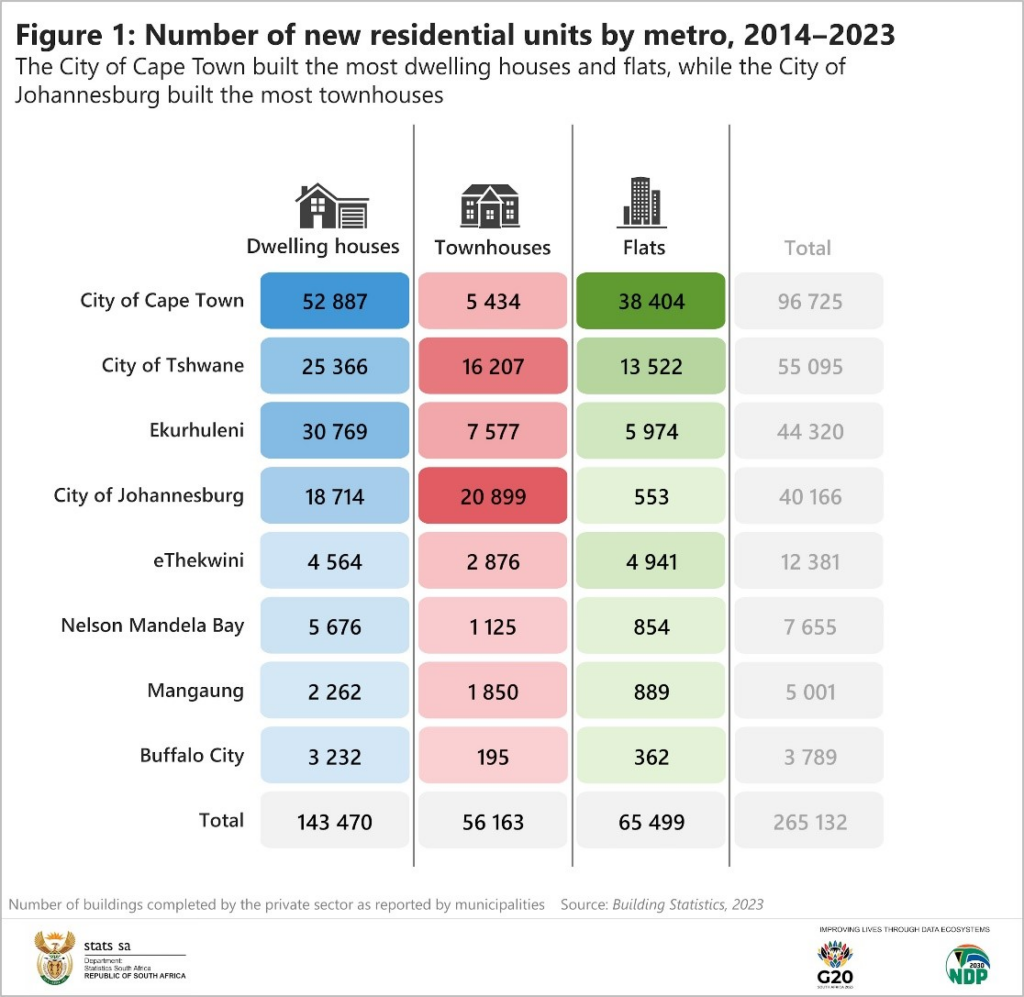
In contrast, the City of Cape Town built 96,725 residential buildings over the same period, including 52,887 townhouses and 38,404 flats.
These statistics, recently released by Statistics South Africa (Stats SA), come as the country is hoping to increase the private and public sectors’ fixed investment, which plays a key role in driving economic growth.
Stats SA recently published a ten-year review of private sector building statistics, which revealed the metropolitan municipalities where the private sector built the most residential buildings between 2014 and 2023.
This review revealed that the City of Cape Town was the most active metropolitan municipality during this period, recording the highest number of new residential units overall.
The Mother City saw the completion of the most dwelling houses – i.e., free-standing homes – and flats.
Although it placed fourth overall, the City of Johannesburg recorded the most townhouses – i.e., clustered houses – with 20,899 units built over the ten-year period.
South Africa’s administrative capital, the City of Tshwane, registered the second-highest number of flats and townhouses, adding a total of 55,095 residential buildings over the decade.
Stats SA’s data also provided insight into the housing priorities of each metropolitan municipality.
The agency found that dwelling houses remain a popular choice. This was undeniably the case for Buffalo City, where 85% of new residential units were dwelling houses, with less focus on townhouses and flats.
“Development in Nelson Mandela Bay and Ekurhuleni also focused heavily on dwelling houses, indicating that these metropolitan municipalities are building out rather than up,” Stats SA said.
Surprisingly, a similar trend was noticed in the City of Johannesburg, where only 553 flats were built between 2014 and 2023, compared to 18,714 dwelling houses and 7,577 townhouses.
Stats SA’s comparison between South Africa’s major metropolitan municipalities can be seen in the graphic below.
Building South Africa up
These statistics come as South Africa is looking to increase fixed investment, also known as fixed capital formation, which is considered crucial to unlocking faster and more sustained economic growth.
Currently, fixed investment only constitutes around 14% of South Africa’s GDP. To unlock faster growth, this figure needs to be closer to 20%.
One of the reasons for South Africa’s subdued fixed investment is the private sector’s hesitance to commit to long-term projects in the country’s uncertain and persistently slow-growing economy.
A lack of capital is not the problem, as the private sector has an estimated R1.8 trillion cash pile sitting on the sidelines waiting to be deployed into the economy.
However, subdued business confidence, onerous regulations and political uncertainty discourage corporates from using this cash pile to finance large-scale investments like infrastructure and machinery.
While fixed investment can also be driven by the public sector, the state’s massive debt pile and strained fiscus limit the government’s capacity to fund these investments.
Therefore, to increase fixed investment to levels required to drive faster growth, the government will need to make these investments attractive to the private sector.
This can be done through deregulation, improved policy certainty, and growth-friendly policies that will make corporates feel that South Africa’s growth prospects justify long-term investments.
South Africa is currently on a positive trajectory, with third-quarter GDP data showing a 1.6% rise in fixed capital formation.
This came after three quarters of contraction, signalling that private sector investment is beginning to return and structural reforms are taking hold.
If South Africa can capitalise on this positive momentum and continue increasing fixed investment, the country can meaningfully lift economic growth.




Comments