Only half of South African students who start school pass matric


South Africa’s education system has produced declining outcomes over the past decade, with only 51% of grade 1 learners in 2013 passing matric in 2023.
This reflects South Africa’s ‘real’ matric pass rate, with thousands of learners dropping out or failing before they even reach the final hurdle of a formal education.
While schools and teachers catch most of the blame for this, it is also largely due to South Africa’s deteriorating family dynamics.
This is feedback from the Centre for Risk Analysis (CRA), which recently documented the decline of nuclear families – two parents and their children living in one household – in South Africa over the past 30 years.
The decline is due to a myriad of factors, with the proportion of single-person households rising substantially over the past three decades while nuclear families declined as a share of the population.
Nuclear families now make up only 39.4% of households in South Africa, down from 46.5% in 1996. Single-person households have risen from 16.3% in 1996 to 26.9% in 2024.
The CRA’s Gerbrandt van Heerdem attributed this dynamic to the impact of HIV/AIDS on South African households and poverty, violence, and unemployment.
Family breakdown is now well-entrenched in South Africa, with less than a third of children living with both their parents. Just less than 20% live without a single parent.
Van Heerden explained that dysfunctional households often lead to worse outcomes for children, particularly in relation to poor educational performance and elevated crime-related behaviour.
According to Stats SA’s latest data, over 380,000 children between the ages of 7 and 18 were not attending school of any form.
Children raised by single mothers are likely to fare worse on a number of dimensions, including school achievement and later employability.
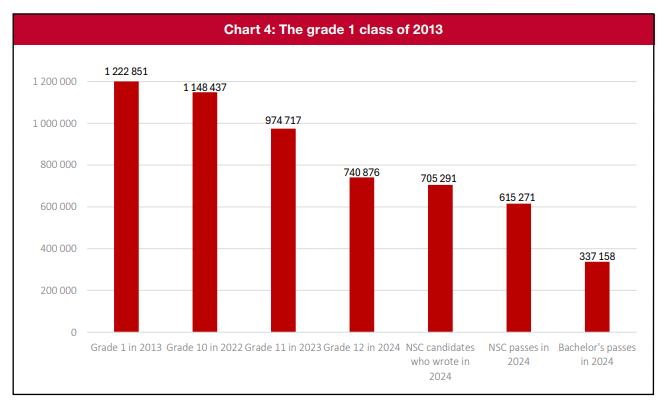
Van Heerden examined data from Stats SA to show that less than 60% of the 2013 Grade 1 class managed to write their matric exams in 2024.
Worryingly, only 51% of those who started Grade 1 in 2013 managed to pass matric, with about a quarter achieving a passing grade sufficient to study a bachelor’s degree at university.
This can be seen in the graph below, courtesy of Van Heerden and the CRA.
Unemployment disaster
South Africa’s increasingly poor educational outcomes have deepened its unemployment crisis, with many not having the skills demanded by the labour market.
A rising number of university graduates have also struggled to find work due to the skills transferred at university not being what companies need.
However, this does not mean that having a university degree is not vital for employment in South Africa, with graduates having a 25% greater chance of employment.
Van Heerden noted that 35% of people aged between 15 and 24 years are not in employment, education, or training of any sort.
This is largely because many South African learners who complete matric do not have sufficient marks to enter traditional university courses.
With the decline of South Africa’s technical colleges, this results in many young adults being unable to engage in education or training of any sort, further limiting their employment options.
All of this is despite South Africa’s substantial basic education budget, with the National Treasury allocating R346.5 billion to the department in the current financial year.
This makes it the largest spending item for the government in the current financial year, with more allocated to education than healthcare, social protection, and community development – despite declining outcomes.
As a result, spending on education absorbs around 6% of the country’s annual GDP and 20% of all government expenditure, making South Africa among the highest spenders on education.
However, for all this spending, South Africa has some of the worst outcomes among upper-to-middle-income countries with regard to education.
International assessments show that more than 80% of Grade 4 learners cannot read for meaning, and in 47% of secondary schools, no child reaches the intermediate maths benchmark.
Adjusted for quality, South African learners effectively receive the equivalent of about five years of learning after nine years of schooling.
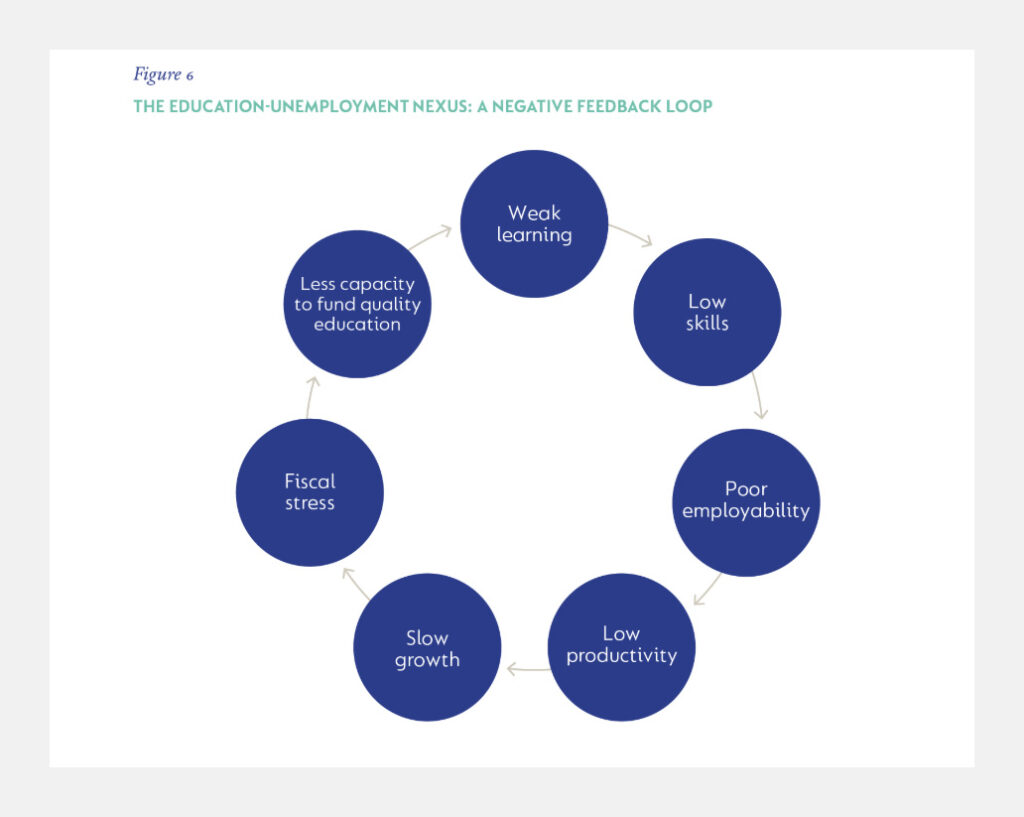
This contributes significantly to South Africa’s unemployment crisis, with these individuals being rendered unemployable in a modern economy.
As a consequence, South Africa’s workforce is increasingly unproductive, resulting in sluggish economic growth and less resources to spend on enhancing education outcomes.


Comments