South Africans paying 50% more for water than five years ago


Water price inflation has far outstripped inflation over the past five years, having risen by 50% since 2020 due to mismanagement and neglect.
This, combined with the far above-inflation rises in electricity prices, has made basic necessities increasingly unaffordable for everyday South Africans.
The Competition Commission’s latest Cost of Living report revealed the significant increases in administered prices over the past five years.
The prices of water and electricity are administered prices insofar as municipalities and/or state-owned enterprises levy them.
The report explained that price regulation does not guarantee lower-cost provision, as it is based on operating costs and capital requirements.
Additionally, each municipality typically determines its own tariff for supplying end customers, based on its own costs, resulting in uneven pricing across the country.
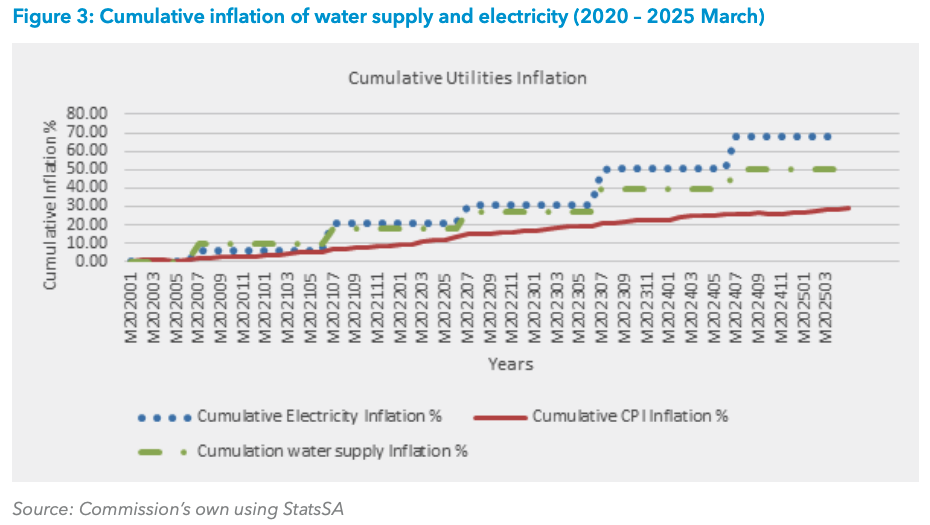
The report pointed out that both electricity and water prices have significantly increased over the period, with electricity prices increasing at a much steeper rate.
Between 2020 and 2025, electricity prices increased by 68% and water prices increased by 50%.
These figures become even more staggering when zoomed out over the past few decades. Since 2009, electricity prices have jumped by more than 600% and water prices have soared by over 500%.
“It is concerning that the prices of these essential services have increased significantly and at a much higher rate than general inflation,” the Competition Commission said.
“These increases negatively affect all households and businesses in South Africa. However, the effect has been severe on lower-income households.”
The topic of electricity pricing in South Africa has garnered much attention over the past few years, as the issue is intertwined with Eskom’s operational and financial struggles.
Decades of underpricing its services, followed by years of operational troubles that increased production costs, have led to Eskom’s sky-high electricity prices.
“I have repeatedly made the point that electricity is unaffordable. It has now reached the point where the situation is untenable,” Electricity Minister Kgosientsho Ramokgopa previously said.
“Households are finding it difficult to keep up with the increases and the rapid erosion of their disposable income.”
“Companies are also increasingly becoming less competitive. So, again, it is an existential problem.”
South Africa’s water crisis
While electricity prices have been a hot issue for years, the significant rise in water prices has received much less attention.
The Competition Commission explained that the increase in water prices has been influenced by several factors, including water scarcity and inadequate infrastructure management and maintenance.
These issues also contributed to the country’s current water crisis, which has resulted in many areas of South Africa being without the resource for weeks or even months at a time.
“In recent years, there have been significant concerns regarding debt impairment, lack of investment in infrastructure and losses due to leaks and burst pipes,” the report explained.
The 2023 No Drop Report revealed crucial insight into South Africa’s non-revenue water, which refers to the difference between the amount of water injected into the water supply system and the actual amount of water billed to customers.
This report found that the country’s non-revenue water increased from around 42% in 2014 and 2015 to above 46% between 2021 and 2023.
The commission said these factors all contribute to increased water tariffs. However, one overlooked factor that also contributes to inflated water tariffs is the cost of electricity.
The Competition Commission explained that electricity accounts for between 5% and 15% of the total cost of water supply.
Although this is a relatively small share, electricity price increases have been identified as a key driver of inflation in water prices.
“The increase in water tariffs has raised serious concerns not only with regard to access to drinking and cooking water but also hygiene concerns,” the report added
“Civil society has raised concerns with the public health concerns likely to arise due to unaffordability of water.”

Comments