One thing South Africa must get right to avoid economic disaster


South Africa’s economy is showing signs of recovery, with various economic indicators pointing to increased confidence and activity.
However, any potential growth is unlikely to be sufficient to tackle the country’s unemployment crisis and be sustained unless there is a significant pick-up in fixed investment.
Without increased investment in fixed assets such as land, machinery, equipment, and infrastructure, South Africa’s economy is likely to continue to stagnate.
The government aims to unlock immense private capital through reforms in key sectors and reduce red tape to make it easier to operate in South Africa.
However, these reforms are moving painfully slow outside of the electricity sector, with faster implementation needed to get private capital off the sidelines.
This is feedback from Old Mutual Investment Group portfolio manager John Orford, who outlined the potential for faster growth in South Africa and what is preventing it.
Speaking at the asset manager’s latest quarterly update, Orford explained that South Africa’s economic growth is set to pick up, with key indicators pointing in the right direction.
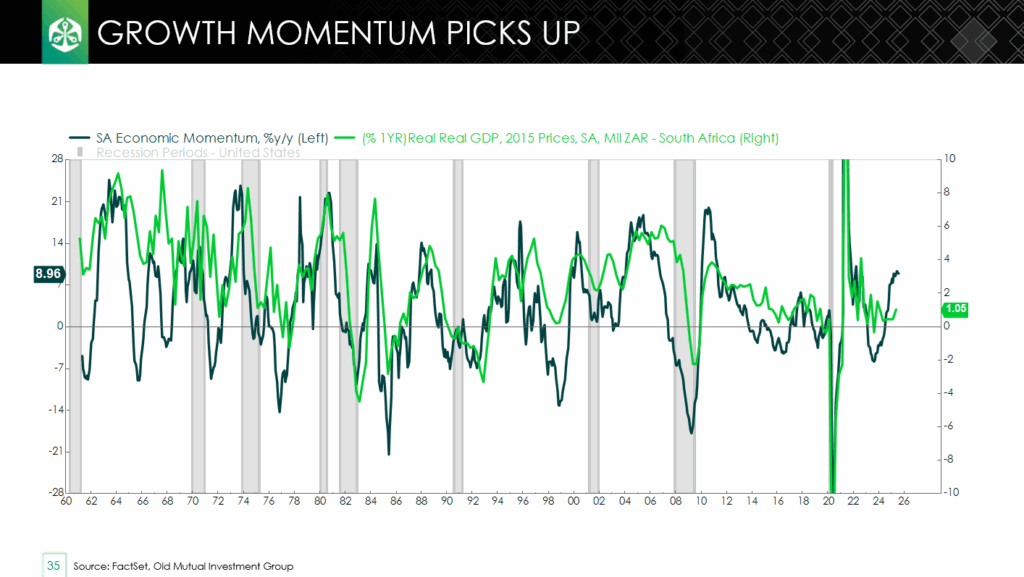
In particular, business, civil, and consumer confidence is trending in a positive direction, leading to South Africa’s economic momentum index hitting its highest level since 2012, excluding the pandemic anomaly.
This is very positive for the country’s economy as it indicates that it is on the cusp of faster growth and the end of an era of economic stagnation.
The improved positivity is partly explained by the rise in commodity prices so far in 2025, with gold hitting all-time highs and platinum group metals (PGMs) surging.
This is expected to result in improved economic activity in South Africa and patch up the government’s finances, to an extent, through increased tax revenue.
More importantly, key reforms are beginning to bear fruit, with load-shedding considered a thing of the past and Transnet showing some improvements.
The private sector has invested heavily in adding generation capacity to the grid and sourcing alternative energy sources for their own operations.
Coupled with improved performance from Eskom, South Africa is now able to go beyond energy security to focus on affordability and long-term planning in the sector.
Transnet has begun concessioning several rail corridors to private players, and Durban’s container terminal is set to be operated by Philippines-based International Container Terminal Services.
These are positive developments set to increase private participation in the economy and result in increased investment in infrastructure.
This will positively impact South Africa’s economic growth, Orford said, with the economic momentum index’s recent uptick shown in the graph below.
Investment must follow
This positivity is likely to be short-lived unless there is evidence of increased fixed investment in the local economy.
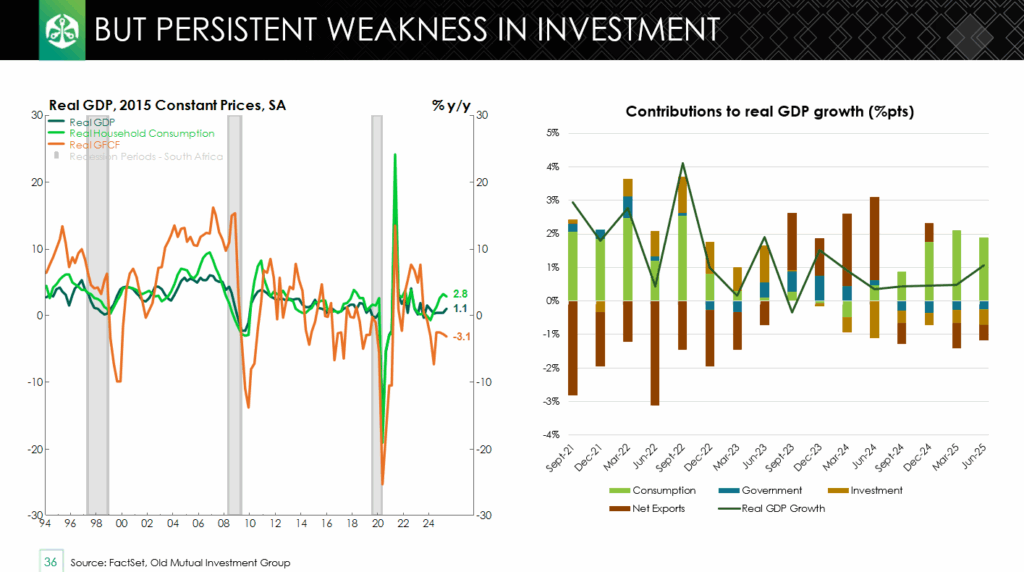
Orford explained that fixed investment, reflected in the gross fixed capital formation (GFCF) index, remains poor due to a lack of confidence in the local economy.
Declining investment is also a result of the mismanagement of the state’s finances and public companies, which are unable to invest heavily due to their weak balance sheets.
This is a major reason behind the push for increased private participation and investment, as companies remain the only source of sufficient capital to revive the local economy.
South Africa’s GFCF as a share of GDP has declined steadily over the past two decades from around 30% in 1976 to below 15% in 2024.
This is half of the levels seen in faster-growing emerging markets such as India, Indonesia, and China, where GFCF as a share of GDP sits above 30%.
GFCF is a key indicator of infrastructure investment, reflecting the extent to which the state and private sector are investing in assets such as land, machinery, equipment, and infrastructure.
This investment is a major driver of long-term economic growth, with a clear correlation between increased fixed investment and economic growth.
As a result, South Africa’s economy is being kept alive by personal consumption, which is unsustainable and unlikely to result in declining unemployment.
Most of this consumption is of products that are not produced locally and is based largely on cyclical factors, making it inherently short-term.
Increased consumer spending in South Africa is driven by low inflation and interest rates, which, by nature, will reverse at some point.
More worryingly, some of this increased spending is driven by early withdrawals from two-pot retirement funds, reducing South Africa’s pool of long-term savings.
The graphs below, courtesy of Orford and Old Mutual, show the steady decline in GFCF over the past 30 years.