South Africa’s government is doing the wrong things


The government’s implementation of policies that are detrimental to South Africa’s economic growth will continue to act as a cap on the country’s potential.
This includes policies such as the Expropriation Act, National Health Insurance (NHI), and a harsher version of the Employment Equity Act.
These pieces of legislation discourage investment in South Africa and make existing businesses hesitant to expand their operations and increase employment.
Furthermore, the time and resources that go into these policies could be better allocated towards the government’s efforts to revive the local economy.
This includes work from Operation Vulindlela to reduce red tape, the reform of the electricity and logistics sectors, and efforts to increase infrastructure investment.
The Centre for Risk Analysis’ (CRA) executive director, Chris Hattingh, explained that these laudable efforts will continue to be hamstrung by the government’s doubling down on failed policies.
Despite more positive corporate and market sentiment towards South Africa, as shown by the JSE’s strong performance and continued investment into local bonds, the country’s economy remains largely stagnant.
South Africa’s GDP grew only by 0.5% in 2024, with its first quarter growth of 0.1% improving to 0.8% in the second quarter of 2025.
Hattingh said this indicates that the best case overall for growth in 2025 is 1% and 1.2% in 2026, with the International Monetary Fund (IMF) projecting further declines in GDP per capita.
This growth is not enough for the country to begin tackling its unemployment crisis, with the economy simply unable to absorb the 500,000 new entrants into the labour force each year.
Hattingh pointed to the continued implementation of policies that discourage investment from businesses as one of the main factors preventing faster economic growth in South Africa.
“Policy impediments to domestic investment will continue to act as a cap on South Africa’s growth potential,” Hattingh said.
“The Expropriation Act, possible implementation of the NHI, and a harsher version of the Employment Equity Act disincentivise business growth and capital formation.”
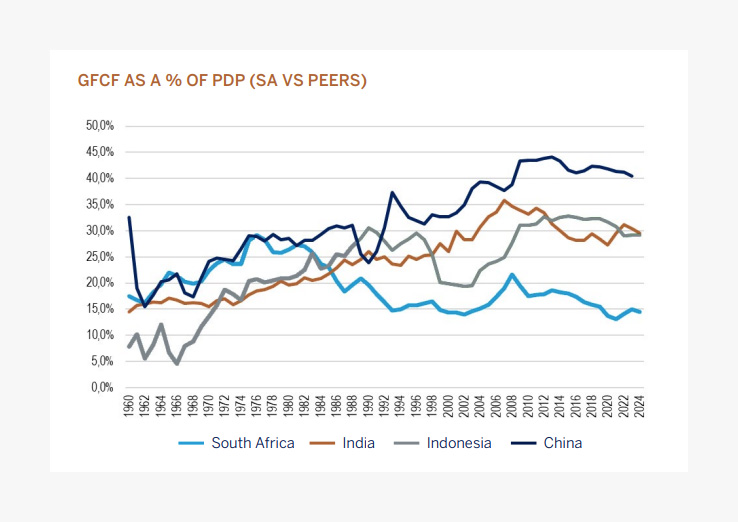
This can be seen in South Africa’s declining gross fixed capital formation (GFCF) as a share of GDP over the past three quarters. It declined by 3.2% year-on-year in the second quarter of 2025.
As a result, South Africa’s GFCF as a share of GDP remains about half of the levels seen in other faster-growing emerging markets, such as India, China, and Indonesia. This can be seen in the graph below, courtesy of Melville Douglas.
Businesses do not want to invest in South Africa
South African businesses are hesitant to invest in the local economy due to low confidence, policy uncertainty, and an increasingly difficult environment to do business in.
This has resulted in corporates sitting on over R1.8 trillion in cash that is held in call accounts or money market funds, waiting to be invested in the economy.
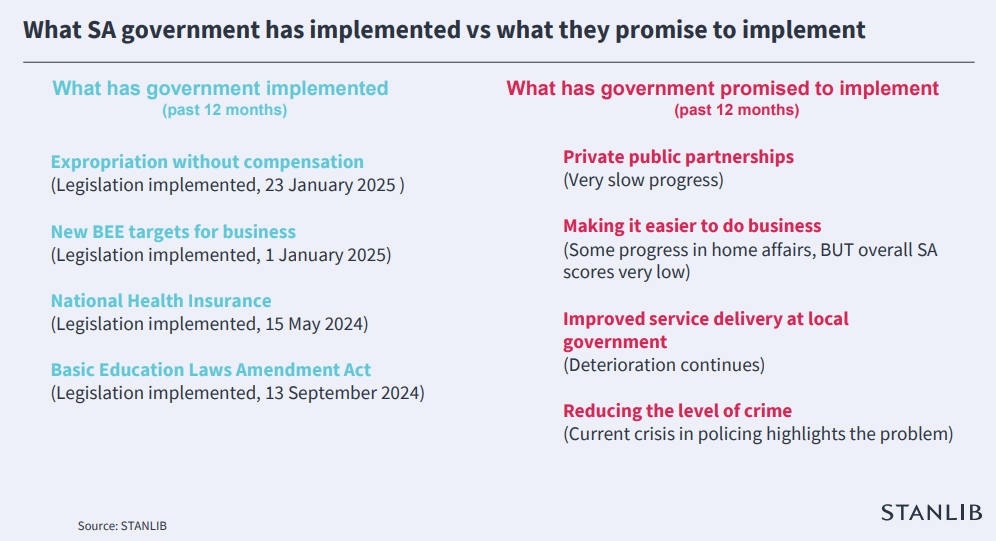
Stanlib chief economist Kevin Lings recently compared what the government promised to do over the past year versus what it actually implemented.
Lings said the government knows what it needs to do to revive the economy, but has not done so for various reasons, mainly a lack of political will.
“Please do not think the government has done nothing in the past year. The government has done stuff,” Lings said.
“What are those things? Expropriation Bill, done. We have new fancy BEE targets. We have the NHI Act and we have the BELA Act.”
These policies stand in contrast to what the government has promised to do over the past year, which includes various proposals to reform the economy and make it easier to do business.
“How do I know the government has said they are going to do it? It is in every single speech from a government official. Sometimes they mix up the flow, but the same things are said,” Lings explained.
“They say, ‘We are going to make it easier to do business. We are going to fix crime. We are going to improve service delivery’.”
“All of those ingredients that we keep talking about that will boost the economy. It is not as if we do not know them. That is the problem – they are just not done.”
Lings explained that the set of policies the government has implemented will not improve business confidence or make it easier to do business in South Africa.
“That is the problem with this list,” Lings said. “I ask you, which business says, ‘Look, South Africa has a shiny new Expropriation Act – I need to invest there. Let me go and invest in South Africa’.”
“Really? Which business is that? Which business says they want to invest in that country because they have shiny new BEE targets? I want to invest in them because look at that NHI Act?”
Lings said that businesses simply will not invest in the back of the policies implemented over the past year, as they do not move the needle in terms of making South Africa more attractive to investors.
“But, if you did the right-hand side, businesses would invest, and employment would grow. If you improve crime and service delivery, businesses will invest,” Lings said.
“And so, the government is concentrating its efforts and resources on a particular aspect of society. You can argue that the left-hand side is very important. That can be argued.”
“All I ask you is that if you are going to argue that, do not ignore the right-hand side. Because if you ignore that, then you are ignoring the private sector.”
“You are ignoring private business and not giving the business community what it needs. As a result, businesses have not invested in South Africa.”
The graphic below shows the comparison Lings pointed to in explaining what the government has done versus what it said it would do.