SABC wants another bailout to address TV licence disaster


The South African Broadcasting Corporation (SABC) said it needs support from the government to address funding gaps at the state-owned enterprise (SOE).
The state broadcaster said this support should include loan guarantees to make access to financial markets possible.
The SABC explained that it has become clear that its current funding model, which includes licence fees, no longer works, necessitating a new, innovated model.
This is according to SABC CEO Nomsa Chabeli in the group’s 2025 Annual Report, released in early October.
For its 2025 financial year, the SABC reported a loss of R253.29 million, significantly worse than the R197.76 million loss it recorded the year before.
This marks a continuation of the SABC’s financial struggles, which have plagued the SOE for years, fueled by financial instability, allegations of corruption, and its inability to keep up with new technology.
In the company’s annual report, Chabeli explained that the SABC’s business model was developed for a world that existed 50 years ago.
“It assumed that captive radio and television audiences would generate substantial commercial revenue which could then fund the SABC’s public service mandate,” she said.
“The reality however is that the world has shifted fundamentally. The market has opened to both global and local competitors, none of whom have the same public interest obligation (and associated cost) as the SABC.”
Therefore, she said the state broadcaster needs a new, innovated funding model, as the current system is no longer sufficient or relevant.
The SABC, which is overseen by the Department of Communications and Digital Technologies (DCDT), relies heavily on TV licence fees for income.
However, non-payment of these fees has become a growing problem, with high levels of evasion and a wide-spread consensus that the current regime lacks validity and legitimacy in the public’s view.
“It has been clear for some time now that the current licence fee regime no longer has the legitimacy or relevance to South Africans and, in line with shifts globally, needs to be replaced by sustainable and equitable and sustained revenue streams,” Chabeli said.
“We have continued to focus time and management attention on optimising licence fee collections with some positive outcomes. These efforts have now reached a point of diminishing returns.”
The graphic below shows the SABC’s current revenue sources, with the vast majority derived from advertising and sponsorships, while TV licence fees represent less than 15%.
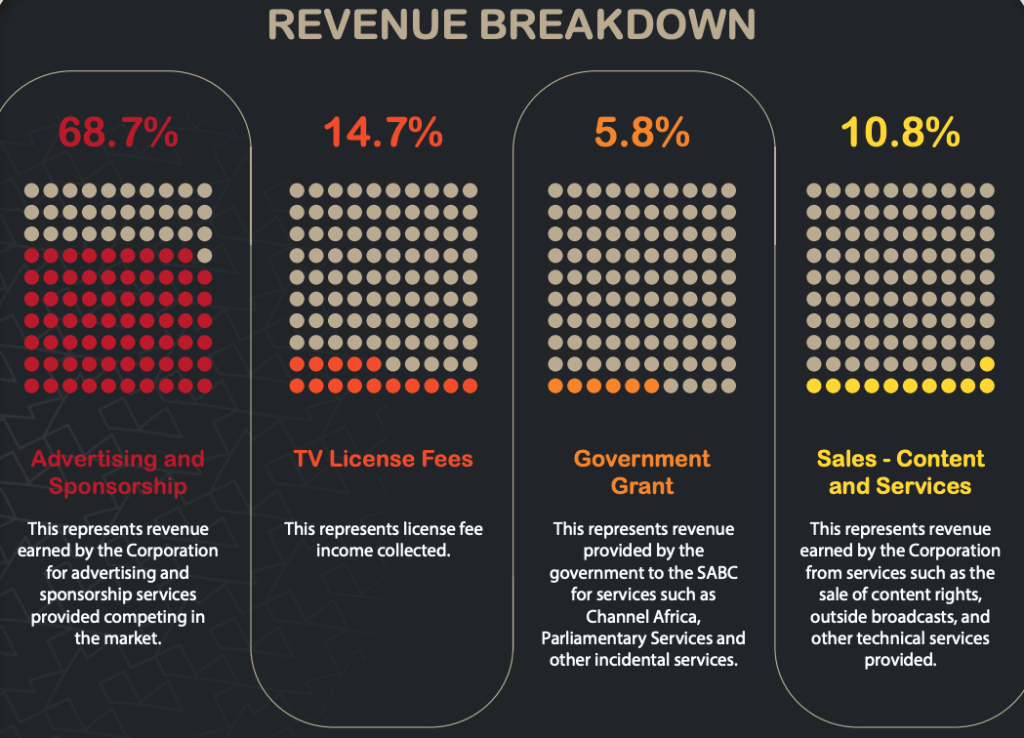
Funding the state broadcaster
Chabali explained that the SABC’s challenge is that it cannot fully control or innovate its business model independently.
She said the broadcaster need capital to remain competitive, but making changes like increasing the licence fee amount or shifting to a new revenue source requires a new funding model.
In addition, to implement this new model, changes to the applicable legislation and regulations are required.
“We welcome the DCDT initiating a process to develop an innovated funding model for the SABC and stand ready with our inputs to inform such deliberations,” she said.
“We also support the reintroduction of a new SABC Bill in Parliament to make the necessary legislative changes.”
The previous SABC Bill, suggesting a new funding model for the state broadcaster, was withdrawn from Parliament.
Chabali said this has resulted in further delays to the legislative and regulatory reforms essential to the SABC’s ongoing survival and financial sustainability.
While hopeful that the new Bill will pass muster, Chabali said the SABC continues to struggle with limited access to funding and capital to finance its operations.
“Addressing this funding gap, is a critical aspect of our business model innovation. It is essential that our shareholder responds to this issue in ways that provide us with the necessary support, including loan guarantees, to make access to financial markets possible,” she said.
This would not be the SABC’s first government support, as the public broadcaster received a significant bailout in 2020.
The government allocated R3.2 billion to the broadcaster to help it address its financial woes, specifically its outstanding debts, and implement a turnaround strategy.
However, in November 2023, former Deputy Minister of Communications Philly Mapulane told Parliament’s Portfolio Committee on Communications that the SABC is worse off now than before it received the bailout.
“You will recall we supported the turnaround plan. It was implemented with the hope it would turn around the fortunes of the SABC, but the turnaround plan never turned the finances of the SABC,” he said.
“We are back to where we were, if not in a worse position than when we started with a bailout.”
In November 2023, Deputy Minister of Communications at the time Phil Mapulane revealed that the SABC had asked the National Treasury for R1.5 billion in additional funding, but it was rejected.
Mapulane said the SABC expected R1.5 billion in funding from the National Treasury in the Medium-Term Budget Policy Statement (MTBPS).
However, Finance Minister Enoch Godongwana did not announce additional allocations to the ailing state broadcaster.
“The argument was that because of the macro environment the SABC has painted, operating under the environment of analogue switch off and the need for the SABC to ensure the elections are covered, we submitted a motivation to the Treasury for R1.5 billion,” Mapulane said.
“When the minister was tabling the MTBPS, that allocation was not accepted, so we didn’t get what we requested.”

Comments