South Africa’s government is doing all the wrong things


South Africa’s government has continued to double down on policies that have hindered economic growth over the past 15 years and ignored what the private sector needs to invest.
With the government’s financial health deteriorating significantly, it needs the private sector to leverage its strong balance sheet to invest in the local economy and particularly in infrastructure.
This investment would significantly boost economic growth and employment in South Africa, with private companies sitting on over R1.5 trillion in cash.
However, instead of listening to what private businesses need to invest, creating an enabling environment, and boosting business confidence, the government’s attention has been elsewhere.
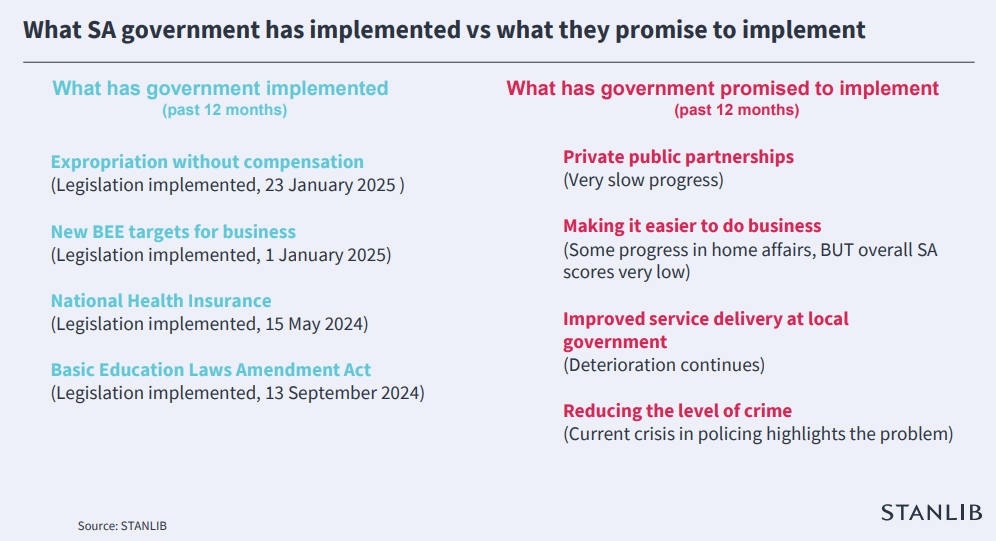
This is feedback from Stanlib chief economist Kevin Lings, who compared what the government has promised to do over the past year versus what it has actually implemented.
Speaking to the 2025 Morningstar Investment Conference, Lings said the government knows what is needed to boost South Africa’s economy but for various reasons does not do what is required.
“Please do not think the government has done nothing in the past year. The government has done stuff,” Lings said.
“What are those things? Expropriation Bill, done. We have new fancy BEE targets. We have the National Health Insurance Act and we have the BELA Act.”
This stands in stark contrast to what the government has said it will do over the past year, which includes various proposals to increase the private sector’s role in the economy and boost investment.
“How do I know the government has said they are going to do it? It is in every single speech from a government office. Sometimes they mix up the flow, but the same things are said,” Lings said.
“They say, ‘We are going to make it easier to do business. We are going to fix crime. We are going to improve service delivery’.”
“All of those ingredients that we keep talking about that will boost the economy. It is not as if we do not know them. That is the problem – they are just not done.”
The graphic below shows the comparison Lings pointed to in detailing what the government has done versus what it said it would do.
No confidence
While the government has done all the things on the left, it has made very little progress on the list on the right, which would boost the local economy.
Lings explained that the implementation of those policies on the right-hand side would significantly boost private investment in South Africa and grow the economy.
“That is the problem with this list. I ask you, which business says, ‘Look, South Africa has a shiny new Expropriation Act – I need to invest there. Let me go and invest in South Africa.’”
“Really? Which business is that? Which business says they want to invest in that country because they have shiny new BEE targets? I want to invest in them because look at that NHI Act?”
Lings said that businesses simply will not invest in the back of the policies implemented over the past year, as they do not move the needle in terms of making South Africa more attractive to investors.
“But, if you did the right-hand side, businesses would invest, and employment would grow. If you improve crime and service delivery, businesses will invest,” Lings said.
“And so, the government is concentrating its efforts and resources on a particular aspect of society. You can argue that the left-hand side is very important. That can be argued.”
“All I ask you is that if you are going to argue that, do not ignore the right-hand side. Because if you ignore that, then you are ignoring the private sector.”
“You are ignoring private business and not giving the business community what it needs. As a result, businesses have not invested in South Africa.”
Lings explained that businesses have the capacity to invest in the country, with corporate debt being among the lowest in the world.
In particular, with the government’s deteriorating financial health, the cash these corporates are sitting on is desperately needed for infrastructure investment.
“The business community is the only community with a balance sheet. It is the only community that can actually leverage a balance sheet, borrow more, and invest in growth and employment,” Lings said.
 Loading ...





Comments