ANC policies crushed South Africa’s economy


South Africa’s business confidence has been severely impacted by the continuation of poor economic policies from the government over the past 15 years.
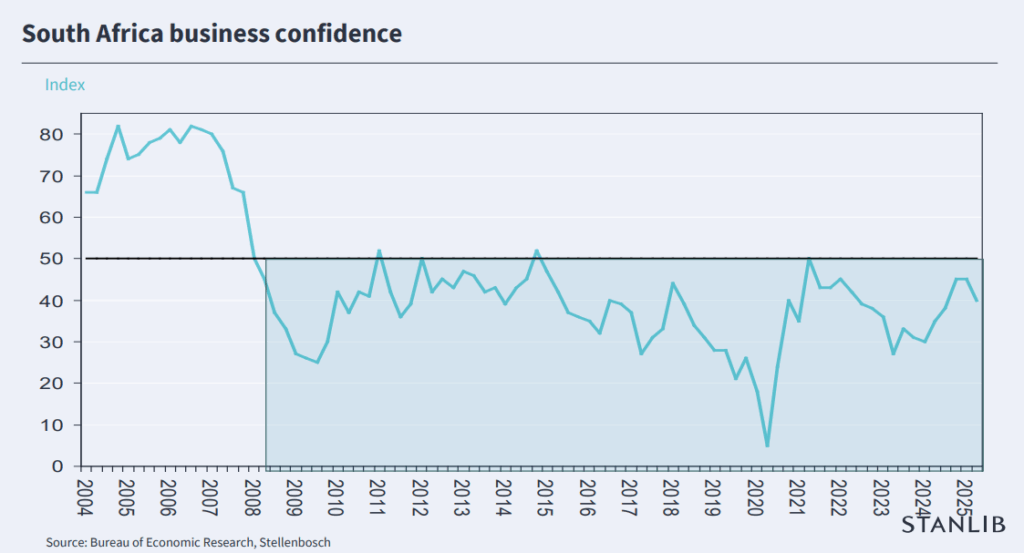
Since 2008, business confidence has only crossed into positive, expansionary territory on three occasions and never for consecutive readings.
This has resulted in a steady decline in investment from companies in South Africa, hampering economic growth and employment.
South Africa’s confidence crisis is one of the major reasons why big corporates continue to sit on a large cash pile of over R1.5 trillion and are unwilling to commit it to new projects in the country.
Rather, they prefer to keep cash on hand waiting for better opportunities, as a buffer against potential headwinds and in anticipation of faster growth.
This is feedback from Stanlib chief economist Kevin Lings, who told the 2025 Morningstar Investment Conference that the government over the past 15 years has largely ignored private business and what it needs to succeed in South Africa.
“Is the business community able to invest? Yes, business debt is only 31% of GDP, with corporate debt levels being among the lowest in the world,” Lings said.
“Corporates are sitting on R1.5 trillion in cash in the bank. They have got great balance sheets, the capacity and skill to invest.”
The question is why don’t businesses invest in South Africa and, for Lings, the answer is in government policies that have steadily eroded business confidence.
“If you look at business confidence in the mid-2000s it was at a record high. Investment was flooding into South Africa and the economy was booming,” Lings said.
During this period, South Africa’s GDP growth averaged an annual rate of 4% and the economy created over 500,000 jobs a year.
Since then, business confidence has plummeted and investment along with it. At the same time, growth has stagnated and unemployment has risen.
“Business confidence does not just go away. It was destroyed through the policy choices we made. Those policy choices have destroyed the confidence and we have not bothered to resurrect,” Lings said.
“I have never seen a business community anywhere in the world invest with that level of confidence. It does not happen. You have to be fundamentally confident to invest.”
South Africa’s poor business confidence under the past 15 years of ANC rule can be seen in the graph below.
R1.5 trillion goldmine
South African companies are sitting on R1.5 trillion cash pile that remains undeployed in the local economy, presenting a significant opportunity to boost investment and growth.
This pile is now worth around 20% of South Africa’s total GDP, with an increasing number of questions being asked as to why it is being kept on the sidelines.
Lings admitted that one of the major reason why companies let cash sit in money market or call accounts is because of their elevated yield.
With elevated interest rates providing higher yields, there is a significant hurdle to invest in fixed assets based purely on potential returns.
Corporate cash on hand has been growing at around 12% per annum for the past few years, despite the country’s economy growing at less than 1% annually.
“This is telling you a couple of things. Corporates are generating good earnings and managing to keep costs under control,” Lings said.
“But, it also shows that they clearly do not want to deploy that cash in terms of fixed investment, in terms of expanding their business, or in investing in the local economy. There is very little of that happening.”
However, Lings also said companies are showing signs of being ultraconservative with their buildup of significant cash reserves.
“When I look at it from an economic perspective, this is ultraconservatism. Looking around the world, South Africa stands out as being especially conservative in how it manages its corporate balance sheet,” Lings said.
“That is both a positive and a negative. The negative component is that companies could be doing a lot more in terms of generating additional returns for themselves with minimal increase in risk.”
The cash South African companies are sitting on lends itself towards a negative outlook for the local economy, with businesses lacking the confidence to invest.
“South African corporates are taking on very little investment, and they are sitting on significant cash reserves. All of this is a byproduct of lacking confidence in the future performance of the South African economy,” Lings said.
“This is not a great environment if you are looking at it through an economics lens, or a growth point of view, or an employment point of view.”




Comments