Another taxpayer bailout for Transnet on the cards


Rating agency Fitch expects government guarantees for Transnet to continue, as the state-owned utility continues to struggle and reforms are slow.
The rating agency highlighted South Africa’s slowly recovering logistics sector as one of the key constraints on the country’s growth, which has been significantly slower than its peers over the past decade.
On Friday, 12 September, Fitch affirmed South Africa’s long-term foreign currency issuer default raring at ‘BB-’ with a stable outlook.
A ‘BB’ rating indicates an elevated vulnerability to default risk, particularly in the event of adverse changes in business or economic conditions over time.
The rating agency explained that South Africa’s prospects of attaining a higher rating are constrained by low GDP growth, a high level of poverty and inequality, a high and rising government debt-to-GDP ratio, and a rigid fiscal structure that hampers budget deficit reduction.
In particular, it said South Africa’s growth is hampered by a slowly recovering logistics sector, weak investment, uncertainty over external trade relations and deeply entrenched structural factors like high levels of inequality, poverty and unemployment.
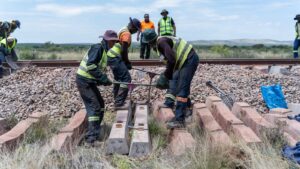
On Transnet, Fitch explained that the utility remains hampered by maintenance backlogs, rolling stock shortages, theft, vandalism and years of mismanagement.
It highlighted that, under Transnet’s 18-month recovery plan announced in October 2023, rail and container volume rose to 160 million tonnes in the 2024 financial year, up from 152 million tonnes in 2023. However, it noted that this is still below the utility’s 170 million tonnes target.
In addition, Transnet continues to accumulate net losses, with the utility reporting a R1.9 billion loss for its 2024 financial year.
Concerningly, Fitch further pointed out that the utility’s financial sustainability is constrained by high leverage.
“We expect Transnet will continue to rely on government guarantees to access funding,” the agency said.
This means Transnet will continue to impact South Africa’s fiscal health, with the government’s contingent liabilities expected to continue rising given the utility’s reliance on guarantees.
Private sector to the rescue

To address the country’s struggling rail logistics, the government recently shortlisted 11 private companies to operate South Africa’s freight-rail network.
This is expected to help tackle logistics bottlenecks that have weighed on the country’s economic growth for years.
These 11 companies will now hold talks with Transnet about securing access to 41 routes and six corridors used to move coal, chrome, manganese, fuel and other goods.
Licenses of up to 10 years will be allocated to firms that make the final cut, and they will be allowed to commence operating once they’ve met the required conditions.
This will effectively end Transnet’s monopoly over the country’s rail networks and help the utility to carry an additional 20 million tonnes of freight annually from the 2026/27 financial year.
While the country’s rail infrastructure will remain state-owned, the inclusion of private sector players will mean it is used more efficiently and effectively, aiding logistics reforms.
In addition, it will alleviate some of Transnet’s financial strains, as well as pressure on the fiscus, with the utility heavily reliant on government support.
In July 2025, the National Treasury approved further government support for Transnet through R94.8 billion in guarantees. This is in addition to the R51 billion guarantee facility approved in May.
The Bureau for Economic Research’s Roy Havemann previously said it is unclear to what extent these guarantees have been linked to ongoing and essential reform initiatives at Transnet, particularly port and rail reforms.
He said it also represents a significant increase in contingent liabilities for the National Treasury.
While Transnet has made significant progress in reforming its operations, this is not happening fast enough to address its financial struggles, making it perpetually reliant on government support.
Transport Minister Barbara Creecy previously explained that this has led Transnet into a vicious cycle, as companies have reduced their reliance on the state-owned utility.
The utility’s financial struggles mean it cannot afford to invest in improving its rail network, which drives customers away, decreases Transnet’s revenue, and further worsens its financial position.



Comments