South Africa heading for disaster


South Africa is yet to feel the worst effects of Trump’s tariffs on the country and some of its major trading partners, with the true impact being masked by corporate stockpiling in America ahead of the implementation of increased duties.
This stockpile will run out at some point and companies in the United States will have to adapt to a world with increased duties on some of their imports.
For a country, such as South Africa, that has failed to negotiate a trade deal with the United States, the implications could be severe.
South African exports to the United States are effectively uncompetitive, with major competitors experiencing substantially lower tariffs on the goods they export to America.
For example, South African agricultural products are tariffed at 30%, while those from Chile and Peru are only hit with a 10% tariff.
This makes citrus from these countries immediately cheaper than South African alternatives, making it likely that American companies will prefer to source their products elsewhere.
The other sector that was heavily impacted was the automotive industry. Exports to the US have already fallen sharply, which might lead to parent companies scaling back local operations.
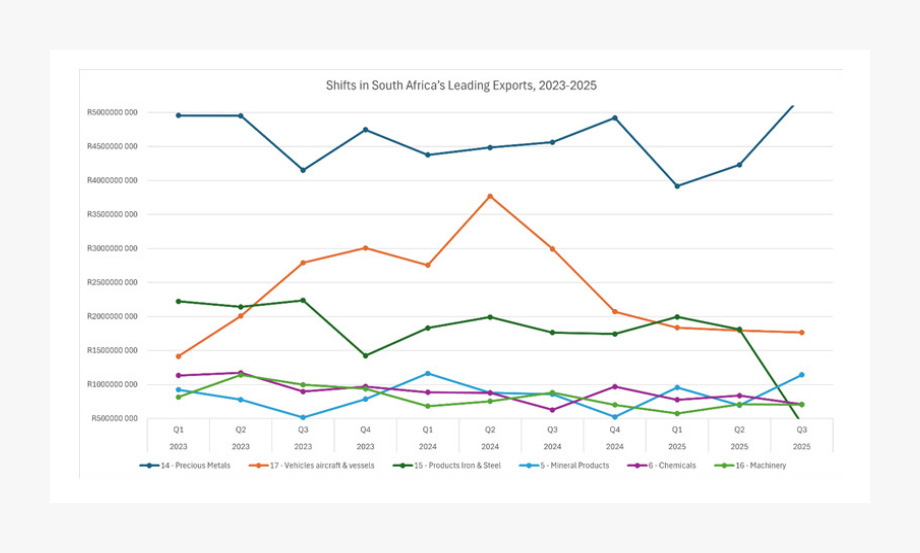
Data compiled by trade union Solidarity show that only minerals and precious metals are holding up, as they are exempt from tariffs.
Other sectors, including iron and steel and machinery exports to the United States, have plummeted so far in 2025.
Steel exports have been relatively consistent over the past few years, but according to the quarterly average in the graph, they show a sharp decline in the second and especially the third quarter.
Steel exports have consistently increased in March in previous years, while the volume of exports in March this year was the lowest in the past three years, Solidarity said. Since then, it has been consistently lower than in previous years.
The tariffs have the potential to result in widespread job losses, with Mercedes, for example, already halting production at their factory in East London while it tries to adapt.
Up to now, the impact of tariffs has only been visible in the steel industry, as it is subject to a tariff that came into effect in February.
Solidarity expects other industries to also be strongly negatively affected by the Trump administration’s new trade policy.
The graph below shows the change in exports across sectors in South Africa.
South Africa its own worst enemy
South Africa’s inability to meaningfully address American concerns means much of the pain from tariffs is self-inflicted.
Pan-African Investment and Research Services CEO Dr Iraj Abedian explained that music has changed, but South Africa keeps dancing the same dance.
This makes it out of tune with the rest of the world, unable to grow its local economy and effectively engage with the United States.
Abedian, a former Standard Bank chief economist, said one of the country’s major problems is the government’s lack of action and willingness to view problems as outside of its control.
This has happened more recently with the imposition of tariffs on South African goods exported to the United States, with the government failing to meaningfully engage with Washington to secure a trade deal.
“Tariffs are not beyond our control. They are very much within our government’s control. We need to change our attitude and look at how other countries have dealt with the United States,” Abedian said.
“When President Trump comes into office, it is like you are on a dance floor and the music changes – you have to change your dance. You cannot continue the old movements because the music has changed.”
South Africa has ultimately failed to adapt to the rapidly shifting realities of US trade policy and its impact on the local economy.
At the start of the year, economists were pencilling in South African GDP growth of around 1.8% for 2025. This has now been cut to around 1% due to the tariff headwinds.
Standard Bank’s economics unit has calculated that for every 10 percentage point increase in the tariff rate, South Africa will lose 0.1% of GDP growth.
This may not appear significant, but considering the bank only expects South Africa to grow at 1.1% in 2025, a 30% tariff rate could shave off a significant amount of GDP growth.
The graph below shows the effective tariff rate placed on South Africa in contrast to that of other major emerging markets.






Comments