Major retailer slams South Africa’s difficult business environment


Italtile saw its turnover shrink in the 2025 financial year, with the retailer bemoaning South Africa’s difficult trading environment.
In particular, Italtile CEO Lance Foxcroft described the country’s investment climate as “difficult and relatively unsupportive” for manufacturers compared to neighbours like Zambia and Zimbabwe.
Founded in 1969, Italtile is a South African manufacturer, franchisor and retailer of tiles, bathroomware and other home-finishing products.
The company’s retail brands are CTM, Italtile Retail and TopT, represented through a network of over 200 stores, including seven online webstores.
On Monday, 25 August, Italtile released its results for the year ended 30 June 2025, which revealed a subdued performance for the company.
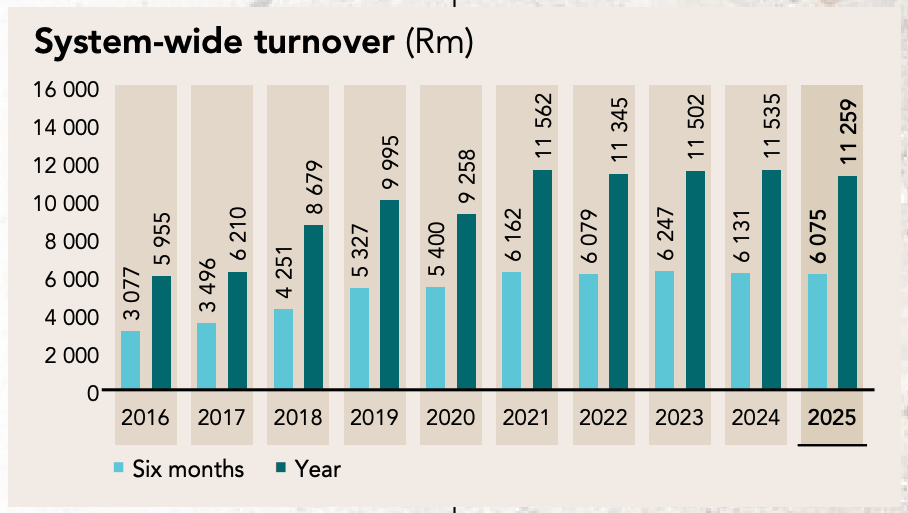
The company reported a 2% decline in system-wide turnover, from R11.5 billion in 2024 to R11.3 billion in 2025.
Foxcroft said this decrease was driven by a small increase in retail revenue, but a decline in revenue in supply chain businesses and Ceramic Industries.
However, he noted that retail sales improved 1% year-on-year and said Italtile retained its market share despite the challenging trading environment.
The number of sales transactions increased 1.3% while basket size decreased 0,7% as price-sensitive customers bought down. Retail profits for the period increased 1%.
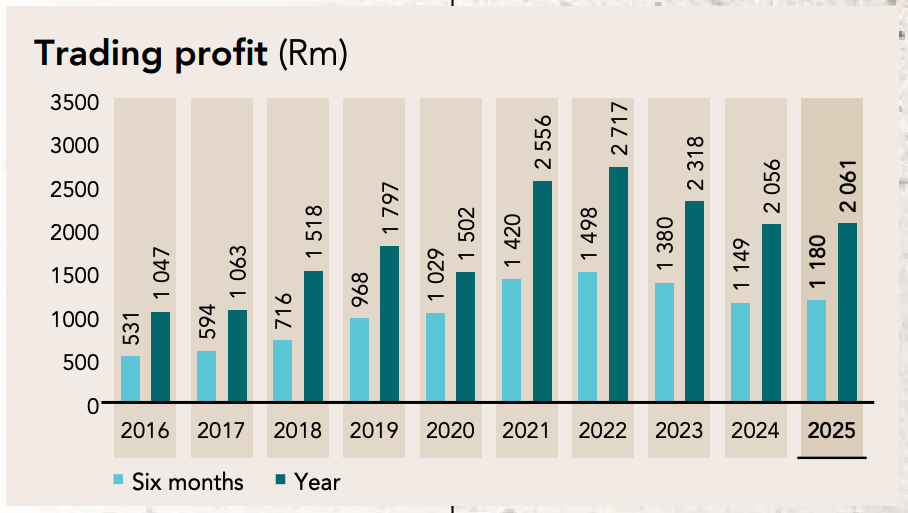
However, Italtile’s trading profit remained flat at R2.1 billion, while earnings per share saw a modest 3% rise from 122.1 cents to 125.6 cents per share.
The company expanded its store network by 1%, adding two locations for a total of 210 stores.
Positively, Italtile reported an 18% increase in cash and cash equivalents, recording R2.2 billion for 2025.
The company said these reserves are in excess of its operational requirements, which led the board to declare a special dividend of 98 cents.
Combined with the company’s interim and final dividends, this brings Italtile’s total dividend for the year to 148 cents per share.
The graphs below show Italtile’s turnover and trading profit growth from 2016 to 2025.
Difficult trading environment
Foxcroft noted both global and local challenges weighed on the manufacturing industry over the year through June 2025.
He particularly highlighted over-capacity and subdued demand as pressures on tile manufacturers worldwide.
“As many seek to find alternative markets, tariffs have been applied in local markets and dumping has increased in those without tariffs, resulting in increased competition in domestic markets,” he said.
“The introduction of tariffs on imports by Zambia and Zimbabwe to protect their local production has affected the ability of local producers to export into these countries, resulting in loss of market share in these export markets.”
“The establishment of major new manufacturing facilities in neighbouring countries due to their investor-friendly environments highlights South Africa’s difficult and relatively unsupportive investment climate for manufacturers.”
He noted that Italtile’s management will continue to engage the authorities to gain the government’s support for a level playing field in South Africa’s market.
He added that South Africa’s subdued economy saw consumer confidence and spending in the building and construction sector remain muted.
In addition, Foxcroft said consumers remain price-conscious and constrained by tight budgets while searching for trusted quality and good value.
Looking forward, he expects many of these headwinds to continue, projecting subdued growth in the construction industry.
However, he said a rigid focus on the controllable aspects of Italtile’s business will position the company to capitalise on opportunities when the trading environment improves.
“Our priorities will be to strengthen leadership through personal development, invest in our brands and product development, improve operational efficiencies to remain cost leaders and grow market share through fully satisfied customers,” he said.
“As part of our continual review of our asset base, we may consider disposal of assets that do not meet our risk, return and growth criteria.”
He said the company has sound assets, iconic brands and industry-leading technology and products, as well as the competitive advantage of a vertically intergrated supply chain.
“Productivity and efficiency are critical in an environment where sales and GDP growth are limited amidst fierce and growing competition. It is our intention to remain a low-cost manufacturer and world-class retailer,” he said.
“We are confident that if we execute retail excellence disciplines better at every customer touchpoint and continue to reduce inefficiencies, we will deliver increased sales, profit growth, and gain market share.
 Loading ...




Comments