Shein and Temu ‘smash-and-grab’ in South Africa


Shein and Temu have been accused of “smash-and-grab economics” in South Africa, with the Chinese eCommerce retailers implementing highly extractive business models.
These retailers’ growth has come at the expense of local companies and jobs, as their expansion is predicated on cheap imports from China.
Initially, they benefited from exploiting a tax loophole, leveraging SARS’ ‘de minimis’ rule, which allows parcels with a value of less than R500 to pass through customs with no VAT payment and only 20% import duty.
Local retailers have always had to pay 45% customs duty and 15% VAT on all imported clothes.
SARS removed the low-value parcel relief in 2024. Imports under R500 are now subject to the standard 45% customs duty and VAT, aligning with other clothing imports.
Despite closing this loophole, Shein and Temu still pose a significant threat to local retailers and clothing manufacturers.
Many have warned of significant job losses and potential business closures due to the rising competition from the Chinese giants.
The Localisation Support Fund (LSF) commissioned research into the impact of the Chinese eCommerce giants on the South African clothing sector.
Long touted as a success of the government’s industrial policy, South African clothing and textile manufacturing has come under significant pressure in recent years.
The study found that the eCommerce sector has expanded rapidly, with online clothing sales growing from just 2.4% of total market share in 2015 to nearly 10% in 2024.
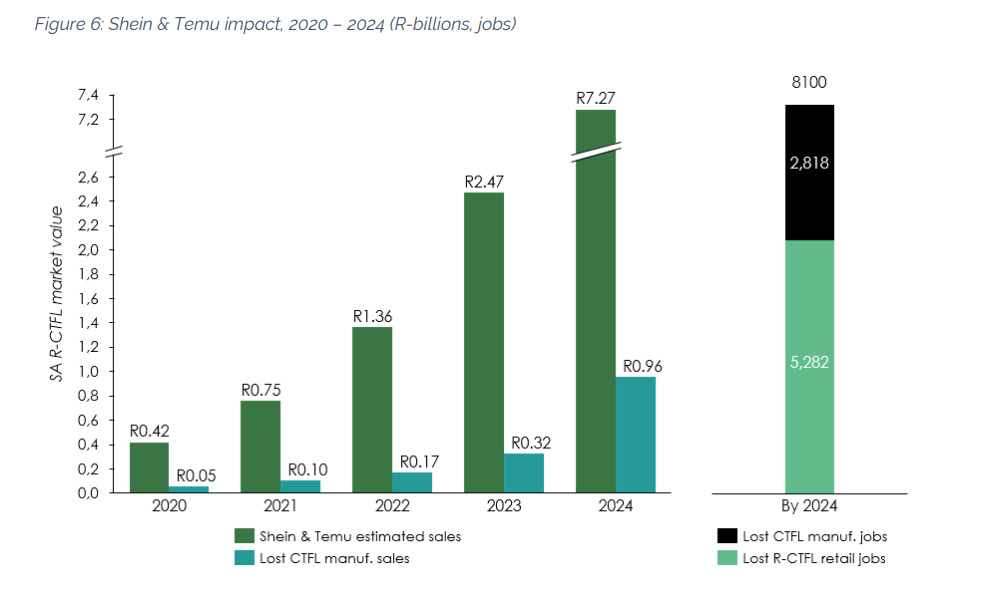
Shein and Temu have captured a disproportionate share of this growth, with an estimated R7.3 billion in sales in 2024, accounting for more than a third of all online clothing sales in South Africa.
Their growth has come at the expense of local players, taking away demand for products from domestic supply chains and undermining local employment.
The LSF estimated that more than 8,100 local job opportunities have not come into being because of Shein and Temu’s market presence.
“The surge in the market of cheap goods from these eCommerce offshore platforms is depressing the prices that local retailers can charge,” Simon Eppel, Director of Research at the SA Clothing and Textile Workers’ Union (SACTWU), said.
“This is smash-and-grab economics, an easy way to come into a country, grab what they can, and leave all the costs to us.”
The impact of the growth of Shein and Temu in South Africa can be seen in the graph below.
Benefits of Shein and Temu
Despite their significant negative impact on South African employment and manufacturing, Shein and Temu also have noticeable benefits.
Their presence and intense competition have helped drive down prices in South Africa, particularly in the eCommerce space.
This, in turn, has raised consumer expectations for lower pricing, convenience, and product variety, forcing local retailers to adapt.
A report from Boston Consulting Group (BCG) on South Africa’s eCommerce market found that international players’ entry into the country can bring significant benefits.
It also found that the intense scrutiny faced by Shein and Temu is not experienced by other international players, such as Amazon, which, in some cases, engages in similar tactics.
The report said the presence of these international players should not be frowned upon entirely, as it indicates that they will use the country as an entry point for regional expansion into Sub-Saharan Africa.
This means South Africa could become the continental eCommerce hub, potentially boosting local employment and economic outcomes.
The international players also bring with them sophisticated pricing strategies, vast product selections, and a willingness to invest in the country to expand their market share.
Their presence also has the potential to raise the bar for customer expectations from local retailers, resulting in improved offerings, prices, and experiences for local consumers.
This, in turn, may result in increased investment from local retailers to match their international counterparts, further increasing job opportunities and economic activity in the sector.
The LSF’s report also highlighted opportunities and lessons for local retailers and manufacturers, with the growth of Shein and Temu forcing them to up their game.
Shein and Temu have succeeded not only because of regulatory loopholes but also because of their highly digitised, data-driven supply chains and investment in supplier performance.
The report said that with the right support, South African firms could leverage similar approaches to build more agile value chains capable of competing globally.
Shein responded to the publication of the report, saying that it will continue to focus on its large and growing customer base in South Africa.
“We are proud that millions of consumers around the world, including our large and growing customer base in South Africa, choose to shop with us because they recognise our focus on value and quality,” Shein said.
“We are committed to building on this by empowering more local brands and creative talent to engage with Shein consumers around the world, as demonstrated by our recently announced partnership with local South African brand, House of One.”
“We operate a customer-driven, on-demand business model. Instead of trying to forecast trends and customer demand, Shein leverages digital supply chain technology to adapt our procurement decisions according to our customers’ preferences and purchases.”
“This model fundamentally differs from traditional mass-production approaches, specifically in reducing excess inventory waste.”
“We believe our approach represents part of the solution by reducing overproduction and waste at the source, and maintaining affordability.”






Comments