Spar forced to take stores away from some franchisees as it prepares to kiss R852 million goodbye


Spar is struggling with overdue retailer debt, which has forced the group to perfect general notarial bonds over some of its franchisees’ stores.
In other words, Spar had to use the store’s stock and equipment as collateral, legally stepping in to take control of the store’s operations to recover its money.
At the same time, Spar reported that its expected credit losses (ECLs) on retailer receivables surged from R405 million in 2025 to R852 million in the 2026 financial year.
This was revealed in a trading update that Spar released on Friday, 27 November, covering the 52 weeks ended 25 September 2026.
This update showed that Spar had a challenging 2026 financial year, as the retailer contended with increased Black Friday promotional investment and the underperformance of its KwaZulu-Natal distribution centre.
These factors, the group said, weighed on its earnings, which are expected to decline significantly.
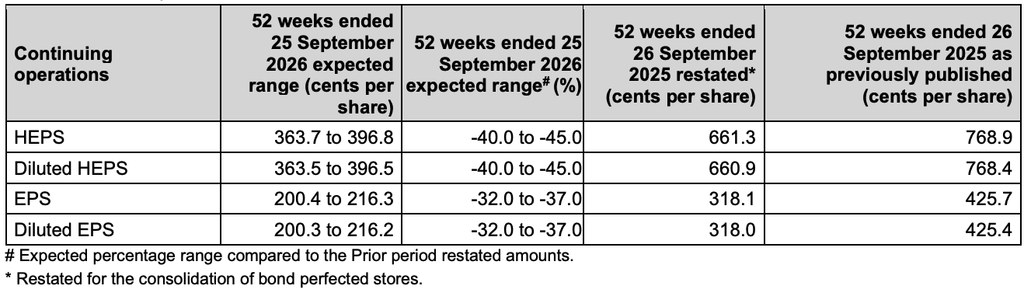
Spar expects its headline earnings per share (HEPS) from continuing operations to decrease by between 40% and 45%.
Earnings per share (EPS) from continuing operations are projected to fall by between 32% and 37%.
With discontinued operations included, Spar’s HEPS are expected to decline by between 65% and 70%, while EPS are projected to increase by between 108% and 109%.
This divergence between EPS and HEPS is due to base effects, with Spar having reported a basic loss per share in 2025 resulting from substantial capital impairments on its discontinued operations.
These capital impairments were included in Spar’s EPS, but not in its HEPS, resulting in the divergence.
Despite its weak earnings outlook, Spar said its underlying operating performance improved in the second half of the 2026 financial year as corrective actions gained traction.
“Group gross margin recovered from H1 2026 with net operating costs excluding ECLs decreasing meaningfully and the underlying operating performance at the KZN distribution centre improving,” the group said.
“Southern African net debt reduced materially from R4.6 billion at H1 2026 to R3.2 billion at year-end.”
Spar’s Irish operations performed well, growing both operating profit and profit before tax in euro terms despite inflationary cost pressures.
Spar taking over franchisee stores
Spar’s trading update also revealed that it has struggled to recover overdue retailer debt.
This has, in exceptional cases, forced the group to enforce its security rights over outstanding debts by perfecting general notarial bonds over the relevant store operations.
Perfecting the bond essentially allows Spar to take operational control of the debtor retailer’s business to try and recover outstanding debts.
This also means Spar was required to consolidate these stores directly onto its balance sheet as subsidiaries rather than treating them as independent third-party trade debtors.
These forced store takeovers come as Spar said its ECLs for the 2026 financial year reached R852 million, more than double the R405 million it recorded for 2025.
The group said the increase in ECLs was driven by its Grocery and Liquor business.
Spar said this segment came under pressure in the second half of the year, with retail trading hampered by concerns over possible looting following March’s protest action.
To address its rising ECLs, Spar said it completed a comprehensive review of its credit methodology, resulting in a once-off reset of its provisioning base.
Spar’s revised approach assesses exposures at store level, with revised assumptions on group-level offsets and cross-sureties.
It also incorporates more conservative recovery assumptions and specific provisioning where appropriate, including for perfected stores.
Spar also reported that, despite a decrease in its debt balance by year-end, its net financing costs rose by 8.9%.
This is because the group had a higher average net debt balance in Southern Africa over the course of the full year.
Log in or register for free access to all articles.



Conversation
1 commentsSPAR in SA in on a downward spiral, circling the drain at an ever increasing rate.