South Africa’s biggest retailer dumping Eskom


Shoprite has made significant strides in reducing its reliance on Eskom for electricity, with it investing heavily in rooftop solar systems at its stores and distribution centres.
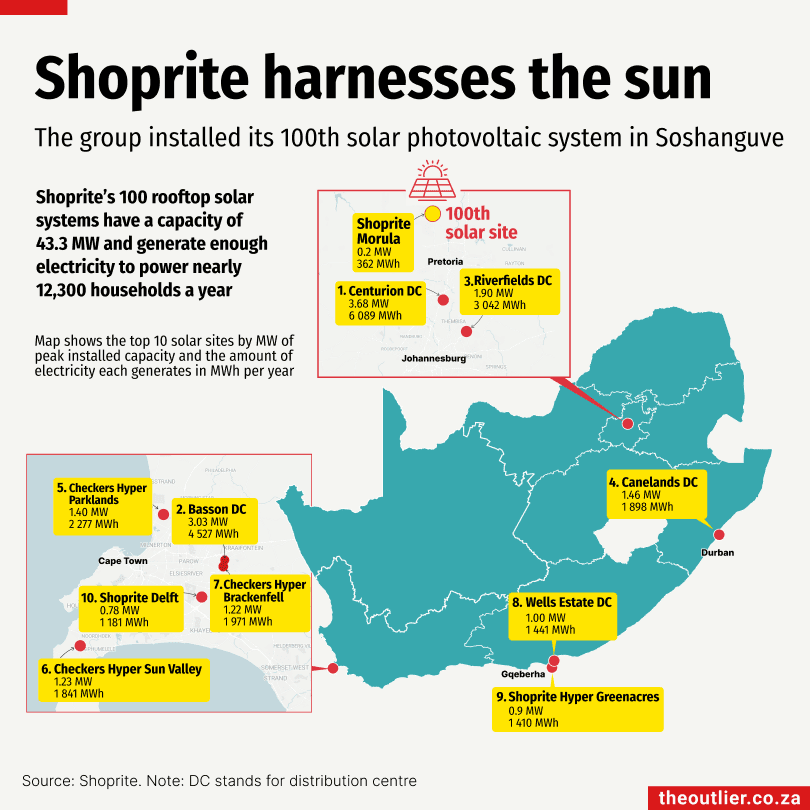
The company has installed over 100 solar systems across South Africa and Namibia, with a peak capacity of over 43.3 MW from its rooftop PV systems.
This could generate enough electricity to power nearly 12,300 households a year in South Africa and currently makes up 7.2% of Shoprite’s total energy consumption.
Shoprite’s efforts to reduce its reliance on Eskom-generated electricity are emblematic of a broader trend in South Africa, with businesses investing heavily in alternative energy sources.
This investment has continued despite the apparent end of load-shedding over the past 18 months, as companies look for ways to cut electricity costs amid surging prices.
As a result, the primary reason for this investment has shifted away from the need for a stable supply of electricity towards cost reduction, with energy prices significantly outpacing inflation over the past decade.
The Outlier revealed that in the 2025 financial year, 7.2% of Shoprite’s electricity came from renewable resources. This is up from 6.5% in 2024.
In 2025, Shoprite consumed 151,243 MWh of renewable energy across its operations, reducing its carbon emissions by 137,026 tonnes.
The company has also searched for ways to make this investment increasingly profitable for the business, with it being one of the first companies to wheel renewable electricity through the City of Cape Town’s grid in 2024.
It is currently wheeling electricity to 13 sites, including its home office in Brackenfell, and is actively seeking further wheeling partners.
Shoprite has also fitted 1,397 refrigerated trailers with solar panels, saving 3.2 litres of diesel per trailer per day and reducing emissions by an additional 6,000 tonnes.
This investment is only set to ramp up in the coming years, with the current level of renewable energy generation being less than a third of Shoprite’s target for 2030.
The scale of Shoprite’s investment in alternative energy sources can be seen in the graphic below, courtesy of the Outlier.
Cutting costs
Apart from reduced electricity costs, Shoprite is also investing in sustainable alternatives to reduce its tax liability with regard to carbon taxes in South Africa.
Currently, a carbon tax rate of R0.11 per litre of petrol and R0.14 per litre of diesel is levied in South Africa. A further R159 to R190 per metric ton of scope 2 emissions is levied.
The company’s tax liability was significantly reduced over the past year thanks to a reduction in load-shedding, which meant it did not use its generators as much and resulted in a sharp reduction in diesel usage and emissions.
In its latest sustainability report, Shoprite said it uses these taxes as part of its feasibility studies when looking at various energy-saving activities.
This includes rooftop solar, renewable energy wheeling, refrigeration efficiencies, and other energy-saving methods, such as switching from fluorescent lighting to LEDs.
“Our energy resilience plan aims to decrease grid dependence by enhancing energy efficiency and increasing renewable energy installations at our operations,” Shoprite said.
The main part of this plan is continued investment in alternative energy sources at Shoprite’s stores and distribution centres.
Shoprite said it has so far surpassed its annual targets with regard to renewable energy generation and is on track to meet its 2030 targets.
This should see its consumption from renewable energy nearly triple to 20% of the company’s total energy demand.
Outside of its investment in renewable energy generation, Shoprite’s investments in increased efficiency are beginning to bear fruit.
For example, it is estimated that by replacing conventional fluorescent lamps with LEDs in all its South African stores and distribution centres, it cut 20% of its annual electricity consumption, which is equivalent to around 108,106 MWh.
Shoprite’s next focus in this regard is reducing energy consumption from its refrigeration systems at its stores and distribution centres.
This demand accounts for around 40% to 50% of Shoprite’s annual energy consumption, meaning that any increase in efficiency will have a significant impact on total electricity costs.
The company is currently testing out various interventions in this regard, starting with retrofitting open refrigerators and freezers with doors, upgrading fans, and installing capacity control on refrigeration systems.
Shoprite said these initiatives will be implemented in line with its store refurbishment cycle over the next two to four years.
 Loading ...




Comments