Major threat to Checkers, Pick n Pay, and SPAR


South African retailers are increasingly reliant on promotions to drive sales and foot traffic, with this tactic becoming embedded in how the market operates.
However, while promotions have become vital for winning footfall and driving volume, they are becoming less impactful as they become expected rather than exceptional.
The high dependence on promotions also indicates a lack of consumer loyalty, with customers shopping around for value rather than returning to the same store.
This was revealed in Trade Intelligence’s 2026 South African Retail Outlook, which analysed the trends seen in the local retail space and how they are impacting businesses.
In 2025, Trade Intelligence noted that real retail growth returned, particularly in food and everyday essentials, but it was hard-won.
Households remained under pressure, juggling debt, utilities and food costs, while retailers and manufacturers competed intensely for market share across formats and channels.
In this environment, price and promotions became central to retailers’ strategies, a natural response to constrained shopper budgets and heightened competition.
Discounting helped protect volumes, loyalty programmes influenced trip decisions and ‘value’ became increasingly synonymous with visible price savings.
As the year progressed, it became clear that the reliance on promotions had become embedded in how the market operates, Trade Intelligence said.
South Africa has one of the highest levels of “promotional intensity” in the world, with a significant share of sales driven by specials.
The country’s retailers have a high and increasing reliance on special offers, discounts and promotions.
Looking at the retailers specifically, Clicks is at the high-end of the spectrum, where 47% of revenue comes from products sold on promotion.
There are different attitudes to promotional intensity levels, with Clicks embracing its high level of promotional intensity, while Shoprite warns of margin erosion.
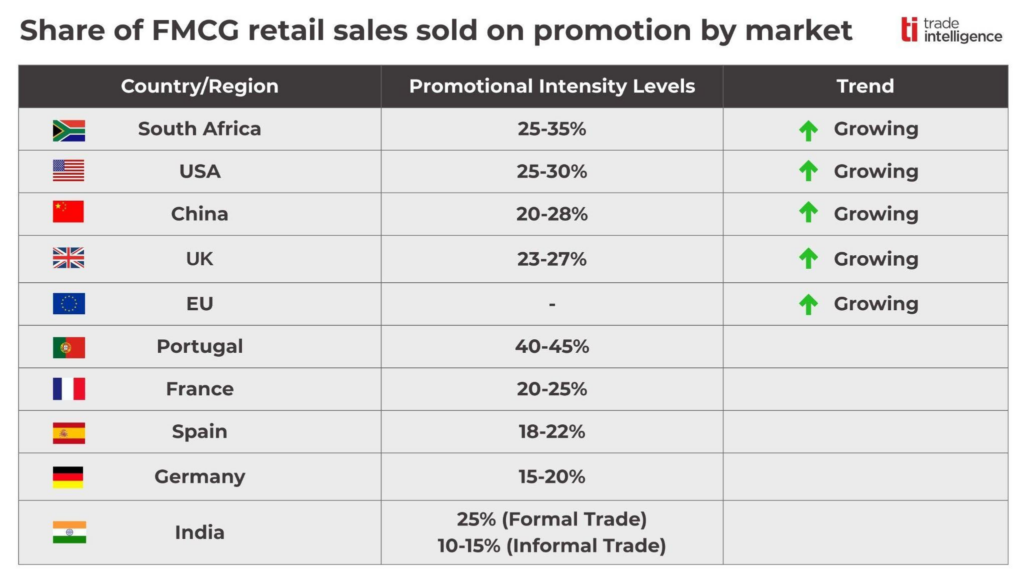
Promotions lose their shine
With promotions becoming increasingly common, they are becoming less effective as it becomes the norm rather than the exception.
A key pitfall of sustained, high promotional activity across the market is that promotions do not automatically build loyalty, Trade Intelligence said.
“Shoppers are highly fluid, cherry-picking offers across retailers and brands, and they are often guided by loyalty apps and digital price comparisons,” Trade Intelligence senior analyst Nicola Allen said.
According to Trade Intelligence research, 58% of South African household shoppers shop at four or more different retailers and have, on average, 3.6 loyalty cards.
“The abundance and constant nature of promotions has also led to the emergence of ‘promo-only shoppers’, who wait for their items to go on promotion before buying,” Allen said.
At the same time, retailers and manufacturers face limits on how much cost pressure they can absorb internally, how aggressively they can promote, and how far prices can be pushed without undermining brand positioning or shopper trust.
High promotional intensity brings diminishing returns, margin pressure and narrows the scope for further price-led growth.
The declining effectiveness of promotions is not the only challenge that consumers’ continued hunt for value has presented to South African retailers.
This trend has seen households increasingly shopping at independent retailers and wholesalers, with these businesses competing more closely with their formal counterparts.
In its latest annual report, SPAR warned of the impact of independent retailers and wholesalers on its business, with its unique operating model coming under pressure from these businesses.
SPAR said its wholesale model depends on a strong relationship between the company and independent retailers, with brand loyalty being a key driver of sustained growth.
“Reduced loyalty or store exits diminish volume throughput and weaken economies of scale, thereby eroding group competitiveness in key markets,” it said.
“Sustained margin pressure and the emergence of alternative buying groups further threaten network cohesion and long-term brand equity.”
SPAR relies heavily on loyalty from independent retailers to its network, with the company leveraging economies of scale to become the preferred supplier.
The retailer is far from the only one affected by this rising challenge, with Trade Intelligence’s data indicating that the shift towards independent retail is widespread among shoppers.
Trade Intelligence estimates that the formal independent retail and wholesale sector is now valued at R268 billion, accounting for nearly a third of the country’s fast-moving consumer goods market.
The firm’s data shows that 11% of South African households shop in the sector, meaning it has the same reach as Clicks, nearly four times Woolworths’, and not far off Checkers at 18%.




Comments