Property boom in Cape Town


The global prime residential market remains resilient, with Cape Town standing out for its strong rental growth, fuelled by limited supply, high demand, and post-election stability.
According to Savills World Cities Prime Residential Index, in the first half of 2025, prime residential markets across the world performed well in the face of economic and geopolitical uncertainty, with rental values outpacing capital growth.
While capital values rose by a modest 0.7% across the 30 cities monitored in the index, prime residential rents increased by 2%.
This reflects a growing investor preference for income-generating assets and a shift in tenant behaviour amid ongoing market volatility.
“Despite a slowdown from the 2.2% growth recorded in 2024, capital values remained in positive territory, with 60% of cities posting gains in the first half of the year,” said Savills World Research associate director Kelcie Sellers.
“Most markets with price falls only saw slight declines. Cities with negative price growth were primarily the larger cities where residential property can be more costly to obtain, such as London, Paris, Shanghai and Los Angeles.”
Tokyo led the Index with 8.8% growth in H1 2025, driven by a chronic shortage of new stock and resilient demand from both domestic and international buyers. Capital values are forecast to rise by a further 6% to 7.9% over the second half of 2025.
Berlin, Dubai, and Seoul each posted growth above 5%, supported by constrained development pipelines and strong buyer sentiment.
Dr Andrew Golding, chief executive of the Pam Golding Property Group, which is Savills’ exclusive residential real estate partner in Africa, noted the importance of lifestyle appeal.
“The Savills Index notes that cities with strong lifestyle appeal, such as Amsterdam, Cape Town, Lisbon, and Sydney, saw positive growth, buoyed by low levels of prime stock and sustained international interest.”
“The lifestyle-driven nature of these markets continues to attract buyers, many of whom are less sensitive to short-term economic fluctuations. This sustained level of demand is likely to support further price growth.”
Looking ahead, Savills forecasts average capital value growth of 1.5% across the Index in H2 2025, with Cape Town, Seoul and Tokyo expected to lead the way with anticipated growth of 6% to 7.9%.
The table below shows the top 10 cities in the Savills World Cities Prime Residential Index ranked by capital value growth for H1 2025.
| City | Capital value growth – H1 2025 | Capital value forecast – H2 2025 | Prime capital value June 2025 (€ psm) | Prime capital value June 2025 (R psm) |
|---|---|---|---|---|
| Tokyo | 8.8% | +6% to 7.9% | €22,900 | R470,041 |
| Berlin | 7.2% | 0.0% | €11,800 | R242,226 |
| Dubai | 5.7% | +4% to 5.9% | €9,600 | R197,065 |
| Seoul | 5.1% | +6% to 7.9% | €19,300 | R396,184 |
| Amsterdam | 3.6% | +2% to 3.9% | €10,500 | R215,531 |
| Cape Town | 3.2% | +6% to 7.9% | €2,600 | R53,369 |
| Geneva | 2.7% | 0.0% | €24,300 | R498,849 |
| Lisbon | 2.4% | +4% to 5.9% | €14,200 | R291,508 |
| Sydney | 1.8% | +4% to 5.9% | €19,700 | R404,417 |
| New York | 1.2% | -1.9% to 0% | €25,800 | R529,716 |
Prime rental boom

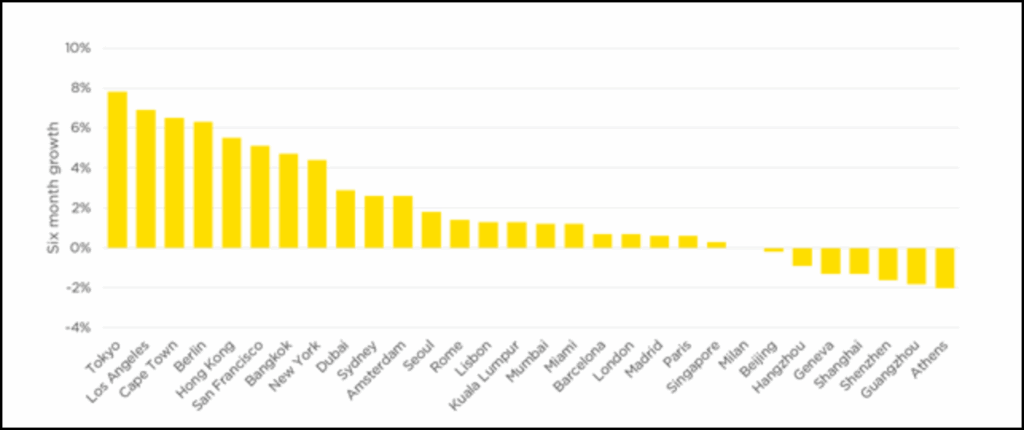
According to Savills’ index, prime residential rents across the 30 global markets have proven even more resilient.
Impressively, 23 out of the 30 cities in the Savills index recorded rental growth in H1 2025, reflecting the continued global demand for top-tier rentals in key destinations.
Tokyo again led the charge. Driven by limited supply and strong demand, prime residential rents in the city increased by 7.8% in the first six months of 2025 and by 13.5% year-on-year.
Cape Town saw strong rental growth of 6.5%, again driven by a shortage of prime rental properties and high demand, and stability in the market following elections in 2024.
While rental growth in Europe was slightly more muted than in other regions, there was still an overarching trend towards price stabilisation. The highest rental price increases were seen in Berlin (6.3%), Amsterdam (2.6%), Rome (1.4%), and Lisbon (1.3%).
Almost all markets that experienced declines during the first half of 2025 are located in China, with six-month growth ranging from a decline of 0.2% in Beijing to 1.8% in Guangzhou. These falls come amid weak demand and high supply.
“For the remainder of 2025, we expect rental growth of, on average, 1% across the 30 cities we monitor, reflecting a general sense of cautious positivity,” Sellers said.
The graph below shows the prime residential rental growth by city in H1 2025, according to Savills.






Comments