South Africa’s window of opportunity is closing


Rising oil prices could delay interest rate cuts and briefly slow South Africa’s economic recovery. In particular, the country’s housing market could be hard hit.
This is according to Landsdowne Properties CEO Jonathan Kohler, who explained that geopolitical tensions in the Middle East may have unexpected local consequences for South Africa’s housing market.
“Rising oil prices linked to conflict involving Iran could slow local interest rate cuts, briefly delaying the residential property recovery,” Kohler said.
“Paradoxically, that delay may create a narrow buying window for South African home buyers and investors before the next phase of the property cycle begins, with house prices still growing modestly while underlying demand strengthens.”
Internal comparative sales data from Landsdowne across its national network shows a clear increase in enquiry levels and transaction activity over the past several months.
The FNB Property Barometer also indicates improving buyer confidence as interest-rate expectations stabilise.
Mortgage originators Ooba Home Loans and BetterBond have also reported rising home-loan application volumes as affordability conditions begin to improve.
“After several difficult years for the housing market, the mood has clearly shifted. However, global developments could complicate this recovery,” Kohler said.
He cautioned that escalating conflict involving Iran has already begun pushing global oil prices higher.
Brent crude was trading around $92 to $94 per barrel in early trade on 10 March, after briefly surging to near $120 the previous session due to renewed conflict in the Middle East.
This decline has been attributed to United States President Donald Trump suggesting that the war against Iran could end “very soon”, which saw oil prices drop from their four-year high.
This statement, along with Trump’s comments that the war on Iran is “very complete, pretty much”, was met positively by the market, with Brent crude prices dropping to below $90 a barrel.
However, Trump also made comments which suggested that the conflict would continue. “We have won in many ways,” he said. “But not enough.”
“If Iran does anything that stops the flow of Oil within the Strait of Hormuz, they will be hit by the United States of America TWENTY TIMES HARDER than they have been hit thus far,” Trump wrote in a social media post.
Much of that concern centres on the Strait of Hormuz, one of the world’s most important energy corridors.
“According to the United States Energy Information Administration, roughly 20% of global petroleum liquids consumption moves through this narrow shipping route. If tensions escalate further, global energy markets could become even more volatile,” Kohler said.
Petrol prices and the economy

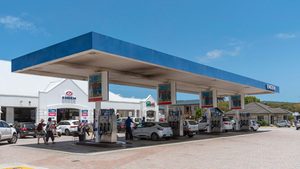
“South Africa imports most of its fuel, which means global oil price movements feed directly into local petrol and diesel costs,” Kohler said. “At the same time, domestic policy changes will already push prices higher.”
In the 2026 national budget, Finance Minister Enoch Godongwana confirmed that the general fuel levy and Road Accident Fund levy will increase by a combined 21 cents per litre from April 2026.
Kohler noted that fuel prices have a broad impact on inflation in South Africa. According to Statistics South Africa’s Consumer Price Index (CPI) basket, the transport category accounts for about 13.6% of the national CPI basket.
This makes it one of the largest contributors to inflation. “Historical CPI data from Statistics South Africa shows how powerful this transmission can be,” Kohler said.
“During previous fuel-price spikes, transport costs have contributed as much as 2.1 percentage points to headline CPI, making it one of the biggest drivers of inflation increases.”
Kohler explained that inflation matters because of how the South African Reserve Bank (SARB) responds to it.
“The central bank has increasingly emphasised anchoring inflation closer to 3%, the lower end of its traditional 3% to 6% target band, a position frequently outlined by SARB Governor Lesetja Kganyago.”
“If higher oil prices push inflation expectations upward, the SARB may need to keep monetary policy tighter for longer.”
The repo rate currently stands at 6.75%, placing the commercial bank prime lending rate at 10.25%.
“Mortgage affordability remains closely tied to this interest-rate path. Many forecasts assume borrowing costs will gradually decline over the next 12 to 18 months, but energy-driven inflation could slow that process,” Kohler said.
Homebuyers on a shot clock

Kohler explained that, against this volatile backdrop, there may be an opportunity for prospective homeowners and investors.
Despite improving sentiment, house price growth across much of South Africa – with the notable exception of the Western Cape – has remained relatively moderate.
According to Statistics South Africa’s Residential Property Price Index, residential property prices increased by about 6.3% year-on-year in 2025.
Private sector data shows a similar trend. The FNB House Price Index recorded annual growth of around 4.9% in late 2025, while industry forecasts expect roughly 6% price growth in 2026 as the market gradually recovers.
Regional differences remain significant. Statistics South Africa’s property price index shows stronger price growth in coastal regions such as the Western Cape, reflecting ongoing semigration trends.
In real terms, however, many parts of the housing market are only beginning to recover after several years of higher interest rates and weak economic growth. For buyers, this creates a window that may not remain open for long.
“Property markets rarely move in perfect alignment with economic cycles. By the time interest rates clearly turn and confidence returns across the board, prices have usually already begun adjusting upward,” Kohler said.
“Ironically, the same global pressures that could delay interest-rate cuts may also support property values over time.”
Higher oil prices tend to increase construction and development costs by raising the prices of materials, transport, and energy inputs.
“Rising replacement costs have historically supported property values, particularly where housing supply is limited,” he said.
“At the same time, South Africa’s structural housing demand remains intact. Urbanisation continues, household formation is increasing, and demand for secure, well-located housing remains strong across major metropolitan areas.”
Kohler explained that, for tenants in South Africa considering a property purchase, the calculation is becoming clearer.
“Buying a property today provides certainty on price and housing costs at a time when the global economic outlook is becoming more volatile,” he said.
“For investors, acquiring well-located residential property before the next phase of the cycle can still provide both rental income and long-term capital growth.”
While the global outlook may be entering a more uncertain phase as geopolitical tensions push energy markets higher, Kohler said property cycles rarely wait for perfect conditions.
“For buyers with stable income and long-term horizons, the current market may represent an opportunity that will only become obvious in hindsight,” he said.




Comments