South Africa’s property market is going from zero to hero


South Africa’s residential property market is poised for a cautious rebound in 2026, with estate agents expecting stabilising demand, rising activity from first-time buyers and investors, and improving sentiment.
Lightstone recently reported that the vast majority of estate agents expect South Africa’s residential property market to improve in 2026.
The expectation is reinforced by many property observers who say they are “cautiously optimistic” that demand will stabilise.
This sentiment comes as interest rates moderate and consumer confidence improves after a period of stagnation and affordability pressures.
First-time buyers and upgraders may accelerate activity, particularly in suburban and lifestyle nodes outside major metros.
However, affordability challenges remain for middle-income households, keeping growth moderate rather than explosive.
“While 2025 was a tougher year than many estate agents anticipated, the confidence we’re seeing going into 2026 is notable,” said Lightstone’s Managing Executive of Real Estate, Hayley Ivins-Downes.
“Expectations are being reset, but agents are clearly encouraged by signs of stabilising demand, easing interest rate pressure and improving sentiment across key residential segments.”
Investment activity in rental and income-producing residential assets could rise, driven by institutional interest.
Continued urbanisation and demand for secure, well-located housing will support selected segments, but overall growth will hinge on economic performance, financial accessibility, and employment trends.
Lightstone’s annual survey of Estate Agents at the end of 2025 found 69% said they did not reach volume targets in 2025, and 62% said they fell short of value targets.
However, despite falling short in 2025, 87% of estate agents said they expected to reach sales volume targets in 2026, up marginally from 86% the year before, where just 26% reached their targets.
Estate agents said they are less bullish about reaching sales value targets, at 82% compared to 85% the year before.
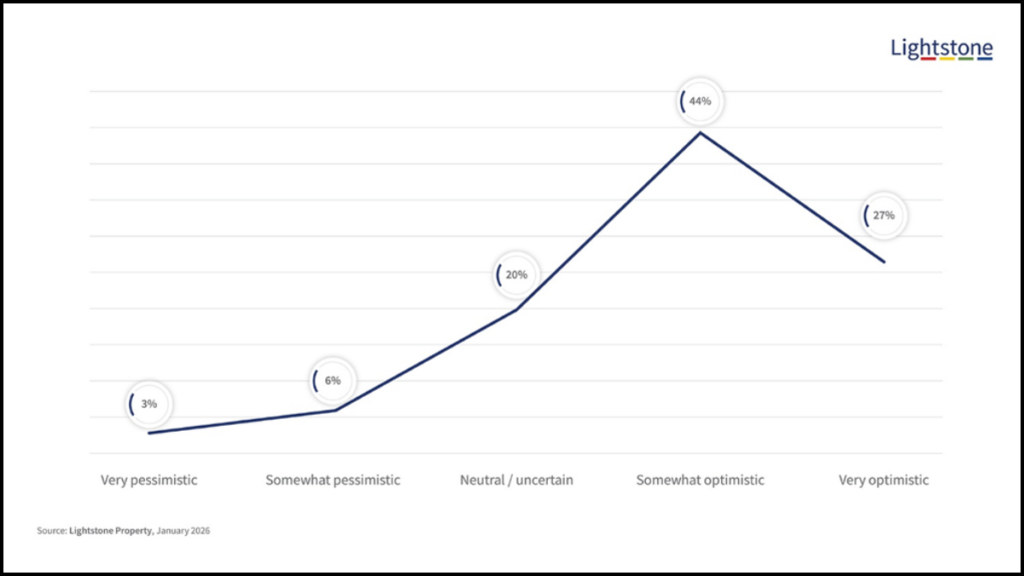
Estate agents optimistic for 2026
While Lightstone’s findings suggest that nearly two-thirds of agents performed worse than anticipated in 2025, the tough year hasn’t dented expectations for 2026.
Positively, 71% of Estate Agents said they are either “very optimistic” (27%) or “somewhat optimistic” (44%) about growth opportunities over the next twelve months.
A fifth (20%) indicated that they are “neutral” or “uncertain”, with just 9% either “somewhat” or “very pessimistic”.
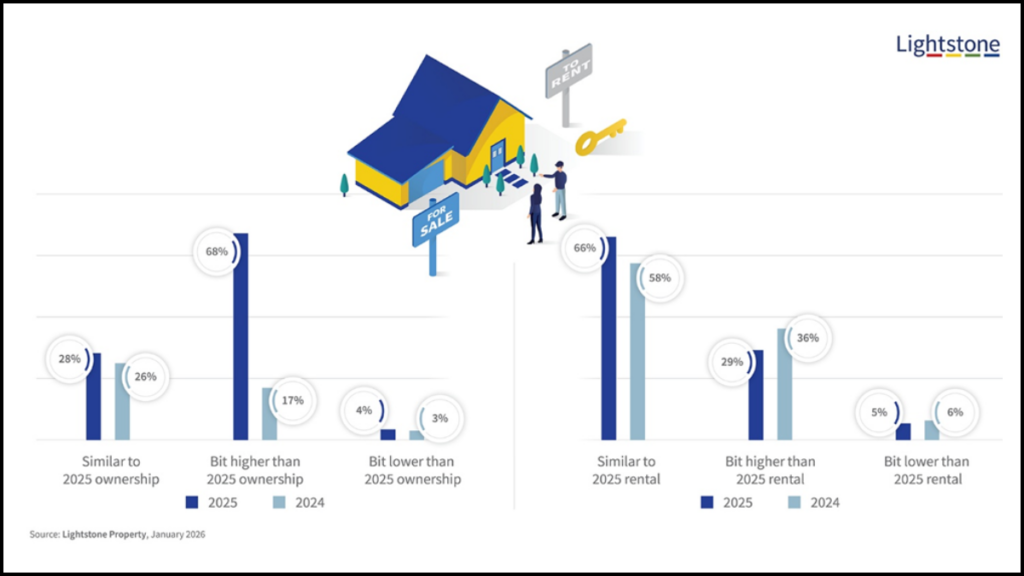
Just over two-thirds expect demand for property to rise in 2026, while 66% expect demand to rise in the rental market.
Estate agents noted a shift in buyer preferences in 2025, with security becoming the primary attribute house buyers were looking for (30%) when compared with 2024 (19%).
All other attributes – including green features, buy-to-rent, work-from-home space, and lifestyle and amenities – fell in importance in 2025.
Of the four, lifestyle and amenities were next most important after security at 26%, down from 33% the year before, followed by enough space to accommodate a home office.
“What’s clear from the data is that buyers are looking for secure homes,” Ivins-Downes said. “Security, location and long-term value are outweighing lifestyle extras, while downscaling and relocation continue to drive seller activity.”
“These preferences reflect structural changes in how households are responding to affordability pressures as well as work and lifestyle patterns.”
Lightstone also reported that downscaling and relocation accounted for nearly 60% of homeowners who sold up and moved on.
A third of sellers listed downscaling as the primary reason they sold in 2025, with 19% citing a lifestyle change and 14% citing financial difficulty.
Meanwhile, relocating to another province (14%) and relocating to another city or town (10%) made up 24%.






Comments