ANC breaking South Africa’s most iconic industry


South Africa’s iconic gold mining industry is a shell of its former self, despite there being evidence that a rich natural bounty remains.
This is because of the rising costs of operating a mine in South Africa and the increasingly burdensome regulations imposed on the sector.
Coupled with these factors has been high levels of policy uncertainty, difficult labour relations, and poor service delivery, particularly in relation to water and electricity.
As a result, South Africa has gone from being one of the best jurisdictions in the world in which to operate a mine to among the worst.
This means that mining companies have been hesitant to invest in South Africa, explore for new mineral deposits, or expand their existing operations in the country.
Thus, the industry that built modern South Africa and is still largely the backbone of its economy is operating as a shadow of its past self.
Modern Corporate Solutions mining analyst Peter Major explained that it has simply become too difficult to operate gold mines in South Africa, despite evidence of a rich natural bounty.
“This country could have revised its resources bounty up threefold an dbeen conservative. Unfortunately, the people are not really looking for the big deposits here anymore,” Major told BizNews.
“We have got them here, but we have no way of developing them. We have no way of attracting money to develop them because they are going to take five to ten years.”
Major pointed to the example of the world famous South Deep mine operated by Gold Fields near Johannesburg as an indication of the country’s rich bounty.
“South Deep was the gem without the illusion. South Deep arguably was set to have 100 million ounces of gold in its deposits,” Major said.
“I think they drilled and had the area blocked out. They were pretty sure it was least 75 million ounces and up to 100 million ounces.”
“So yeah, we have got these deposits and we had it at South Deep, but they have had to keep revising downwards nearly every years because of the costs in this country are so high.”
Major explained that this is partly due to the nature of South Africa’s current goldmines, which are among the deepest in the world nad the most expensive to run.
South Deep’s main shaft is around 3,300 metres underground, which creates immense operating challenges in terms of equipment, personnel, and machinery.
“So, they kept revising that 75 million ounces down to 60, then 50, and then 40. I am out of touch, I am not sure what it is now, but I bet they will revise it up because of the gold price currently,” Major said.
This points to a deeper problem within South Africa’s mining industry, with the sector’s myriad of challenges being covered up by skyhigh metals prices.
During periods of high prices, these costs can be relatively easy to cover, and mines are highly profitable. However, when the cycle turns, these high prices bite and may push mining companies to downscale their operations or shut down entirely.
The Minerals Council said electricity prices have risen by 16% year-on-year, water has surged by 12%, and labour costs are up by 6%, warning that once the commodity boom is over, these costs will remain.
The council said these price increases are eroding the competitiveness of the South African mining industry, making it less attractive for investment.
Destructive policies
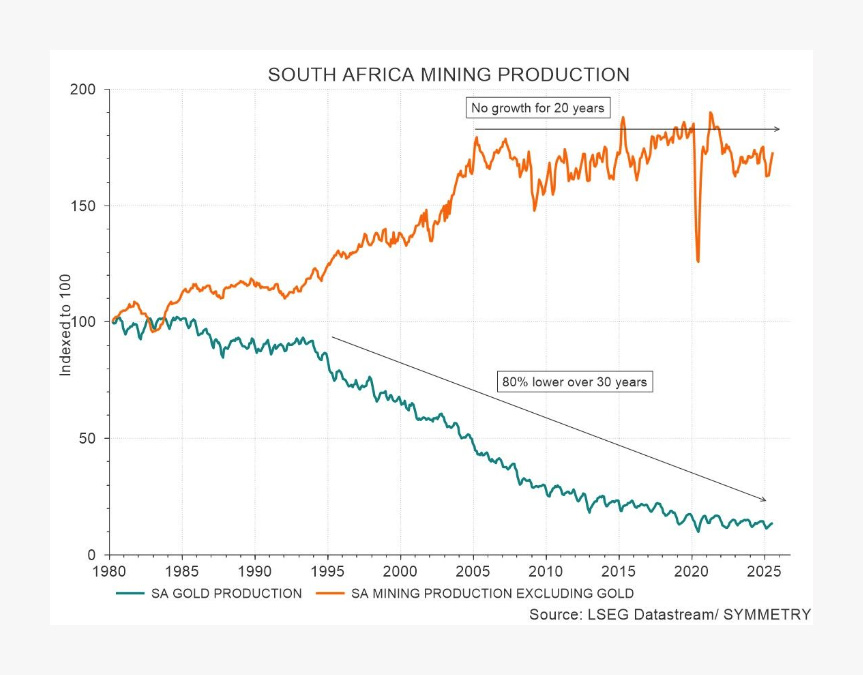
Apart from mismanagement resulting in surging prices for key inputs such as electricity and water, government policies over the past 30 years have made the country’s mining industry uncompetitive globally.
This has translated into minimal investment in exploration and expansion from mining companies, with the sector’s output declining by an annual rate of 0.4% since 1994.
As a result, it is estimated that South Africa’s gold mining industry alone has lost around half a million jobs, with other subsectors having lost over 100,000.
Major has placed the blame for this squarely on the ANC’s decision to implement the Mineral and Petroleum Resources Development Act (MPRDA) of 2002.
Since this piece of legislation has been neacted, there has been little to no exploration in South Africa for new mineral deposits and the country’s mining output has flatlined.
While South Africa has not nationalised any mines, this piece of legislation has still had a chilling effect on investment as it has eroded the rights of mining companies.
“Can you imagine working your whole life, decades, building the most modern, efficient plant? And then you wake up one day, and the dirt it is sitting on is no longer yours?” Major asked.
“The government tells you, ‘Your plant may be sitting on some dirt, but you don’t own any of that dirt. And if you do everything we tell you, you might use it for 20 years, 25 years, and then we will decide if we want to renew it.’”
Major said this shift dramatically changes the investment case for mining in South Africa, with it significantly increasing the hurdle above which the reward justifies the risk.
“Mines are a hundred-year investments. So, are you happy investing now? Somebody else took away your minerals, but they will let you borrow them with a lot of different terms and conditions than the day before,” Major said.
“That is something that just does not register with Pretoria. It does not register with the mindset that the ANC has or indeed that South Africa has.”
The destructive policy of the MPRDA type has crushed South African mining, turning an industry that was once the envy of the world into a shell of its former self.
“We were a leviathan in 1980. Nobody could beat us. Anglo American was the largest investor in the United States. The Americans were terrified of us,” Major said.
“When the new administration took over, it decided to try to totally revamp mining law in South Africa and copy what other African nations did,” Major said.
“It said, ‘We will nationalise these mines and take them back. They are no longer private property but are the state’s property.’”
“You can imagine. You put billions into projects for 100 years and are now threatened with state ownership. New investment just stopped. Exploration and expansion just stopped. Why put money in something the state owns?”
Major explained that this was coupled with constant changes to regulations and transformation legislation.
“You first had to have a BEE partner that owned 25%, and that quickly increased to 30%. And then, they said 70% of the money you spend had to go to BEE suppliers,” he said.
“As if nationalising property was not enough, they put on all these horrendous conditions that drove capital away.”
For investment to increase in South Africa’s mining sector, drastic changes will need to be made to make the industry more attractive to capital.
“We are only in a bad position because we have got the wrong bus driver. We have a busload of good people and a busload of great assets, but we have the same driver we have had for the past 30 years,” Major said.



Comments