Money flooding out of South Africa


Foreign investors have been steadily withdrawing money from South African assets, with this trend accelerating in recent years as political uncertainty and economic stagnation worsen.
In particular, foreigners have been dumping South African equities for the past decade, with some estimates putting the sum taken out of the country at R1 trillion.
On the other hand, South African bonds have fared much better, with the high yields offered on local debt keeping foreign investors interested.
Stanlib economist Kevin Lings explained that foreign investment can be seen as an indication of a country’s economic fortunes.
Increasing foreign investment tends to indicate better economic performance and can create a positive feedback loop: Strong economic growth results in increased investment, which, in turn, drives further growth.
This was the case in the early 2000s, when foreign investors pumped money into the country based on strong economic growth and fiscal discipline.
Under Thabo Mbeki’s presidency, the economy averaged annual growth of over 3%, and foreign investors rushed into South African assets, snapping up $70 billion worth from 1994 to 2011.
The JSE during this period averaged an annual return of 14%.
The story of the most recent decade has been almost the exact opposite, with foreign investors beginning to sell South African assets at a rate of knots from 2016 onwards.
In less than a decade, foreigners have reduced their equity holdings in South Africa from $70 billion to $10 billion, and the JSE’s returns barely outpace inflation.
This has led to many local investors and asset managers looking offshore for better returns, further eroding investment in South Africa.
From 2016 to 2024, the hard work done by the first two administrations was undone, with foreign investors losing trust in the government’s promises to turn things around.
In this context, Lings said it is difficult to sell South African equities to clients. Even since the formation of the GNU, foreigners have continued to sell local equities every month.
This trend has continued in 2025, with foreigners being net sellers of local equities for the first few months of the year. The graph below displays this.

Government bonds holding their own
One area in which foreign investors have begun to return is government bonds, which offer attractive risk-adjusted returns.
As such, these assets have not experienced as significant outflows as local equities over the past decade and have actually seen net inflows for the past few quarters.
The Reserve Bank’s data showed that non-residents snapped up debt worth R53.1 billion in the fourth quarter of 2024.
This followed strong buying activity in the third quarter of the year, where foreigners bought R41.4 billion worth of debt.
The bank explained that this buying activity includes the proceeds from the national government’s issuance of two international bonds amounting to $3.5 billion.
This was largely due to increased investor confidence in South Africa after the formation of the Government of National Unity (GNU) in June 2024.
The GNU is largely seen as the most business-friendly in South Africa’s democratic era and has crucially renewed its commitment to key reform measures.
For investors, the GNU has made local debt more attractive as it is committed to fiscal consolidation and improving the government’s finances.
The GNU has also significantly reduced the risk premium attached to South African assets, making the country’s high-yield debt very attractive.
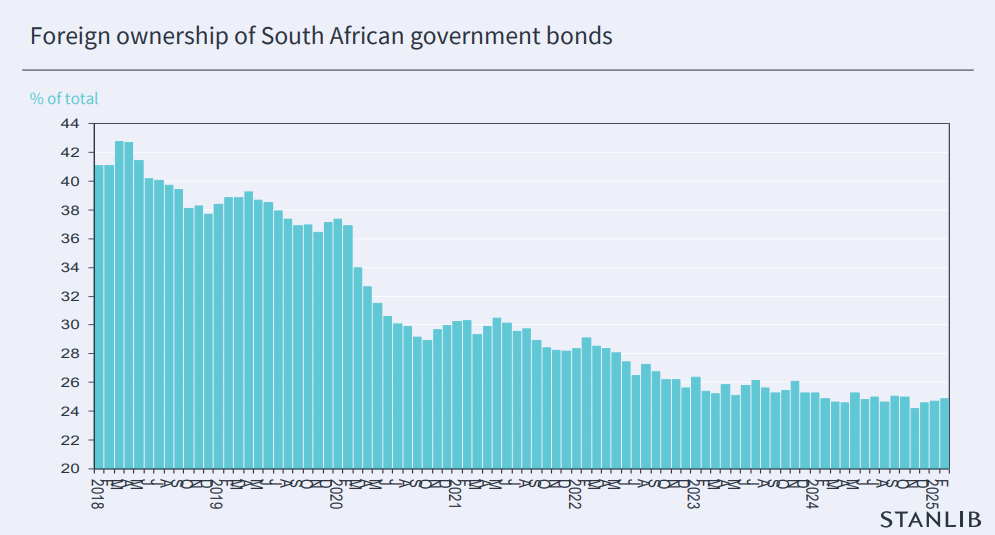
However, at the same time, the government’s overall debt level has skyrocketed, meaning that foreign ownership as a share of total government debt has declined.
Foreign ownership of South African government bonds has plummeted from over 40% in 2018 to around 26% in 2025.
This trend has stabilised as foreign investors return to the local bond market, but a much improved economic performance and fiscal discipline are needed to return ownership to healthier levels.
 Loading ...





Comments