Foreigners dump South African stocks


Foreign investors bought up South African bonds in the fourth quarter of 2024 as the government issued new international debt, and high yields continue to make local fixed-income assets attractive.
However, they continue to dump South African equities as the local economy remains stagnant and geopolitical uncertainty pushes investors to safe havens, such as United States-based assets.
The Reserve Bank’s Quarterly Bulletin for the fourth quarter of 2024 outlined the dire state of South Africa’s economy.
Data from the bank shows that the local economy only managed to grow at an average annual rate of 0.8% for the past decade, while its population grew at 1.6% per year.
This meant that South Africans, on average, got steadily poorer over the last ten years, significantly impacting consumer confidence and spending.
More fundamentally, this slow growth limits the earnings potential of South African companies and, thus, the returns they can provide investors.
As a result, the JSE All Share Index’s returns have barely beaten inflation over the past decade, making it a highly unattractive place for investors to allocate capital.
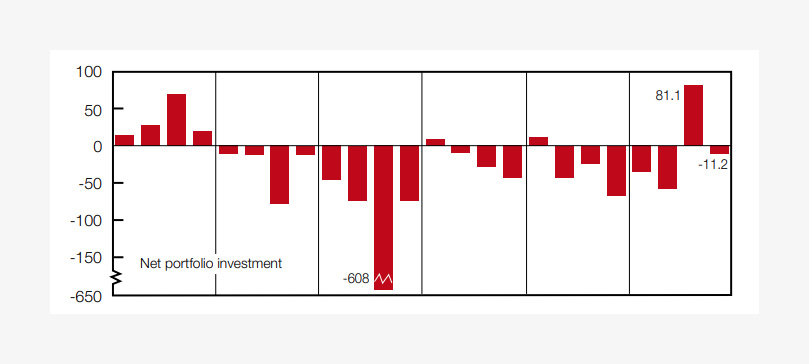
Non-residents sold as much as R19.7 billion of South African domestic stocks traded on the JSE in the fourth quarter, reversing a purchase of R4.1 billion in the third quarter.
The last time there was a selloff of that magnitude was in the third quarter of 2023.
The Reserve Bank said the net sales of domestic shares by non-residents were dominated by the selling of stocks in the software and computer services sector and precious metals and mining.
“The persistent sell-off in the domestic secondary share market by non-residents reflected continued global risk aversion due to, among other factors, ongoing geopolitical tensions, uncertainty around US tariffs, and China’s economic slowdown,” it said.
“The biggest drivers behind foreigners selling indicates a general decline in investor sentiment toward emerging markets and weak domestic economic growth.”
The graph below shows the net portfolio investment of non-residents in South African assets.
Government debt remains attractive
In contrast, foreign investors continue to be attracted to South African debt, which offers attractive yields at relatively low risk.
The Reserve Bank’s data showed that non-residents snapped up debt worth R53.1 billion in the fourth quarter of 2024.
This followed strong buying activity in the third quarter of the year, where foreigners bought R41.4 billion worth of debt.
The bank explained that this buying activity includes the proceeds from the national government’s issuance of two international bonds amounting to $3.5 billion.
These purchases outweighed the selling of equities, resulting in an overall net inflow into South African assets of R33.4 billion in the fourth quarter.
Throughout 2024, non-residents were net buyers of R6.9 billion worth of local financial assets, a major swing from a net outflow of R99.3 billion in 2023.
This was largely due to increased investor confidence in South Africa after the formation of the Government of National Unity (GNU) in June 2024.
The GNU is largely seen as the most business-friendly in South Africa’s democratic era and has crucially renewed its commitment to key reform measures.
For investors, the GNU has made local debt more attractive as it is committed to fiscal consolidation and improving the government’s finances.
The GNU has also significantly reduced the risk premium attached to South African assets, making the country’s high-yield debt very attractive.
The Reserve Bank also revealed that foreign companies invested heavily in local subsidiaries in the fourth quarter, bringing R7.5 billion into the country.
Throughout 2024, foreign companies invested R45.3 billion in their local subsidiaries, a significant boost to the local economy.
 Loading ...





Comments