Tables turn on South African investors



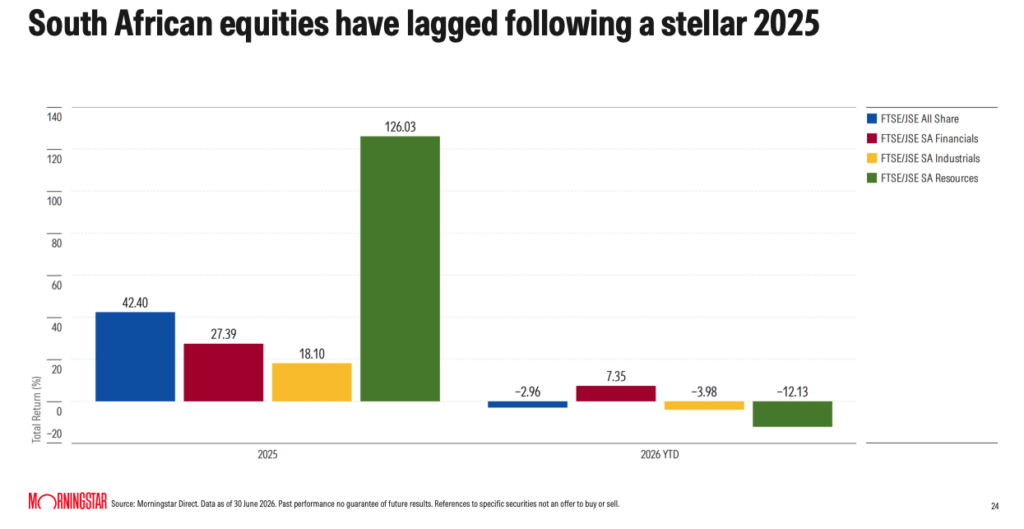
South African stocks have seen a turn in fortunes in 2026, with the stellar performance in 2025 not being repeated and, in some cases, being reversed.
This has left the country’s stock market lagging its peers in 2026 amid renewed geopolitical tensions, rising oil prices, and resurgent inflation.
For the country’s economy, this reverses the wealth effect experienced towards the end of 2025 that helped to boost economic growth.
This effect refers to individuals feeling richer as asset prices rise, leading them to spend more money as they feel more financially secure.
The reversal of the wealth effect, combined with elevated inflation and interest rates, will translate into lower consumer spending and slower economic growth.
However, Morningstar South Africa’s director of manager selection, Michael Dodd, made it clear that it is not all bad news for investors on the JSE.
There are still pockets of opportunity, and the long-term outlook looks very positive for the country and financial assets.
“South African equities have lagged so far in 2026, following a really, really good 2026. This strong performance was mainly driven by resource stocks,” Morningstar’s Rone Swanepoel said.
“Now we have begun to see a divergence at play in the South African market, with resources beginning to underperform and financials outperform.”
This is markedly different from the second half of 2026, which was dominated by stories of gold surging to new highs on a regular basis and reports of looming platinum shortages.
For mining companies listed on the JSE, this was a perfect cocktail to outperform, as many are heavily exposed to precious metals.
This translated into stronger performance more broadly as the rise in mining stocks pulled indices higher and led to positive news for the country’s finances.
Coupled with the surge in precious metals prices was South Africa’s first credit ratings upgrade amid the state’s improving financial health.
The formation of the Government of National Unity also boosted investor sentiment and confidence in South Africa’s reform agenda.
This cocktail of factors resulted in renewed hope of faster economic growth in South Africa and the escape from the country’s lost decade.
Stocks surged as a result. The JSE All Share posted a 42.4% gain in 2025, with the financial sector reporting a 27% gain. Resources shot the lights out with a 126% return.
The script is flipped
The situation halfway through 2026 is vastly different, with war in the Middle East, rising inflation, and fears of slower growth hitting investor sentiment.
This is lethal for South Africa, which relies heavily on investors being willing to take on risk and invest in emerging markets.
It is also particularly damaging to its economic recovery as rising inflation and interest rates impact consumer spending. In turn, this affects state finances.
“What we have seen is a bit of a rotation in the market leadership. It was always going to be a difficult act to follow for South African stocks,” Dodd said.
“2025 was a standout year for the local market. Ultimately, what led it higher was not sustainable, with a narrow grouping of mining companies leading the market higher.”
As the small group of gold and platinum miners surged, their weightings within stock market indices rose, making them more vulnerable to a downturn in commodity prices.
“This combination also made it really difficult for active investors to outperform. But, it also made the indices more vulnerable to a downturn in commodity prices,” Dodd explained.
“In 2026, we have seen this flip around. Resources are now dragging the local market lower. We have seen some of the market leaders from last year give back their 2025 gains.”
Dodd noted that it is not only about mining stocks, with traditional index heavyweights such as Naspers and Prosus coming in for a tough time in 2026.
“Naspers and Prosus have struggled in line with their underlying exposure in Tencent and the general weakness we have seen in the Chinese market,” he said.
“Against this background, we expect active managers to do a little bit better than the indices in 2026, given that it is almost the reverse of 2025.”






Comments