South Africa’s stock market is shooting the lights out


South African equities have proven to be one of the best places to park your money in 2025, with the JSE All Share Index rising nearly 40% in rand terms and over 50% in dollar terms.
This has largely been driven by the outperformance of a handful of mining companies, which have benefited from soaring gold and platinum prices.
On the other hand, South African-focused stocks, often referred to as ‘SA Inc’, have had a more difficult 2025 as investors remain cautious amid slow economic growth.
However, the standout performance of the local exchange is likely to reignite some investor interest in local assets and will bring second-order benefits for the country.
This is feedback from Old Mutual Investment Group’s Sehrish Khan who outlined the strong performance of the JSE during the asset manager’s last quarterly update for the year.
Khan explained that the JSE All Share has outperformed almost all broad indices in the world, with it being the top MSCI regional performer in 2025.
She said this is also not a once-off performance, with the JSE’s annual rate of return over the past five years comparing favourably with major indices.
Over the past year, two years, three years, and five years, the JSE has outperformed the S&P500 in dollar terms. Over these periods, only gold and bitcoin have consistently beaten the index.
This outcome has been boosted by the rand’s strong performance in 2025, with the currency strengthening by nearly 10% against the greenback so far.
However, Khan did point out that the rally on the JSE has been relatively concentrated in precious metals companies.
Locally-focused companies, particularly retailers, have had a difficult 2025 on the JSE, as investors continue to be cautious about businesses with significant South African operations due to the country’s stagnant economy.
This can be seen in data outlining foreign investor behaviour on the JSE, with these investors pumping billions into local bonds while simultaneously selling equities.
This indicates that these investors are believing the story around improving state finances in South Africa, but are still concerned about slow economic growth.
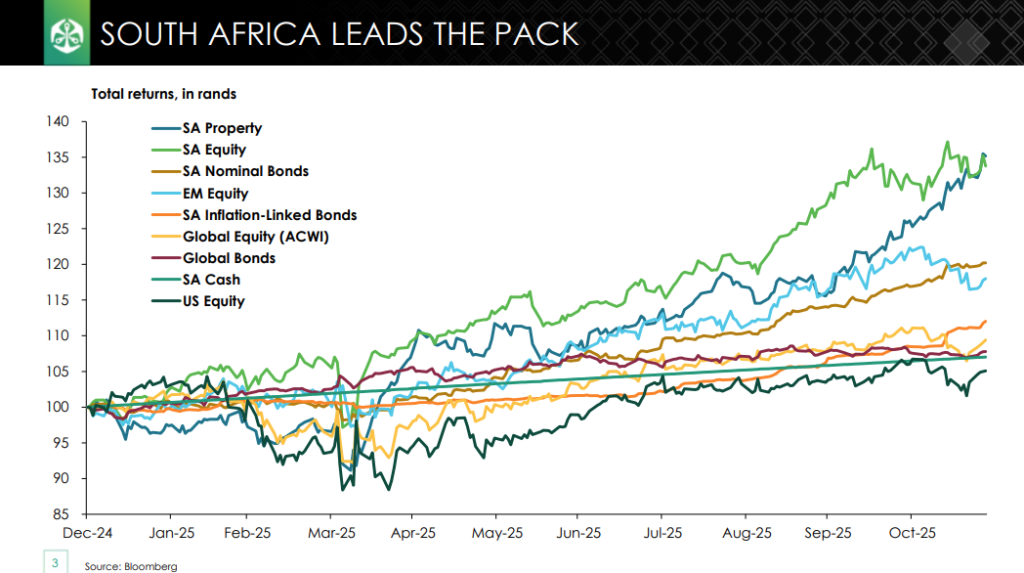
Despite this, all major JSE indices have outperformed US equity markets so far in 2025, in rand terms. This can be seen in the graph below.
Benefits for South Africa
With the rally being highly concentrated in a handful of companies, many of whom make a substantial portion of their earnings outside of South Africa, there have been questions about whether this will benefit South Africa.
Khan explained that many of the benefits will be second-order ‘wins’ in the form of wealth generation, which tends to increase spending, and improve state finances.
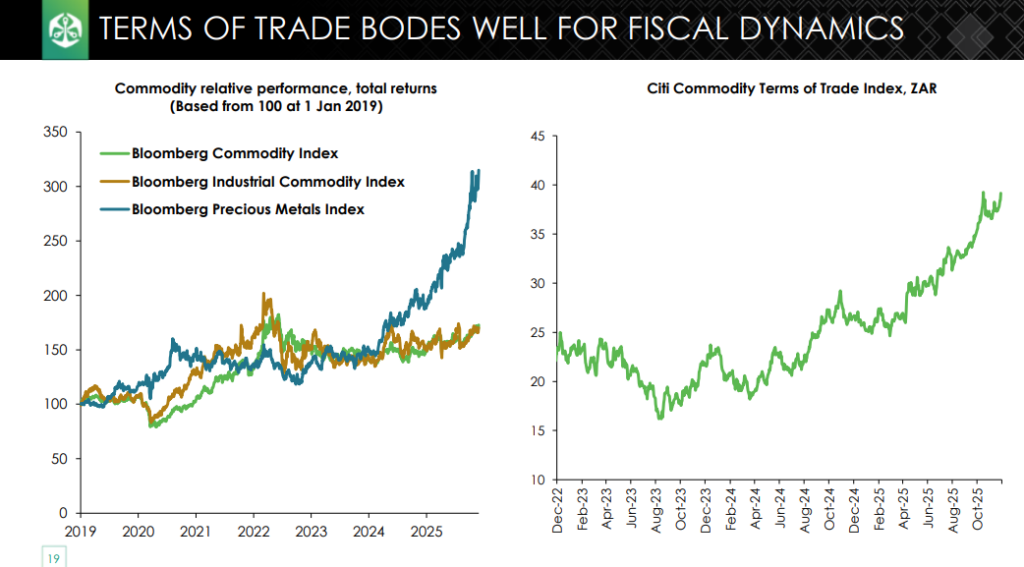
The rally in mining shares has been driven by rising commodity prices, which translates into better terms of trade for South Africa as the country is a major exporter of commodities.
For example, although South Africa only produces 100 tonnes of gold a year, due to the rise in prices, this production is now worth over $15 billion (R254 billion) at current prices.
Coupled with rising platinum prices, which South Africa produces over 70% of globally, the country’s terms of trade have significantly improved. This bolsters the local currency, keeping inflation subdued.
Furthermore, the rise in prices also results in substantially elevated corporate income tax receipts for the government as mining companies generate higher profits.
However, the country is not benefiting from the rally in commodity prices as much as it used to, due to declining mining production and logistics bottlenecks.
Symmetry chief investment strategist Izak Odendaal pointed to the 1970s as a bull market where South Africa raked in the cash.
At that point in time, South Africa was the largest gold producer by far and, amid elevated inflation in the United States, gold prices soared.
Today, gold production is 90% lower, mainly because most of it has been mined out over the past 100 years. Around a third of all the world’s gold was extracted from the Witwatersrand Reef.
This does not mean the industry is not important, as it is still a vital generator of foreign exchange earnings, tax revenue, and employment.
The industry has come under increasing pressure from onerous regulations, policy uncertainty, and difficult labour relations.
Odendaal previously also noted the disappearance of South Africa’s junior miner funding as a reason for the country’s declining output, with investors and banks unwilling to invest heavily in fledgling miners.
In effect, South Africa has gone from one of the best mining jurisdictions in the world to among the worst in less than three decades.
Even excluding gold, South Africa’s mining output has been flat for 20 years, and with the decline in exploration, production is not going to rise quickly.
This is even in the best-case scenario where regulatory bottlenecks, infrastructure, and security are resolved. This means that while the country benefits from commodity price booms, it doesn’t benefit nearly as much as it should, Odendaal said.






Comments